Fantastically interesting article in the NYT about the apparent lack of conservative plays/playwrights. I haven't the time or energy to fully explore the topic here, but some quick takes:
a) The article bugs me for some reason... I think because it takes for granted that the highest standard for something is whether or not it's present; that is, it's easy to argue all/many/most plays are left-leaning. What's harder is to ascertain the reason and the content -- are they liberal because they celebrate multiculturalism? Mock convention? Are flamingly gay? What? Should plays that are on the bleeding edge of avante garde or transparent political leanings be placed in anything like the same genre as big Broadway hits that, like Hollywood, treasure profitability and production values over content? (Not that good content doesn't happen, it's just secondary to profit.) The author doesn't begin to engage these ideas until the second page, and then the article ends. I guess I feel like the argument is pointless in the abstract, without analyzing what specific themes are absent, within AND without a liberal "canon," rather than the simple binary she sets up.
b) There's the occasionally repeated point that arts tend to draw in people with radical ideas and/or marginalized agenda; would it be fair to say that free-marketeerism wasn't (at least until recently, and I'm not convinced even now) is not an endangered ideology? Considering the embrace of it in so many aspects of our life, do conservative ideas just not stage as well? I mean, no one makes plays about happy, untroubled people living in harmony with their neighbors for 3 acts. Why? Because conflict is the heart of a play, and theatre is a great place to be "in your face" in a way that things rooting for the status quo usually aren't. There are "in your face" conservative novels, but don't they tend to be ideologically shocking more than stage-shocking? What is the conservative stage equivalent of the first gay kiss, the first interracial kiss; the conservative stage equivalent of brilliant strung-out prophets and flamboyant, flashy colors and dancing and scantily clad ladies and gents? Is conservatism, which at its heart tends to be backward-looking (i.e. we would be better served by going back to "values of old", from the Bible to Patriotism to freer markets), just hard to portray?
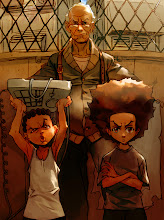
c) In relation to b), I've often asserted that the reason, for example, that there are also fewer conservative running comic strips, a conservative "Doonesbury" or "Boondocks" for example (yes, fine, I see you Mallard Fillmore, but you're still not funny or very popular) is because irony doesn't play as big a part in conservative thought. Hypocrisy has to be accepted in more cases. (Sure, this is "skewed liberal," I'm sure conservatives, in fact I know conservatives charge liberals with hypocrisy, but it just seems less, I dunno, authentic to me. What's a situation with more inherent conflict making for ironic humor/hypocrisy: revering the founding fathers and strictly honoring their positive accomplishments, or questioning their authenticity and own moral consistency, from slave-holding to elitism? Is it just easier to go to the well repeatedly to find new inconsistencies and questions than it is to continuously make interesting reverent works? Has 1776 already plumbed most of the play-worthy reverence?) Ultimately, it just seems to me to be more of a conservative trait to believe some ideas aren't to be questioned, there's an avoidance of conflict, whereas within liberalism, despite caricatures, not everyone feels the same about feminism, affirmative action, war, abortion, what not? Can you make a conservative play that questions adherence to core conservative ideas? Or does it become liberal then? Does a play questioning liberal ideals become conservative, or does it tend to stay within a broad liberal orthodoxy, making it still liberal?
d) Last point: it also funnily strikes me as vaguely, you guessed it, ironic when these arguments about diversity of viewpoints are made about academia or theatre. It is *not* that diversity of viewpoints isn't a good thing, but rather that it's a supposedly liberal, relativistic argument (actually a corruption of post-modernism in my opinion) that all ideas are equally worthy. Conservative arguments about being in academia, for example, presuppose conservative viewpoints are just as valid as liberal ones and should be included. And hey, I'm not saying that they're NOT just as valid, but rather that the conservative argument that they must be included just to include them, and that it's actually discrimination that keeps them from their proper share of positions, is strictly speaking an affirmative action, relatistic argument. That is, "we aren't succeeding at X because of discrimination, and therefore structures must be changed, people must be included, and the way things are done must change to address this." They contend that the best people aren't being chosen but rather that selection is biased, but the empirical evidence I've seen is sparse and equivocal, it seems to me. And in any case, you don't see many arguments (at least I don't) with specifics, that is, THIS person, THIS idea is clearly qualified, and isn't accepted for the following reasons, but rather, THIS person, THIS group of people aren't represented, and therefore are discriminated against, QED. The quality of their work and the possibility that their points of view don't stand up academically is rarely broached -- again, I'm not saying the answer is already known, but rather that by failing to pose these questions, in theatre or academics, conservatives are asking for mushy multi-culti relativism that they supposedly oppose: include me in your "marketplace" of ideas because everyone deserves to be there. In the end, apparently, we need marketplace adjustment in academics and theatre because, apparently, the market is supplying a suboptimal amount of conservatism.
I'm just saying, it's a funny idea.
-J
PS Oh yeah, and I forgot to mention: is it possible that there's so much celebration of conservatism in other venues, that those who espouse it don't need to go the relatively difficult route of a playwright? Just saying.



 Posts
Posts


Multiplication of unlawful disjunctions
1 year ago


