Showing posts with label Culture. Show all posts

Sunday, June 19, 2011

Shit from the Vaults: BSG

So, a little something from my files. I expect I may get some comments from friends on this. I'm hoping I'm able to ignore them -- I'm behind in about 15 things, most of them annoying :-/ But I still wanted to put this up here so it could be squeezed out of my mind grapes.

Warning: SPOILERS.

---

“I’m not going to live in it. Captain, I’m a monster.”
--The Operative, Serenity

Although I found the series quite affecting and effective—high production values, sharp writing, great characters that drew you in, suspenseful action—there is one thing perhaps that so galled me about BSG (Battlestar Galactica) that it took me out of the series completely and made me basically, care less for whether our heroes, our species, survived. I repeatedly came back, because of the factors I mentioned before—it was an extremely good series. But each time I came back, my excitement eventually waned and I plowed through episodes, hoping for the sweet release of conclusion, again swept up into individual scenes or episodes but left empty on the whole. The thing about this incredibly gritty show, full of emotional-political verisimilitude, vast constellations of moral gray, constant compromises and moral vicissitudes, the thing that eventually overcame the excellent characters in my mind and made their convincing emoting tedious was that eventually, all was overhelmed to me by the question “Do we (they) deserve to survive?” Is there a bridge too far such that, as a species, you no longer deserve to live? Is there any compromise that must not be made, else we’ve lost ourselves in the breach? To me, the interesting question may not necessarily be if there’s such a line, but rather, where it is. But BSG seemed to so constantly answer that there was no such line, or if there was, it was understandable, even admirable, to cross it. (And for the sake of narrative continuation, to assume that the line re-set somewhere afterwards; otherwise, if the idea that there was no line was truly embraced, the moral anguish and grittiness disappears, robbing the weighty episodes somewhat of their heft because if anything goes, without remorse or question, there is much less dramatic tension.) Such dynamics may be quite interesting to watch, and even may again reflect the complexities of reality, yet it felt to me like this larger question (Are we truly damned if we do this?) was time after time ignored, forgotten, never raised or sort of waved away by an affecting scene reuniting friends or lovers, or more often distracted from by a new tragedy to be wrought on our characters in order to once again make them sympathetic.

Within this gray moral universe, all of the characters, at some point, became monsters to me, monsters who, like Whedon’s Operative, had no place in the “better world,” no place in a world that once again knew peace, no place being the founding patrons of the continuation of our race. If one admits this, as The Operative did, there are a number of possibly interesting ways to explore it—perhaps no compromise is to far, because survival means the ability to try and make amends or do better next time, and without survival there is no next time. Perhaps survival means continuing on in the hope that your descendants can reach a place where they can make more sophisticated moral choices—again, echoing The Operative’s idea of founding a brave new world that would have no place for those such as we. Or perhaps morality only matters when you can afford to indulge in it without jeopardizing the existence of your species. If so, however, such a message goes against the cultural tropes we’re brought up in (though it fits rather well into the realpolitik world where it’s said that “The Constitution is not a suicide pact”).

We’re well-versed in the idea that some things are worth dying for, and the characters in BSG are no different, constantly risking their lives for each other, for the species, for life, for love, for faith, for loyalty (and for craven self-interest in Baltar’s case, time and again)—but the thing is, all of these came into conflict with each other time after time, and it seems like pretty much all of the characters violated one in favor of the other at some point. A case in point, to me, was the quite excellent episode where Adama pater refused to jump (that is, leave the area at effectively faster-than-light) the Galactica because he wouldn’t leave Kara Thrace behind. (He later said to his son that had it been him, they would never have left.) An excellent, affecting episode—yet it seemed to me that the show (or more accurately the writers) never fully grappled with what this meant in real terms. That is, Adama was willing to risk the ship, and by extension the fleet, and by further extension the human race, to recover Kara (essentially, his adoptive daughter). At no point does this, which is essentially a dereliction of his duty on multiple levels, come back to bite him directly (though this trait manifests itself in other ways and causes other crises throughout the series). Co-occurring with this is the recurring evidence of his crew’s devotion to him. This devotion decays, frays, and re-forms throughout the series, and its tattering does have its roots in his devotion to personal loyalty over larger duties (for example, standing by his closest friends even after rather startling revelations about them [SPOILER] i.e. that his first officer and old friend Tyrol is actually a Cylon, the human race’s enemy throughout the series, responsible for the genocide of billions at the series’ start [/SPOILER]). But time and again he is able to draw on his moral authority, both narratively in the form of taking the part of “hero” in a number of stories, and within the plot, such as various grunts, non-comms and officers staying devoted to him through thick and thin and his actions in guiding, commanding, and occasionally taking over the fleet of human survivors. Perhaps, one thinks, they respect his personal loyalty and see it as representing his loyalty to all of them as individuals—yet this loyalty to individuals is a liability for the human race itself, something that tended to be voiced only by villainous or characters of darkly-tinged morality. Further, it seems clearly selfish—he pushed the envelope for his adoptive daughter, yet he tells his biological son that he would’ve pushed even further had it been him. He clearly is able to sacrifice the lives of others of his crew—not just on the line, in battle, where he does indeed endure his children putting themselves in danger’s way, but in leaving behind, arresting, overthrowing or executing those who expediency or necessity requires. Again, there is much to admire for such loyalty, but it made it hard for me to take credibly when the show and characters demanded certain sacrifices must be made for the sake of humanity—excusing torture, rape and extra-judicial execution, justifying the suspension of democracy or secretly rigging the stakes against it, sublimating personal feelings or desires, etc. etc. etc. Yet for our main characters, risking our survival was ok, even admirable when they did it. This is what I mean by our characters nobly putting their lives on the line for their principles—but what principles they were doing so for that week depended. Thus in the end no line couldn’t be crossed for some reason, and no value was sacrosanct in the face of whatever plot-relevant value we were worried about this week.

This created characters of incredible moral complexity, but that’s another manifestation of this problem—people with this much emotional damage just wouldn’t function any more. I suppose that’s often true, it’s a bit of the reality of all action-packed fiction, but BSG plumbed new levels of moral ambiguity, constantly, and this is reason #eleventy the finale didn’t work for me. There would not be a happily ever after for people so scarred—PTSD has nothing on them. Further, I didn’t want there to be a happily ever after—they had become so compromised, so “gray” that I didn’t care for them as human beings. They/we did not, in my opinion, still deserve to live. Nor deserve to die, per se, I’m just saying my empathy for the characters had left me. The show’s genius, or one of them, was the ability to keep thrusting us into the characters’ inner conflicts and make us care, but it feels rather like being a fan of your college sports team—at some point, you’re probably cheering on at least one alleged date-rapist or so, but when they pull a touchdown out of a difficult situation, get that surprise interception, you cheer as loud as anyone. Only later, perhaps, (maybe after the conviction) does the victory taste of ash.

Baltar is the incredible example of this. Ron Moore has said, I think, that the two-faced and morally ambiguous doctor (something like BSG’s own Snape) is his favorite character, and he is a character of exquisite ambiguity, falling climbing and jumping from one dilemma to the next, betraying people and saving them at somewhat unpredictable intervals. But the one constant in the series was that he always, always, always ran away from personal danger—if he could save his craven life, he would do it in whatever craven way available to him. (Ok, two constants: he also couldn’t and wouldn’t say no to sex, for any reason, at any time, with an attractive woman of whatever species it seemed. Sex ranked perhaps one and a half steps below survival in his driving passions, though his extreme lack of foresight often meant that he was surprised by unwise sex endangering his survival.) This man gets a happy ending at the end, seemingly redeemed in the series’ eyes—and seemingly for essentially one or two acts of non-cravenness, for standing up for once for what was right, and charging into battle guns blasting, with luck saving him more than anything else. One act of bravery, conducted stupidly and impulsively, excuses years of bad acts? For fucks’ sake, show.

Bottom line for me was that BSG refused to face the simple idea put forward in Joss Whedon’s Firefly: that perhaps sometimes the sacrifice one must make to make a “better world” compromises the possibility of making such a world in the first place. Perhaps survival—interestingly, pursued relentlessly and at all costs by the creator’s favorite character, still to be forgiven in the end—does break all ties, yet when it was narratively convenient, it didn’t. But it seems that the show didn’t want to completely admit this—that some lines, once crossed, bar a peaceful end. Oh sure, people suffered for their choices, but in the end those who survived were effectively fêted as heroes, given a musical-emotional tongue bath by the beautiful, but to me hollow, ending. One who had made the darkest act, an act of passion that doomed reconciliation between two races and caused the near-annhilation of one of them, wandered off, apparently too broken inside to stay in society, yet the fact that he nearly caused the end of two races in his rage wasn’t really broached. Again, it’s one thing for a protagonist to do such a thing; it’s another for him to do it and the show pull our heartstrings for him nonetheless (and to have spent so long convincing us that survival was paramount and anything could be betrayed in its service for most characters).

I believe that some lines, once crossed, do all but preclude redemption. I say “all but”, because perhaps, given enough time, enough good acts, enough work and regret, redemption can be conceived of for nigh anything. But BSG didn’t just sometimes ignore the question of how much redemption was enough; it was very fond of forgetting the idea that redemption was necessary in the first place. It wanted to be dark and gritty, nigh-nihilistic, while asking us to believe in fate and some kind of loving God or something. But in reality, neither the Cylons, nor the One True God, nor Moore or anyone else had a Real Plan. The God that, apparently, actually exists, in the end, and sent Head Six, Head Baltar, and [SPOILER] Reincarnated Thrace [/SPOILER] had a plan that inexplicably included the near genocide of the human race, in order to teach the human race… what? Nothing? Should we be comforted, tolerant, or even terribly interested in a God that apparently can intervene enough to send Angels directly into people’s heads and guide them ‘round a merry chase, but chooses to either abet or not to prevent a genocide? What lesson were we supposed to learn from that? The God crossed a line right there in the very beginning of the series, wiping out (or allowing to be wiped out) billions, and spending a disproportionate amount of time inside the mind of one of the least morally scrupulous characters, without seeming to do much to truly redeem him until a futile, moronic gesture crosses him over.

I’m not annoyed that BSG asked or posed or created such questions. I just continue to be annoyed that it didn’t even seem to realize that it HAD done so.

Tuesday, September 22, 2009

HoYay! brought the Visigoths at the Gates

-or-
"I wanna be noted for the fall of your Civilization! At the Gay Bar, Gay Bar, Gay Bar, Woo!"**

Interesting article on the otherwise-annoying-me-quite-a-bit-recently Slate today, reviewing James Davidson's "The Greeks and Greek Love." Author Emily Wilson goes over Davidson's "fascinating, meandering, funny, and thought-provoking study of how ancient Greek men loved one another." Observing the current state of things vis a vis gay marriage and the status of same-sex relationships, Wilson calls it
"a central problem for modern Westernized societies. Many countries allow same-sex couples the right to a "civil union" but withhold from them the name of marriage. The Netherlands was the first modern nation to legalize marriage proper for gay people, in 2001. Since then, seven U.S. states have also legalized gay marriages, although one, California, has just backtracked. On May 26, Californian lawmakers upheld a ban on same-sex marriages in the state... The ban is based on the idea that there is—or should be—something fundamentally different about sexual and romantic relationships between people of the same sex and those between a man and a woman. Since history is so often invoked, either implicitly or explicitly, on both sides of the debate, now is a particularly good time to look back at the history of same-sex relationships."
She goes on to say that the book
"ought to be required reading for anybody curious about the antecedents of the current impasse. [It] is a landmark study that challenges earlier historical interpretations of the evidence. For instance, [some] scholars... have argued that the Athenians were obsessed with anal sex, which they saw as an act of domination and humiliation. Davidson brilliantly shows that this interpretation is largely a projection on the part of modern historians, who have been reluctant to imagine a world where gay relationships could be expressions of love, affection, and appreciation, rather than deeply skewed power arrangements."
Observing Davidson's arguments on the Athenians ("same-sex relationships—which seem to have generally taken place between youths in their late teens and young men in their early 20s—were an important part of a boy's journey to manhood... [and] many men continued to be interested in "boys" even after marriage; happily married poet Sophocles and unhappily married philosopher Socrates both flirted with young men at drinking parties and caused no scandal in doing so. (The amazing thing about Socrates' sex life, according to Plato's Symposium, was not that he fancied the gorgeous Alcibiades but that he resisted having sex with him, even when snuggling under the same blanket"), Cretans ("Cretan rituals were equally strange, from an Athenian perspective..."), and Spartans ("In Sparta... a curious kind of sex seems to have been the custom between well-behaved men and chaste teenage boys. Apparently the lover was supposed to relieve himself only by rubbing against the boy's cloak: The cloak had to remain on at all times, as a sort of all-body condom"), I realized that I must have missed that part of The 300.

Of course, the funniest thing to me about the article (and somewhat exemplifying Slate's more-than-occasional breathtakingly tone-deaf and dumb contrarianism) is that it reminds me of a typical Slate contrarian years ago who was all "can't we have just ONE uber-violent movie with mainly manly men battling, oiled and sweaty, without just ASSUMING homoerotic tones?" To which I thought, sure, go ahead, but if I were you, I wouldn't take my stand on HoYay's inappropriate over-application and tie up the end of my mediocre article on the (lack of real) homoerotic undertones in action movies by talking about "The 300" and fucking SPARTA, where there actually WAS homoeroticism, you know, in the form of HOMOSEXUAL SEX. Not explicitly in The 300 itself, if I recall, but in that silly thing called "real life."

This being, after all, the same real life where two of Western Civilizations's most influential cultures, Greece and Rome, had common and rather accepted forms of gay love and managed to, oh, form the rhetorical and historical basis for much of modern Western society. (Not to mention the many celebrated philosophers we so often cite in our paeans to reason or democracy who, at the very least, batted for both teams, and of course that historical war juggernaut, Alexander the Great.*) But, I'm sure Rome's eventual fall was probably due to a lack of heteronormative "family values."


*"Alexander the Great, just steaming through Persia; took out Darius the 3rd as we all know. And then he ran on... and after a while his army's going, 'Hang on. Alex, I think we lost 'em. You know, I don't know where we live any more, and we've killed most of the people we've met. So would you just like to chill out.' And Alex is going, 'Look, I'm 32, I'm gay, I'm on a roll. Let's go!' On you go."

**

Wednesday, May 13, 2009

The Daily Show: Fuck Yeah. (Coming again to save the motherfucking day, yeah.)

Satire is the only way!

I'm just reminded for the eleventieth time why Jon Stewart is so FUCKING awesome, and that those who've bemoaned the rise of The Daily Show as some kind of rise of political unawareness don't know their ass from a hat.

A) He is interviewing the ambassador from Pakistan, Husain Haqqani. He does this shit all the time -- he's had foreign dignitaries, like Bolivian president Evo Morales and Liberian President Ellen Johnson Sirleaf, to Obama officials like Peter Orszag (director of the Office of Management and Budget) and Interior Secretary Ken Salazar, to important and (or?) thoughtful authors and thinkers, some with viewpoints he very much disagrees with, like Cliff May, and others like Doris Kearns Goodwin and Philip Alcabes. Don't recognize some or all of these names? Good. You see, that's called learning, baby. It feels real good, don't it?
B) He's fucking PREPARED for these interviews, asking Haqqani, for example, various detailed questions based in Stewart's studying of the issues and previous writings of his guest and others ("As you yourself has written sir..." is a phrase intimating research to a degree you don't often hear on late night shows like Leno or Letterman, or even to some extent on Lehrer, when the guest is neither promoting a book nor is a columnist.) He debated Cliff May on torture, and even though they disagreed on it (if I may grossly distort Cliff May's viewpoint, he's all for it), with May actually saying that it was probably the best discussion he'd had of the issue on TV. And I don't think he was bullshiting, either. All in all, Stewart's combination of thorough research, thoughtful analysis, and a (somewhat over-stated but, I think, genuinely felt) "everyperson" (aka "everyman") approach that keeps even hostile guests mostly open to continue the discussion.
C) Given his place (and Colbert's) as a cultural phenomenon in the space between late-nighters like Leno or Conan and earnest news magazines and interview segments on NewsHour, CNN, 60 Minutes, or what have you, his popularity with "the kids" is actually a fantastic thing. He not only invites thinkers, politicians, and authors (and also comedians, actors, musicians, and other people with less urgent effects on global politics), but he interviews them premised on a pretty high level of understanding from his audience. One might surmise that they're simply sitting through this but really there for the rest of the show, though I think one would miss about half the humor without a working knowledge of current events and politics (the other half the humor is a melange of puns, self-referential and self-mocking humor, and graphical puns). And in a way, that's the genius -- whatever the audience is "there for", the relatively high level of discourse in his political interviews might get some learnin' in for him and the audience, intended or not.

From the Colbert/Stewart approach, I feel you get a much more working understanding of global events and ideas than the drier approach of the Lehrer et. als (that tend to AVOID challenging guests on equivocation or directly contradicting them when they spin, and thus remain on a superficial level alarmingly akin to a typical late-night interview like Leno) and yet also keeps the fun of a Leno, Letterman-type interview with jokes, sarcasm, etc. while maintaining nuance and in-depth probing of ideas.

The only other person with comparable deftness and intellectual rigor as a pop figure is Bill Maher, who evinces a similar level of intellectual curiousity as Stewart. With both of them, you don't just get topical thinkers, but also challenging ones that you just don't see on any other channels or shows, news or entertainment, from authors and scientists that simply interest them or whom they find insightful to the dignitaries I mentioned earlier, who I haven't seen on any of the mainstream news shows -- but that could be because I don't typical watch them. (Still, I challenge you to show me an interview of Ellen Johnson Sirleaf of similar length on TV -- which there may very well be, but I again doubt it had either the good-natured humor and non-forced light-heartedness of Stewart nor implied the depth of research he did.)

Ok, I'm done flogging TDS. I'm just saying -- at it's best, it's a TV show without parallel or competitor (well, except Bill Maher and sometimes Stewart's own protegé Colbert), and at its worst, it's probably a step or so ahead of Wait Wait... Don't Tell Me, the light-hearted NPR news quiz show focused on weird currents events to a greater extent than it is to any kind of education about the topics discussed.

Fuck yeah.

Tuesday, November 25, 2008

Magical Negros (not Barack Obama)

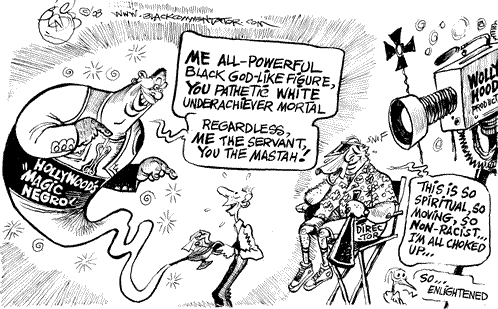
Regardless of Limbaugh's unintentional irony with his "Barack the Magic Negro"(his somewhat thick-headed defense being that "liberals did it first", failing or refusing to understand the actual intention, significance, and meaning of the term), the magical negro phenomenon is fantastically explained here. Basically, magical negro-ism is a tendency in certain narratives (movies, especially) to have a near-perfect black character, whose job it is to redeem the white main character. The problem with this, as the linked article points out, is that it deprives the black character of an inner life and their own narrative arc and agency.

This post is apropos of nothing, it was just mentioned in the context of this review of the movie Australia. Interestingly enough, Daktari has a similar post on sexism today. (Well, vaguely similar -- it's on sexism, but it's similar in that she's discussing the subtleties between sexiness, sexism, and pedophilic objectification.)

Anyway. The concept is well illustrated in the commentary's accompanying cartoon:


Laters.

Tuesday, October 14, 2008

In the Name of All That's Holy...

Geez. A quite snotty, if correct in its overall conclusion in regards to free speech, article here from the Calgary Herald. (How/why was I reading the Calgary Herald? Short answer: thesising is driving me batty. Long answer: checking Slate every 20 minutes meant I read this post from Rachel Larrimore referencing the article. It was a not particularly bad post for the increasingly gormless posts on the XX Factor, but I digress.

The thing annoying me about the Calgary Herald piece is the presumption it carries that Muslims should "clean up their own house", one of my FAVORITE wackaloon fuckwit notions of all times. Besides the fact that many Muslims are already engaged in trying to do just that, there are several unasked questions that really aren't discussed, and the at least arguable viewpoint that Muslims individually hold some responsibility for the actions of others within the religion or hold responsibility to outreach to the more diverse communities many of them are living in in Europe and the US (or if not diverse, different non-Muslim communities) slides into blaming Muslims as a whole for the actions of some. When is the last time we blamed Catholics for the sins of some of them? White people? Republicans? Democrats? Oh, wait... Nevertheless, the sophistic reasoning that Islam is some kind of inherently violent brutal religion, despite millions of negative examples, is ridiculous. Any group containing one billion people is going to have a lot of very violent ones within it. Notwithstanding that, during the Middle Ages and for times after that, they were the ones carrying the torch of tolerance and knowledge for Western/Middle-Eastern civilization. It quite seems from the historical evidence that, on the whole, you'd be better off as a Jew or Christian in many of the Islamic-controlled areas than, oh, say, SPAIN? (Achem, Inquisition, achem.)

Anyway. I needn't remind everyone again that many Christians have done horrific things in the name of Christianity. And though I enjoyed Bill Maher's movie Religulous, my friends and I were all horrified by his equating of religion with extremism. His basic point in the end was that religion = war = nuclear armageddon. Now, don't get me wrong, it'd take a severe... replacement with a wholly different person for me to join an organized religion at this point, and I may agree with Maher that much of it is senseless, but I think if religion disappeared from the world today, there would still be violence, threat, strife, and possibly from the exact same people. Religion doesn't, on average, cause irrationality -- it serves as a rationale for many. It is a channel for energy, be it goodwill, love, and a feeling of greater than yourself, or your hate, dissatisfaction, and longing for direction. Islam didn't cause terrorism, just as Christianity didn't cause the Holocaust. Religion is an abstraction, and abstractions don't do anything -- it's the people that choose how to use them. (Well, kind of, but it sounds rhetorically nice so we'll leave it.)

Anyway. Lost train of thought.

There are many legitimate and interesting questions to be asked about religion, animosity, modernism, liberal/secular values, etc. But they musn't and can't start from a presumption of inferiority, of this ridiculous "your religion must've caused this and ours is the way of liberal democratic peace" bullshit. All religions -- all peoples -- have histories that have involved violence. If we want to talk about, seriously talk about how to address violence in the modern era, we should all start with a look inside and ask how we've stopped killing those different than ourselves as we did in the past, and hope that we're even correct in the presumption that we've gotten that far. If we look to our own cultural baggage first, and then at another's in an attempt to understand it as a real lived human experience and not an existential threat from a hot mess of an abstract nonsensical conglomeration (Islamofascism, I'm looking at you), then we may find ways to address things and appropriate and reasoned questions to ask. If we don't understand ourselves, we can't understand others, and deflecting soul-searching in favor of crude generalization and cultural blaming will only keep things the same. Is our goal to feel good about ourselves, and superior to others? Or is it to actually stop the present strife? Because I guarantee you, we will never do the latter if we embrace the former.

Wednesday, January 16, 2008

Big Brother is Watching, Listening, and Reading... for Bootlegged Britney

In a potentially light-weight return to blogging, I would like to call your attention to this Slate article about AT&T's apparent desire to start monitoring all their electronic traffic from their customers for illegal content.

In what may end up being nothing or may end up being, as author Prof. Wu calls it, the beginning of a privately-run police state (though likely without a young Red Forman heading Detroit crime syndicates under the table for OCP). He rightly points out:
No one knows exactly what AT&T is proposing to build. But if the company means what it says, we're looking at the beginnings of a private police state. That may sound like hyperbole, but what else do you call a system designed to monitor millions of people's Internet consumption? That's not just Orwellian; that's Orwell.


This may be nothing, as I think Wu's right that it would be corporate disaster for AT&T: "AT&T's new strategy reverses that position and exposes it to so much potential liability that adopting it would arguably violate AT&T's fiduciary duty to its shareholders." But as the sole poster as of 10 minutes ago points out, AT&T was known as The Death Star among telecom peeps in-the-know in the old days. "Mandycat" goes on to point out: "They persistently and diligently bought up well-run and profitable companies like NCR and proceeded to destroy them. They even took the extra precaution of changing NCR's century-old name to something idiotic like "GIS" just in case there was any residual goodwill left intact. It was like a sickness."

Hmm... a plausible explanation has popped up here, claiming that perhaps this is just a pretext for remaking the internet hierarchically so that they can indeed get around network neutrality and discriminate service quality between high-payers and average joes and joanns (guess who gets higher quality). Seaturnip says: "I don't think AT&T at all wants to analyze HTTP connections for pictures, as you suggest. That would indeed be horrendously inefficient. They are probably mainly interested in stopping bandwidth-guzzling movie piracy via peer-to-peer protocols such as BitTorrent."

What say you, oh people of the internet? Is the idea that AT&T will go through with what it announced last week, that "it is seriously considering plans to examine all the traffic it carries for potential violations of U.S. intellectual property laws" indeed, as Wu says, "[A] prospect ...too totalitarian for my tastes"? One would think, but of course, I would've said not too long ago that a different prospect would be too totalitarian for most Americans' taste: "AT&T [is] already accused of spying on our telephone calls."

J. Edgar Hoover, eat your heart out.

(ps: what the hell is "eat your heart out" supposed to actually MEAN, anyway?)

Monday, April 30, 2007

Video Games DO Cause Violence: Slate's Iconoclasm is Convincing for Once

It was with a disproportionately heavy heart that I finally gave in and read the recent Slate article, Don't Shoot: Why video games really are linked to violence by Amanda Schaffer. Not because I'm not willing to believe there is some link -- there is certainly some link in such a complex causal chain as personality and behavior. But Slate tends to preemptorily declare "That's it, the answer is wrapped up" in any number of scientific arguments, most especially their execrable "Economics" articles, often by taking one study and generalizing it to be "the answer" (Steven Landsburg and Tim Harford being the "execrablers" in most cases). So I assumed the game-violence article would be along the line of a different recently published article by Slate I'm refusing to read, "Whose life is worth more, a drug dealer or a prostitute?" (Answer: "What the fuck is wrong with you, what kind of assclown asks that?" If there is an answer that doesn't make me feel bad about the human race, I'm rather sure it won't be written by Tim "Scientist" Harford.)

But in actuality, the article (on violence) convinced me. I feel Michael Moore's "Bowling for Colombine" was unfairly lambasted on a number of levels (though he does make it easy for people by seemingly making a number of lazy incorrect assertions and sensational claims in his movies, I think), as it really was a movie that set out to test a series of ideas, and came up with a counter-intuitive (or at least, unexpected from Michael Moore) conclusion: guns really DON'T kill people, violent culture does. That is, he went through a variety of theses, from video games (nope: Japan has more violent video games and less violent crime) to gun ownership (nope: a variety of countries have more firearm ownership and lower crime) and settled on the violence at the root and promoted by any number of facets of US culture (as reflected, perhaps, in our continued imperialism and relatively blasé attitude towards, for example, the 20 to 50 times more Iraqis that have died than our own troops). It really was quite clever and, to me, well done and convincing (though undermined, most agree, by picking on Charlton Heston at the end, especially since Heston's NRA had more to do with the thesis he discarded, that of gun ownership itself being the problem). The point here is that Moore discarded video games as a prime factor, and prima facie at least, I agreed with him. But Schaffer's article reviews three seemingly-prominent studies (as an academic, I can't really trust them 'till I read them myself) with three different methodologies, bolstering her case from longitudinal, comparative, and experimental perspectives.

Nicely, as well, she bothers to distinguish between types of video games, and (seemingly a-purpose) parallels the useful aspects of video games to the downside of violent video games:
"When video games aren't about violence, their capacity to teach can be a good thing. For patients suffering from arachnophobia, fear of flying, or post-traumatic stress disorder, therapists are beginning to use virtual realities as a desensitization tool. And despite the rap that they're a waste of time, video games may also teach visual attention and spatial skills. (Recently, a study showed that having played three or more hours of video games a week was a better predictor of a laparoscopic surgeon's skills than his or her level of surgical training.) The games also work for conveying information to kids that they will remember. Video games that teach diabetic kids how to take better care of themselves, for instance, were shown to decrease their diabetes-related urgent and emergency visits by 77 percent after six months."
The implication here, which I think Schaffer intentionally includes (though oddly doesn't spend a lot of time playing up) is that these useful effects of games work on the same principles that make violent games harmful -- they decrease arachnophobia via desensitization (parallel: violent games desensitive kids to violence), they teach and emphasize a skill set (hand-eye coordination etc. useful for surgery or, unfortunately, assault and murder), and impart information (how to keep up with your diabetes, or how funny and easy it is to beat someone to death witha baseball bat). And it's worth noting, though Schaffer does not, that the military is increasingly using video games to train soldiers (or so I hear) and there are anectdotes of Iraqi soldeirs, especially younger ones, comparing the killing and blowing-up of people and things to games they've played at home. As Schaffer does point out,
"The connection between violent games and real violence is also fairly intuitive. In playing the games, kids are likely to become desensitized to gory images, which could make them less disturbing and perhaps easier to deal with in real life. The games may also encourage kids (and adults) to rehearse aggressive solutions to conflict, meaning that these thought processes may become more available to them when real-life conflicts arise, Anderson says. Video games also offer immediate feedback and constant small rewards—in the form of points, or access to new levels or weapons. And they tend to tailor tasks to a player's skill level, starting easy and getting harder. That makes them "phenomenal teachers," says Anderson, though "what they teach very much depends on content.'"
Of course, she doesn't go into remedies, which is where the whole thing often goes off the rails, as most agree adults have the right to play whatever the hell game they want, and most agree parents should be the point-guards for what their kids play, not stores or the government. And if parents have neither the time, knowledge, or inclination to keep the kids off Grand Theft Auto, well, where does that leave us... (plus the fact that of course it's not one to one, so how do you choose which kids are "mature" enough to kill drug dealers in video-game-land and which aren't? I've always found it interesting that even though I occasionally like to indulge in playing GTA and its ilk, I often feel a deep, deep discomfort or disgust at even the pretend mayhem I'm causing... which I think is likely a good thing...)

Schaffer has a very reasonable wrap up, saying:
"Given all of this, it makes sense to be specific about which games may be linked to harmful effects and which to neutral or good ones. Better research is also needed to understand whether some kids are more vulnerable to video-game violence, and how exposure interacts with other risk factors for aggression like poverty, psychological disorders, and a history of abuse. Meanwhile, how about a game in which kids, shrinks, and late-night comics size up all these factors and help save the world?


A little trite, but all in all, not a bad place to start.