Hmm. We seem to be partly talking past each other. The idea that kids are more civic-minded -- or "a generation of polite, smart, civic-minded Kevin Arnolds", is completely besides the point of my argument. The main problem I have is with people justifying their complaints with "it wasn't like this when I was younger" or some such. Your preferences as a consumer, citizen, etc. are perfectly reasonable and I have no particular issue with the things you named. They may not be my preferences in all cases, or my concerns, but I have zero issue with you having them in itself -- it's the idea that in a past age things were simpler or better or more civil that I take issue with. And not even the simple idea that they may have been -- but rather that arguments that things were better are near-uniformly backed up with, not evidence, but anecdotes, assertions and personal memories. I also find the idea that family life was "simpler" rather than full of different problems to be uncompelling; there are a number of added complexities in today's life, but every generation pretty much has faced more complexity than the previous in certain terms; I don't think we can assert a secular progression in the complexity of family life without defining a lot a lot of terms. The proliferation of information and media don't mean life or relationships were less complicated--for example, there are assuredly certain things in life made more simple by not, for example, owning indentured servants or worrying about slave revolts or attacks by the indigenous peoples. We have a complex war on terror, but don't see armies advancing throughout Europe; we have nuclear proliferation, but the risk of nuclear annhilation seems to have decreased from Cold War brinkmanship. We have venereal diseases, but AIDS is no longer a death sentence.
As far as the civic-mindedness of kids these days, I'm not arguing just from personal experience. There actually are several articles (popular and, I think, scholarly, though I don't feel like searching) that have made this argument; indeed, they made it before I believed it. I was equally skeptical. But my students today are quite different than my students 7 years ago, and much much different than my fellow students when I was in school. I vividly remember in the 90s how completely uncool it was to care about anything. This was clearly different than how the 60s and 70s were portrayed, and certainly, the amount of overt political activity on U of M at least decreased dramatically from the 60s to the 90s. I would argue the 90s were more apathetic than usual; some, and FAR from just me (other faculty, as well as several journalists) have argued the pendulum is swinging the other way. As far as I see it, the jury's out, but this isn't my assertion only, it's a number of people's. And it's certainly plausible -- I think the most likely mechanism is that only a minority of people (or kids) are usually politically active at any juncture in history; in the 60s this minority may have swelled to be more significant; during the 90s I would near guarantee that it decreased; there are signs, far from concrete, that it's back on the rise.
It seems like you and I have been talking past each other in our discussions for months now, I don't know why -- your focus wasn't so much on "kids these days" and insofar as it was it was somewhat tongue-in-cheek; my focus wasn't on how kids were objectively better, and I *certainly* never claimed they were uniformly a group of nice Kevin Arnolds (and I firmly remember Dennis the Menace in several incarnations, thank you! :) My larger point is that if one wants to complain about an issue at hand, that's fine and even often laudable/important/necessary; but the assertion that things were better before is both unnecessary and, I think, largely a product of age and not fact. If one wishes to seriously assert that things are qualitatively or quantitatively different, it should require evidence.
My point was that Language Log and other posts have shown that these concerns are perennial, and as they point out in the comments, if it were indeed true that each generation was losing something over the previous generation, then since the complaints heard of insufficient reading and respect to elders in Sumeria, Rome, and Egypt means that, even at some small objective decline of, say, 5% or less per generation, we would now be at approximately 0.01% of the civility or what have you of Rome. The details of whether or not kids or people are more or less civil would require lengthy debate, but I certainly wouldn't argue it's because they're inherently more beneficient--your point that less-racist kids would be a product of their parents' upbringing is, to my mind, clearly a big part of the truth. But the source doesn't affect the existence (or non-existence) of this quality. Kids have mocked each other with racial, sexual, etc. slurs for time immemorial. I don't know that they do it more or less, though perhaps more openly.
Anyway. I don't know why this is the second or third or fourth time we've had a version of a debate where we seem to not be getting each other's points, but I rather enjoyed it more when we were amplifying each other's ideas rather than deconstructing them. It's important to do both, to be sure, but I still prefer the former :) I don't disagree with a number of the things you find bothersome or disturbing, I do on others. As far as this generation, I'm not the first to have thought things are changing among them, nor the only one, and I think the data would back up a change in attitudes, though perhaps not action. I can't make a strong case of this, but as it's based on more than just my own experience, it takes a faint stab at what I'm asking for. I would say that if I wanted to be taken seriously, I need more evidence--just like if I wanted to seriously argue that they are worse. After all, things *do* change, I just think it occasionally behooves us to define what we think is changing and back it up.
Occasionally, but not always, and especially not if the point we're (or you're) making is really something else :)
Sunday, March 14, 2010
Continuing the conversation
Saturday, March 13, 2010
More evidence for a pet theory of "Kids Today"
J-fave & friend D has been on this trope recently, to my mild peevitude.
I'm not sure why this trope annoys me so much, other than perhaps because it seems like a so relativism-laden "my perspective is the objectively correct one" type of attitude. While it can be a source of commiseration, it's also sometimes sallied forth like a prophetic warning. And it is not, of course, that things can't get worse or perhaps haven't gotten worse, but I think it's intellectually incomplete to simply say "Things/Kids/Civilization Is Going To Hell"; Jon Stewart said one of the wisest things I've heard in popular discourse years ago, pointing out to (either Bernard Goldberg or Rick Santorum) that for all the "negative" directions in culture -- violence on TV, swearing, etc. etc. -- it is simply *not OK* to be a racist. You cannot be openly, blatantly racist and a major mainstream public figure--there are certain things that are not OK to say, that were 20, 40, 60 years ago (to say nothing of the sainted times of our blessed and perfect in every way Mary Poppins-like Founding Fathers); there is no de jure, legal segregation, Jim Crow, while still with us in legacy, is not with us in poll taxes or the nearly 5,000 lynchings and racially-motivated murders between 1865 and 1965. As I said on D's page,
"The fact that they used *different* words to curse at people 100 years ago doesn't mean they were more *polite* words. And certainly no one has been caned on the floor of the Senate in a while. Nor has their been a fucking duel between congressmen. Nor are racial epithets, many of which used to be fine in every day speech, acceptable any longer, a huge step FORWARD in my mind. We are, if anything, more civil -- no one has called me "boy" because I was black in my life. I'd say that's plus 1,000,000 points; I'll deduct 100 for inappropriate [placement of the word] "shit" [in an ad that D saw].
The theory I posed years ago, and feel like is increasingly vindicated, is that when people complain of the conditions of youth, civilization, etc. today, they aren't comparing civilization today vs. civilization before, they're comparing their adult perception of civilization vs. their childhood perception of civilization. Of COURSE things were simpler when you were a kid -- to you! Because -- YOU. WERE. A. KID. Don't confuse this with the world actually being materially simpler or different. For example, I believe (though am not going to look for the stats to show) that the "Roaring 20s" had the highest murder rate in US history; there has certainly always been sex out of wedlock, VDs, war, incivility, swearing, porn, violence, etc. This is not to say the rates of all these things have been constant--they clearly haven't--but nor have they been linearly increasing. Some things, like swearing, one has to look at the language used and what was considered indecent when, but you can see people being chided for salty language in Shakespeare's plays and no doubt before that; we didn't invent naughty words nor their overuse, just because *different* words are naughty now. Kids have always, always been seen as not respectful enough to their parents it seems, so to establish this as a fact and not a cranky complaint takes far more effort than any person who's ever said "Kids these days" in my earshot. And like I mentioned, open racism has simply become verboten--surely a nearly unalloyed improvement, if one that is vastly insufficient compared to actually coming to an end of racism (especially its institutional manifestation). Long story short, some things may be worse, others better, but 99.9999 times out of 100, I'll bet you it's because the world SEEMED simpler when you were a kid because you were a freaking kid; you hadn't been exposed to (if you were lucky) the worst that humankind can muster, or the full wages of every day disdain, incivility, and a lack of an regular, caring space (i.e. parents/family). Whether you were poor and lived simply or had a life of quiet elegance in Greenwich, you hadn't seen very much of the world, had you? So let's be careful about comparing how the world seemed to you then and how it seems now; making any grand pronouncements thereof in reality should be a grand research undertaking (UNLESS, you just want to be cranky -- which is completely fine, I like to be sometimes myself, but don't confuse it with having an accurate bead on the world).
Anyway, the Language Log entry as well as the customarily excellent LL comment area is well worth reading on the topic of Kids Today.
Saturday, December 26, 2009
Race in America: Part the Next, A Partial Response to D
Wherein D owns what she says, smooths D-Fave J's ruffled feathers, and elaborates, possibly inciting deeper discussion or perhaps further division.
Sayings: owned. Feathers: unsmoothed. Further discussion: imminent. Further division: unknown.
(from my previous post): "Wow. I'm kind of surprised to read this from you at this point, D."
Ok, I'm just gonna say this. This sort sounds like I'm your pet project and I backslid or something. Am I supposed to be sorry for my comments? You should know by now that there is almost always deeper thinking behind my ideas. Rather than shame or disappoint one another, let's get right to them... [some time later] My culture is not the caricature that Eddie Murphy and Chris Rock present to great comedic effect. White America is not Buffy and Chip upset because their tee-time was pushed back half an hour because Obama's motorcade was going through town. Sure, the comedy is in the way white people are ignorant to their incredible privilege and have wackaloon ideas about what it means to be put out, but when this is the pole that I have to swing from, how can I be allowed to have a real voice in the race discussion? It has been my experience (and here I mean ME as an individual) that I am not allowed, outside of our conversations, to be taken seriously in any meaningful public discussion about race. Unless, of course, I concede to the default POC position. And in some ways, J, isn't that what your response to me tried to get me to do?
Horsehockey. This point is one that's repeatedly had my blood pressure rising. You have every right to your voice, to your process, to your indignation at caricature. And in no way was my response an attempt to get you to concede the "default" POC position (which would be questionable anyway because such a default is as contested as anything else one may care to name, and any given person of color you may talk to may have a different default). I wasn't present at these other conversations, so I can't characterize what happened there. But my response was critical and disappointed because I freaking WAS critical and disappointed. Does my mere reaction (or expression of it) deprive you of your voice? Does my disappointment in our difference in point of view mean I'm engaged in a ploy to "shame you" into line? I do see your point here, or think I do: you don't want your perspective to be sidelined or undermined by emotional valences attempting to get you to give up your point of view out of guilt, rather than engaging you on the points and convincing you, or failing to, on the logic. All well and good. But you hardly shy from expressing your emotions, clearly and strongly, on your own blog, and even when I feel somewhat besieged by a disagreement between us, I don't presume you're trying to undermine me with an end-run around logic. I felt disappointed in your perspective; maybe I'm wrong to, but I thought I understood you and you me better than this at this point, and I was surprised to read these viewpoints from you, that I've heard many times from others before and that I find disappointing. I may have been wrong every time up to and including now to be disappointed, but I don't think expressing it is an attempt to make you fall in line. It's just expressing what I feel. Whether or not you should be sorry begs the question entirely; I wasn't thinking about you, to be honest, when I said that, but about me: it was how I felt. Surprised. Because "at this point" I thought I understood where you were coming from better than I apparently do, and I didn't think we'd be having a conversation in this way on these points because, like I say, I've heard variations of what you say for years. And usually such a conversation takes place before the types of conversations you and I have had have been, um, had.
I can see how that might sound condescending, or shaming, but it's also true. And except that we have a personal relationship (that doesn't extend to having met in person =} and I don't think you have one of the same kind with the Field Negro) I don't see how my comments are different, and certainly aren't worse in emotional valence, than when you say of him "I have learned a great deal from the field and respect him immensely, I think this idea (if indeed he actually believes it) is preposterously naive." You do hedge it because you don't think he believes his own theory, or rather, that if he does perhaps it is more in the service of rabble-rousing than serious inquiry, but you surely know as well that HE "almost always deeper thinking behind [his] ideas." This applies even if his theory is serious rather than simply provocative. (I do wonder if you've taken this point up with him on his blog, I'd be eager to learn how he responds.) To briefly light on the relevant point from Field, as you summarize it, "That the black power elite are neither powerful nor elite because the real white power elite can jack-slap them back out to the fields the first time they forget their place. He usually suggests this idea after a powerful black person has fucked up royally... He violates common rules of logic when he applies his pet theory not to the broader community of high-achieving black professionals, but only to those who have fallen from grace." Insofar as I agree with this point, which is at least somewhat far, I would say it's true if stated differently. "The black power elite are neither [as] powerful nor [as] elite [because the risks, penalties to them when they do fuck up are much higher, at higher stakes than the white power elite]." This may or may not be true, but I hardly think it naive, and it doesn't violate rules of logic. If you command equal power to other elite, but only in a restricted set of circumstances -- that is, your power is equal in amplitude but much more tenuous and less stable and reliable -- than in a real way, you are less powerful. Now, one can argue many elements of that formulation, but I happen to think it's largely true. Whether or not this is the specific case of Tiger is rather like arguing whether or not Hurricane Katrina was specifically caused by Global Warming -- a direct correlation with the individual event may not be possible or valid, but it can be seen to fit into the pattern one would expect from the actions of the larger phenomenon.
Anyway. There is more to say, but I feel like we already have much to talk about. This is really a better conversation had over drinks I think--maybe we can do so some time and tape it for re-distribution on the respective blogs. There are too many nagging points, clarifications to be made, reconsidered, and remade to be an easy conversation taking place through large passages of writing, where seemingly the suite of points to be analyzed just grows continuously anyway.
(This is part of the reason I've been reluctant to return; it seems like one of those conversations like getting tangled in parachute silk, it just gets the more tangled the more you move. For example, when I try to deal with this: "I would suggest that white people are forbidden from giving explicit thought to race--at least since the 1960s. Sure, as a group, white America has a lot to make up for after 150 years of cross-burnings, lynchings, fire bombing of the 16th Street Baptist Church, water hosing of freedom marchers, George Wallace attempting to prevent the integration of the U of Alabama, and promotion testing that favors white applicants. I am the first to admit that white America showed its ass. But that doesn't mean we should have to give up our voice entirely. If anyone, anywhere tries to stand up and say something about the white race these days, they are labeled a Nazi sympathizer and white supremacist as a matter of course." Is so far from comporting with my experience as to be hard to rationally address. I'm surrounded by white people who give explicit thought to race; you can read white people giving explicit thought to race in any of our nation's major publications; you can see it happening in classrooms I myself have taught and attended. Talking about "the white race" may be fraught, but I have never personally been present where a black person tries to shut someone down for saying it. It's a squeamish topic, it's one someone may be attacked for, but being attacked for your point of view in no way counts as not having a voice. Attempts to shut someone down by guilting them, criticizing them, even defaming them may make people dread to speak, but is emphatically not denying them a voice. The first and latter are, of course, not cricket, but to imply that these tactics are limited to use against those who speak of a "white race" is simply incorrect. And I would further maintain that it's not the concept of a white race which is viewed as sketchy, but rather the phrase "the white race," because of its associations with, say, neo-Nazism. Well, unfortunate connotations also don't constitute an unfair tactic by themselves.
To try to get back to big picture, what I'm trying to say is that I don't doubt you've had experiences where people have tried to guilt, shame, restrict, and condescend to you rather than addressing your actual points. However, in comparison, my experience has been that such worries have almost always been exclusively internal in conversations I've been present for. That is, white people worry about being seen in a negative light, or guilted, shamed, or unreasonably dealt with for expressing honest opinions, but never have I seen a black person in a conversation such as this try to do any of these things. There is simply an uncomfortableness and lack of easy ability to communicate; having a voice doesn't mean having a voice that doesn't require being uncomfortable. I can believe your experiences are different; that doesn't make them more, or less, representative than mine.
Tuesday, October 27, 2009
Response to D: Limits to Know(th)
Wow D, you are way too certain of your own premises for my comfort =o
For one thing, despite your pessimism on people and the ability to control ourselves without top-down (or other external environmental) regulation, the recent winner of the Nobel Prize in economics, Elinor Ostrom, has made her career of showing examples of precisely this. There is also a not-insignificant number environmental historians who believe that there are examples of this in the past. There are certainly examples of both groups that have exercise sustainable management of common pool resources, and of groups that have exercise population control (i.e. with the use of various plants that could be used to terminate pregnancies). One can definitely argue that the tendency of other human groups, perhaps the majority, to expand often or inevitably wipe out smaller pockets of sustainable living, but now one is arguing something rather different. That is, if sub-groups of the human population have managed to live sustainably over long periods (and I would maintain the evidence strongly supports that some groups have), then they are indeed examples of biological populations not controlled by “natural limits” but rather self-imposed social limts. To then say that this is wholly disproved by other groups that don’t live by limits is to essentially say that one (albeit significant) set of groups of the human population represents the one “true” nature of the entire human population.
Further, the whole argument that it’s not going to happen pains me almost physically, because it reminds me so vividly and precisely of the arguments that, for example, slavery (especially its “peculiarly American institution”) would never end, or that women would never achieve a more equal place in society, or contribute to science. Go back 75, 100 years, and you could find no doubt thousands of people, perhaps millions, people as smart as you, who would say “Not. Gunna. Happen.” Slavery is here to stay; women are biological incapable of becoming plant ecologists; blacks cannot handle freedom. We know this for a fact.
And they were wrong as the day is long. As wrong as we may be to say that humans can’t/won’t be sustainable; as wrong as we may be to say that humans can/will be sustainable.
The point to me is that I don’t know. Immanuel Wallerstein has pointed out that we’re in a unique juncture in history (though someone since pointed out to me that you could say that about almost all important junctures of history). Be that as it may, I think it’s only scientifically honest of me to say I don’t know. Oh, sure, we can extrapolate from other biological populations, from human history, from so-called first principles, from whatever you like, but since we all admit that both ecological and social systems are more complicated than their underlying phyisco-chemical constituents, it seems nonsensical to me to then essentialize the larger system down to anecdotes of dumb people we’ve seen, met, and heard of and known and believe exist, the biological destiny of unsustainability, and wrap it up and call it a day. It is, to me, an amazing amount of hubris that I’m not willing to take on, nor think it is productive or useful to do so. To me, saying the we can’t/won’t be sustainable is equally preposterous and hubristic as saying we absolutely will be. Who the fuck knows? Besides which, I think most people agree that the complete extinction of the human race in the near-to-medium term is unlikely, almost no matter what we do to the world. To maintain that we will simply rinse & repeat our mistakes ad nauseum is to ignore the possibility of culture and biological evolution shaping us otherwise. It would take an incredible holocaust to wipe out all the humans on earth; barring that, assuming we achieve something like the average species lifespan (what is it, a couple million years?—ah, wikipedia says for mammals it’s one million) it seems hopelessly facile to me to presume that humans 500,000 years from now will be essentially the same as humans today (and to argue that we will, with certainty, find a way to destroy ourselves before then is equally empirically weak). Any given projection of what humans will be like in the (evolutionary) long term is incredibly flawed, given that predicting this for even the simplest of organisms is wildly dicey, to say the least. Doing this for the most socio-ecologically complex organism on earth is lunacy.
Now, most people respond implicitly or explicitly to this by clarifying that they mean the short-term: they're not concerned with the long-term of the human race in terms of millions of years, but rather, can we avoid disaster in the next 50-200. Who the fuck knows? I certainly hope so. I certainly think study of environmental history gives us reason to think it's possible, as much as it gives us reason to be pessimistic that it's likely. I certainly hope we do not have massive depopulation events and tragedy. But I take solace in the idea that it seems almost inevitable that we will change towards a more sustainable way of being. (One can view this as being of a cloth with what my mom calls my abnormal comfort in rationality, inspired by a trip to Ireland 2 months after 9/11. She was worried about my safety, to which I responded "Well, there are something like 37,000 flights per day in the US, so even if I was flying ON 9/11, the chance that I would've been hurt is overwhelmingly unlikely." There was a pause before she told me I was not like normal people and I should just reassure her that I would be careful and call her when I landed.) And if it is possible to reach in the long term, I think it is only sensical to believe in it and try for it in the short.
The point of my post on the Continuum was that if one believes it is physically possible that we will stave off disaster, it makes no sense to go around emphasizing only that it is unlikely or near impossible. If it is physically possible, it is so in some large part because of our will and ability to learn and organize. Or ability and will to do so is negatively affected by emphasizing its implausibility. So if one cares about pulling it off, one needn't be Pollyannish about it, but why persist with dwelling in negative examples and unlikelihoods?
In my work, I've already seen countries and people accomplish things I never thought possible; feeding a city of 2.5 million people, switching a country as a whole to urban and peri-urban and organic agriculture. If humans found a way to fly when it was said it couldn't be done, if we could get to the moon, split the atom against all odds--why not believe and invest in our ability to break the "scientific" laws of human unsustainability?
"Oh, that's different" people say. Possibly, I say. But equally: Bullshit. We knew women were inferior (though I suspect a number of women all along knew they weren't). We knew slavery was forever. We knew that humans flying was ridiculous. We knew that the sun would never set on the British Empire, that agriculture could never be improved to produce more food, that Rome would never fall, that Monarchies were ordained by God--as Tommy Lee Jones said in Men in Black, imagine what we'll know tomorrow. In all of those cases, there were all the reasons in the world, and all the dumb/racist/misogynist/scientifically informed people you could want to say it wasn't possible. I'd rather be one of the ones saying it is and turn out to wrong, but I hardly think I'm in bad company to assert that another world truly is possible.
My mentor's mentor, biologist Dick Levins, has said that we know from history that the vast majority of today's "scientific fact" will turn out to have been wrong in the future. The challenge is not, therefore, in simply finding science today that is wrong. It is in finding science that will stand the test of time. I think the same applies to this situation; so many of us know it can't or won't be done. I find this attitude to be a fine way of combining hubris, cynicism, and counter-productiveness. I'm not smart enough to say we can't do it. So I spend my time trying to figure out how we can--what facts will allow us to stand the test of time. To me, to do otherwise is self-indulgence almost equal to that of avoiding vaccinations. It may seem fine for an individual to indulge in, but really, we can't afford it.
J's Reasons Why Maybe... We Can Do this: An abbreviated list
Prugh, Costanza & Daly's "The Local Politics of Global Sustainability" (ISBN 978-1559637442)
Elinor Ostrom's "Governing the Commons" (ISBN 978-0521405997)
The City that Ended Hunger (aka Belo Horizonte)
None of these mean or guarantee that we can do this, but I'll tell you what. If in any case I believe in the slogan "Yes We Can!" it is in this arena. No, We Might Not. Yes, It'll Be Hard. No, It Won't Happen Tomorrow. No, It's Not Wildly Likely, A Fait Accompli, or Inevitable. But: Yes, We Can.
Friday, June 26, 2009
Daktari & J continued: Ricci v. DeStefano and I get errors when I try to post this in comments
OK, I'm having a problem following your logic here. So maybe you can try following mine for a minute. Black and Hispanic test takers did not score proportionately as well given their representation in the test taking pool as white test takers so the test was thrown out. (I assume that the single Hispanic plaintiff is the one who passed the exam.)
It seems to me that the racial imbalanced results have two possible origins: 1) the test was racially biased against black and hispanic test takers, or 2) it is the product of chance. Now, to the best of my knowledge, no black or hispanic test takers claimed that the test was biased at the time of the test. So any bias wasn't apparent to any of the test takers, regardless of race. All test takers were willing to wait on the results, presuming that it was a fair and balanced exam. Also to the best of my knowledge, no post-test analysis has been performed on the actual test taken to see if there is support for the claim of racial bias in the test.
Other than perfomance, there is no evidence to support the claim that the test was racially biased. So it must stand to reason that it IS the fact that no blacks made it to the "promotion level" that the test was thrown out. The city did not get the results they desired. What the hell? This case is going to go to the Supremes without the test in question even getting a once over by the people in a position to evaluate such tests?
I am sure you are right that there is residual institutional racism in the New Haven fire department. But it seems to me that the problem lies within the department's flawed policies. Change the policies if they don't give you what you want.
I for one cannot see the problem with saying that gender and racial representation should reflect that of the broader community. Therefore, half the firefighters should be men, x% should be black, x% white, x% hispanic. If you don't like that idea, then take a job somewhere else.
BUT, a handful of firefighters have been denied promotion based on the criteria that the city said it would use to promote firefighters. I hate the idea of an all white supervisory staff there, especially given the community's racial composition, but you can't switch boats mid-stream. I think these guys have a legitimate case.
The real issue for New Haven will be how to design a promotion policy that allows more equitable representation without being discriminatory against minority (for their community) ethic or racial groups.
Finally, didn't Ricci take 6 months off work to study for this test? Surely he, and anyone else who did similarly, must be seen as outliers. What happens to test results when you take these couple of fellows out of the analysis? Who know? Maybe the playing field does seem more level. There is too much unknown here to presume anything about the fairness of that test. However, it seems incredibly unfair to me that the criteria were established and agreed upon by all participants and then the rules change because the right people didn't win the game.
Will be interesting to see what the Supremes say.
J responded, here in a post body because his comments post refused to work:
Don't know that I entirely misunderstood you. I'm only half awake, but I don't think this particular policy constitutes a contract with its employees. I'm not sure how often supervisory positions come up, but seemingly not very. Besides which, promotions are (I would think) discretionary; sort of like tenure -- there doesn't have to be a particularly great reason to deny someone tenure. It can't be a purely discriminatory one, but it can be as simple as "you don't fit where we thought we were going when we hired you/when we told you that typically people with your track record of crazy hard work get tenure yesterday before the review". I mean, especially if this test is unrelated to the skills needed for the position, which is a quite arguable position (and one of the positions the black firefighters have taken). Clearly, it is not a "contract" in any absolute sense, as no one would say they were required to promote them if the deal were "we draw straws and whoever gets the longest straw gets promoted." If you then (rightly) decided that pure chance was a horrible reason to promote someone, I don't think you are breaching contract to refuse. (It may be "unfair" but again it depends on your perspective; in this case, it would be "unfair" to the supervisees and the city to have firefighters chosen by raffle when a better method could be devised to gauge quality.) Further, if the test does depend on white privilege, it could therefore be called discriminatory even if it were fair in the way I outlined earlier, that is, given sufficient backgrounding in the facts and culture, you could excel. Of course, that's the further problem -- the "contract" was that the top scorers absolutely get the promotions, not all those who passed any arbitrary cut-off. Most would agree that a written test cannot be the most effective way to determine a manager and firefighting supervisor. The agreement was for the written test to be everything -- and for having the highest relative scores being as important as high absolute scores. If the scores had been 99.9, 99.8, 99.7, 99.6, etc. and those first several were white, under the agreement as it was, they still would have to be the ones promoted -- even if those differences were within the margin of error and any number of other factors (20 years on the force vs. a well-testing greenhorn to make an extreme example) said that Mr. or Mrs. 99.2 should get promoted.
The problem is, you're of course right that if the test is "fair" then the employer shouldn't change midstream just because the results weren't what they wanted. But the law defines unfair as "ending up with a result affecting minorities differently when an alternative would work as well or better." That is, unfair for that exact circumstance, i.e. the test the white firefighters did better on is by default unfair if there is a difference in race and it can be shown that better practices could've been used for the test. Hence the tough spot the city is in -- the black firefighters may've had the law on their side had the city gone with the test because discriminatory results apparently automatically raise the possibility if not plausibility of a discriminatory test.
The problem to me is not whether or not you can change requirements mid-stream; if tomorrow the test were found to be a horrible predictor of skill, you aren't going to risk firefighters & civilians lives because of a tacit agreement with the test-takers. And if the test were obviously discriminatory, then the city would be within its rights you seem to be saying. The problem is, it's easy to (to me) to argue both sides, and no matter how you decide you may be "unfair" to one group. Fairness depends on where you stand, as does the test's discriminatory nature. In the end, the test is an attempt to make a qualitative process strictly quantitative, and that underlies the whole problem -- we can't reduce any of this to "facts" because almost every bit of it but the most basic elements are subject to interpretation.
Thursday, June 25, 2009
D & J Discuss Firefighting Institutional Racism
OK, I'm having a problem following your logic here. So maybe you can try following mine for a minute. Black and Hispanic test takers did not score proportionately as well given their representation in the test taking pool as white test takers so the test was thrown out. (I assume that the single Hispanic plaintiff is the one who passed the exam.)
It seems to me that the racial imbalanced results have two possible origins: 1) the test was racially biased against black and hispanic test takers, or 2) it is the product of chance. Now, to the best of my knowledge, no black or hispanic test takers claimed that the test was biased at the time of the test. So any bias wasn't apparent to any of the test takers, regardless of race. All test takers were willing to wait on the results, presuming that it was a fair and balanced exam. Also to the best of my knowledge, no post-test analysis has been performed on the actual test taken to see if there is support for the claim of racial bias in the test.
Other than perfomance, there is no evidence to support the claim that the test was racially biased. So it must stand to reason that it IS the fact that no blacks made it to the "promotion level" that the test was thrown out. The city did not get the results they desired. What the hell? This case is going to go to the Supremes without the test in question even getting a once over by the people in a position to evaluate such tests?
I am sure you are right that there is residual institutional racism in the New Haven fire department. But it seems to me that the problem lies within the department's flawed policies. Change the policies if they don't give you what you want.
I for one cannot see the problem with saying that gender and racial representation should reflect that of the broader community. Therefore, half the firefighters should be men, x% should be black, x% white, x% hispanic. If you don't like that idea, then take a job somewhere else.
BUT, a handful of firefighters have been denied promotion based on the criteria that the city said it would use to promote firefighters. I hate the idea of an all white supervisory staff there, especially given the community's racial composition, but you can't switch boats mid-stream. I think these guys have a legitimate case.
The real issue for New Haven will be how to design a promotion policy that allows more equitable representation without being discriminatory against minority (for their community) ethic or racial groups.
Finally, didn't Ricci take 6 months off work to study for this test? Surely he, and anyone else who did similarly, must be seen as outliers. What happens to test results when you take these couple of fellows out of the analysis? Who know? Maybe the playing field does seem more level. There is too much unknown here to presume anything about the fairness of that test. However, it seems incredibly unfair to me that the criteria were established and agreed upon by all participants and then the rules change because the right people didn't win the game.
Will be interesting to see what the Supremes say.
J responds:
Don't know if you read my prior post and the linked piece by Richard Thompson Ford. But the choice between "it's racially biased" and "it's random chance" isn't so easy as it appears. That is, it doesn't have to be racially biased in a way most would recognize ("these are questions black people somehow are less likely to know the answers to") but rather "the test (possibly inadvertently) gives advantage to whites based on greater access to certain types of knowledge -- the institutional history of most of them being nth generation firefighters whereas almost none of the blacks are anything but 1st gen. firefighters". It also -- the linked article makes this point -- relies strongly on "book learning" of (almost seemingly esoteric) knowledge of fires that doesn't apply to the job at hand to a high degree.
"Switching horses in midstream" is really not a concern to me. After all, fighting discrimination is by definition switching midstream. You don't get to benefit from it just because it seemed fair at the time.
It rather seems that the test was "fair" in that given the same amount of studying and background in firefighting, anyone could do as well. There are two parts to unpack here: one is that the white firefighters seemed to have a greater interest (due to family history and culture seemingly) and greater background in the "book aspects" of firefighting and thus did better on a test of such aspects; two, even presuming it was "fair", the law around discrimination (as I understand it from R. T. Ford) is that, if there is an equal or better way to test for skills related to promotion that would be less likely to result in disparate impacts, it is essentially a discriminatory act to use the test that ends up with disparate results.
That is to say, no one (except the firefighters who passed) argues that this test was the best way to determine their suitability for promotion. If there is a test that would better test such suitability, it should be used and this test should be thrown out. Since the test was not based on actual comportment in the field, people skills, or operational knowledge rather than memorized knowledge, one can easily (in my opinion) argue that it's not the best way to test for promotions. Whether or not discrimination was intended, if there is a better way to test for suitability that would end up with less disparate results, it should be used and this thrown out.
don't know if you read the articles linked in *this* post, but the test hasn't been publicly examined because it's proprietary and the company and city's contract doesn't allow it to be released. But the description makes it quite seem to me that the test is fair in the ways I described. But, that's the point of institutional racism -- you can set things up that are nominally "fair" and use them, inadvertently or purposefully, to end up with disproportionate results. Such disproportionate results are inherently suspect, and if there is a different and plausibly better way to do things, then they should be done that way, whether or not the intention was to discriminate.
It seems to me like this test was a case of "white privilege" -- the white firefighters in this case benefited from culture and history in a way they had no control over, but in a way that would tend to maintain a discriminatory status quo. As I said to my white colleagues at Procter & Gamble -- if you reasonably believe in equality, then in certain zero-sum situations like promotion, you *have* to believe that whites will be promoted less often then now. you can't both maintain the status quo of disproportionate power and achieve equality. And like the original SATs, which appear fair but which were explicitly instituted for discriminatory purposes (originally to keep out Jews, though it didn't work very well), you can't argue to maintain a seemingly fair solution if there are better solutions, especially when the present one, even unintentionally, holds people back.
And I completely agree with you on making things reflect community %ages, but people argue that a) this is a quota (which it is) and quotas per se have been illegal for a while now, and b) that this means "unqualified" people (minorities) will get in, and if you require some "basic" competence, then you return to defining what this competence is, and you almost never end up with a "basic" test favoring minorities (historically speaking, and if you do, you get lawsuits like this).
I guess this is one of the reasons I feel so strongly -- this to me is a case of white privilege, where the racism is not intentional or obvious, yet to leave things status quo means perpetuating "hidden advantages." I would propose that everyone taking the test get equal access to studying resources, but even then, the nth generation firefighters have an advantage, and since almost all several-generation firefighting families are white... well, there you go.
It's prickly, and hard to explain in writing for me, but by your definition, essentially, the white firefighters are as a group outliers (which is statistically an inviable proposition I'd say). Of course, the criteria established and agreed upon were not by "all participants" but rather by the union, on behalf of "all participants," but then, the union is majority white and split on racial lines and supporting the white firefighters. Hardly a good way to establish "criteria agreed upon by all participants."
If it only turns out after the fact that the "right people" didn't win the game, when the game doesn't necessarily test the most pertinent skills, then it seems to me that changing the rules is not unfair. There is no right to a promotion, and fairness is not "holding the rules steady" per se; like I said, if fairness were simply constancy of rules, then rules couldn't be changed in the face of discriminatory results. There is more to fairness than constancy, and not all institutional barriers are obvious before they are smacked right into.
Sunday, May 24, 2009
Ending anti-racism?
So apparently, I actually am going to comment on this.
My quick dois centavos is that during my brief time at a Fortune 500 company making consumer products, we had Diversity Training, and its been one of the single most useful things I've experienced. Prime among the important lessons is something referred to obliquely, and in a different manner, on G-Mama's comment board: The Golden Rule is wrong. That is, don't treat others as you want to be treated, because that assumes everyone is like you, and they aren't -- whether they share your race, gender, religion, culture, or not. (But it especially may be true if they don't.) Treat others, get this, as THEY want to be treated. And how do you know how that is? Only through dialogue, by asking and by understanding and learning, through trial and error, will you know how that is -- but it is more likely to work and generate a good and healthy relationship than assuming they want to be treated as you do. (I've found this IN.VAL.U.ABLE. in personal relationships.)
Speaking of healthy relationships, G-Mama has a rather good post highlighting and praising this excellent entry on IllDoctrine, the Hip-Hop video blog (which I believe in turn I found a while back via EpicFu, meant to start following, and never did). I have no idea who this "Aster Roth" kid is, but J Smooth's smoothly produced vlog is a fantastic commentary (Aster Roth apparently played at Rutgers and joked "ironically" that he was hanging with "nappy headed hos", apparently not with malice but as a joke that, um, didn't work.) J Smooth:
[This] illustrates where a lot of us are at right now with race in america. We're in a new place right now. We're not in The Promised Land, but we're a few steps further down that road than we've ever been before. And as we make progress, we get more comfortable. And as we get more comfortable some of us get a little... extra comfortable. We start acting as if coming closer together means not having to care how our words affect each other. We start assuming we can make any kinda joke or use any kind of epithet without any kind of second thought because now that we've made all this progress - everyone's always gonna know we don't mean it like that.
Right?
Nooooooooo! That is not how this thing is gonna work!
...In any healthy relationship, the closer you get, the more you care about how you affect each other...and yet, somehow, in our racial interactions, we tend to forget that. And start thinking coming closer together means we can care less about how we affect each other.
See the whole thing here.
J Smooth couldn't be more right about relationships, racial or otherwise. Something we've said in my family is that being close to someone doesn't mean you get to treat them however you want because they already know that you love them; it means taking *extra* care to treat them right. It does mean that they will see you at your best and worst, and sometimes, it's all you can do to behave decently, or even sub-decently. But all the more because those times are going to happen, whenever you can, you should put out the extra effort, not the lower or below-average one. You appreciate them because you love them, you don't love them so you can depreciate them. J-Smooth:
The whole process of getting closer is becoming more aware of [the] constantly evolving boundaries [in the relationship], and getting better at respecting them... In any healthy relationship, the closer you get the more you care about how you affect each other... somehow in our racial interactions we tend to forget that, and tend to think that as we get closer to together, we can care LESS about each other's boundaries... 'Respecting each other's humanity is such a PAIN in the ASS, do we really have to do this FOREVER? Can't you guys just lighten up so I don't have to respect you anymore? Isn't the whole process of Coming Together As One so that I don't have to care what YOU think?
Anyway. J Smooth's points are good ones, and echoes something I posted before by Ta-Nehisi Coates:
"I never thought the fact that there was a magazine called Heeb gave me the right to address my Jewish buddies as such. More to the point--I never wanted to. ...What's the big beef? ...I don't get white people who have a hard time with this--you call your mother "Mom," I call her Ms. Phillips--same deal here. Nigger means one thing when used amongst a group of people with similar experiences, and something else when used by people outside of that experience.
So yeah. Go read, learn, see this good shit that I found by going down the rabbit whole of following the damn links on people's damn blogs. (How DARE they be so good, make me spend all this time reading them? =p
Links:
D-Constructing-D (General goodness)
Quin on PunkAssBlog (wherein the author, a white male, decides he needs to reconsider and start to take seriously the issue of "white male privilege", including the privilege he previously exercised of avoiding all discussions of gender or race)
Field Negro
Guerrilla Mama Medicine
Ill Doctrine
Tuesday, November 25, 2008
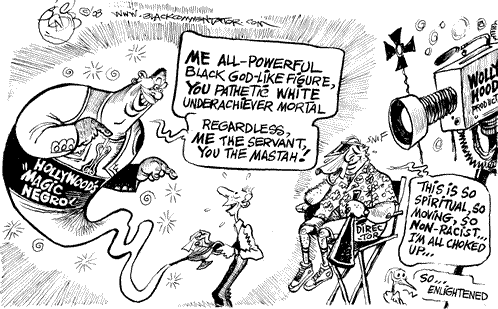
Magical Negros (not Barack Obama)
This post is apropos of nothing, it was just mentioned in the context of this review of the movie Australia. Interestingly enough, Daktari has a similar post on sexism today. (Well, vaguely similar -- it's on sexism, but it's similar in that she's discussing the subtleties between sexiness, sexism, and pedophilic objectification.)
Anyway. The concept is well illustrated in the commentary's accompanying cartoon:
Laters.