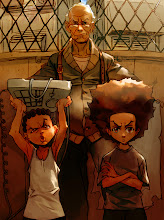
Anyway, there has been in recent years (or decades, rather) a sort of push-back on, "How come blacks can use it talk about each other but it's verboten for everyone else?" Leaving aside the fact that I don't think blacks should use it to refer to each other endearingly as a general rule (this being my least favorite part about the mostly-otherwise-brilliant animated version of The Boondocks) it nonetheless is different when "we" use it rather than white people or others using it pejoratively. On Feministe recently, this post by J-fave PhysioProf briefly discusses this point in a pretty enlightened way, though two posts, here, and here make the excellent points. The first, from "Holly", ends with
Of course, I don’t think it’s that most people don’t get it. At this point they do — they just don’t like black folks being allowed to do something that they can’t.Lauren's, the latter, references this excellent post by Ta-Nehisi Coates (I have no idea who this nigger* is), in which he says
never thought that because Toby Keith made a record called White Trash With Money, that somehow gave me the right to address random white people in the fashion. I never thought the fact that there was a magazine called Heeb gave me the right to address my Jewish buddies as such. More to the point--I never wanted to. So this is what I don't understand--What's the big beef? Why is that in "Blackworld" the normal laws of human interaction somehow don't apply? I don't get white people who have a hard time with this--you call your mother "Mom," I call her Ms. Phillips--same deal here. Nigger means one thing when used amongst a group of people with similar experiences, and something else when used by people outside of that experience. Nigger when used by black people, is a lovely, lovely thing. I will believe that till the end of my days. It can be beautifully ominous ("Nigger, what?") and just plain beautiful ("Ta-Nehisi, that's my nigger").
Just my $0.02 -- though I don't quite believe the use of the word nigger is a "lovely, lovely thing." It can be said to be amusing versatile at times, like the word "Fuck," though. (I know that's a lame conclusion, but I have work to be doing.)
*I do also, incidentally, think using the words "nigger" or "nigga" ironically or in jest is fine between two people who understand each other. For example, my friends often wonder if they can even say it in front of me in that way, even though we say all sorts of terrible things about other people and groups, expressly because we know each other well enough to understand it's not meant. On the other hand, it does seem to be a still much-charged word in my circles; I can't help but to feel that this is in no small part due to the fact that I am perhaps the only close black friend of many of my friends, or at least, one of the few. I can understand here extra hesitation, and identify with it (I don't usually use the word even in jest around my white friends, or indeed, around anyone usually). What I think is the case is that the de facto segregation that has led to many of my fellow suburban-raised friends having only one or a few black friends puts too fine a point on the wages of US' history to make joking about something like that comfortable. If you're curious as to why/how it may be different, in some opinions, in regards to Italians, Irish, Jews, and other historically discriminated-against classes, see Karen Brodkin's How Jews Became White Folks. Scanning Amazon, there appear to be a number of valid criticisms against it, but I found the chapter I read for a class at least to be a revelatory socio-political analysis of US racial politics, at least for one not already immersed in the literature of that field.



 Posts
Posts


