Showing posts with label Slate. Show all posts

Thursday, March 25, 2010

A somewhat uninformed screed that didn't fit in Slate's comment box

I skimmed this piece by Ron Rosenbaum on Slate about a book on the persecution, and insufficient condemnation of said persecution, of Ayaan Hirsi Ali, a prominent critic of Islam who has been under death threats for years because of it. I've seen Hirsi Ali; I don't like Hirsi Ali, I disagree with Hirsi Ali, although as I point out below, I certainly believe she shouldn't be threatened and should be protected from the threats on her life. From my reading of her, her strident critiques of Islam are of a piece of Hitchens' and other "New Atheists'" critiques on religion more generally. That is, absolutist critiques that, in their condemnation of persecution, intolerance, and irrationality, veer into irrational essentialism in characterizing religion (Islam or otherwise).

What follows is not an entirely coherent rant, from skimming a piece I found tiresome and somewhat coherent, even if I agreed with the underlying point. I really should address my direct criticisms of Ali at some point, but for the time being, here's my somewhat befuddled, procrastinatory words on Rosenbaum's piece:

Wow... I consider myself an intellectual, but obviously not nearly enough--I haven't heard of most of these people (excepting Hirsi Ali). So I can't comment on, what is to me, the inside baseball here. All mainstream intellectual commentators I know of have condemned violence against dissidents generally and against Hirsi Ali specifically, should the subject arise. And the probability I'm going to read Berman's book is near zero. But from Rosenbaum's piece, it seems like if you strip the sarcasm from his caricatured hypothetical reaction to Rushdie's persecution ("Sure, I'm for his not having his life threatened and all, but I'm tired of all this magic realism stuff, and he seemed arrogant when I saw him interviewed on TV. Maybe he was too contemptuous of the culture of the people who want to murder him"), the main thing wrong with it is the obvious indifference to the threat. But once you mount a vociferous defense of their rights to be free from persecution -- along with whatever material support one might muster as a public intellectual -- isn't taking a critical look at the actual work, attitude, motivations of the persecuted a perfectly valid pursuit? That is, do the "tired of magical realism" and "arrogance" critiques really belong with the lukewarm defense of Rushdie or Hirsi Ali's rights? And should it be verboten to think that, perhaps someone *is* too critical of the culture of the people who want to murder you? After all, if it's *not* possible to be *too critical* of such a culture, then the civilians who have died or been persecuted by US actions, say, under imperialism, foreign adventurism, Iran-Contra, etc. etc. are absolutely justified to have any level of anti-Americanism. (And mayhaps they are.) Or, does persecution only count when it is intellectual, and not when it is, say, blatant disregard for your right to and quality of life? If it's not possible to be "too critical", then both the most extreme Palestinians and the Israelis are right in their abhorrence of the other (if not right in violent actions against one another).

While violence against someone for their ideas -- or nationality, or siting above a resource you covet, or strategic importance of their country -- are all reprehensible and should be opposed in the strongest terms, I don't see why that would exempt the persecuted from criticism. Shouldn't it be possible to abhor the threats against someone, but disagree with them in whole or in part? I agree that the criticisms listed here against Hirsi Ali by intellectuals I've never heard of sound petty and insubstantial, but in my own reading and listening to Hirsi Ali, I find much to substantively disagree with her on, regardless of the righteousness of her freedom to express it and the clarity of *parts of* her critiques.

Since I don't know these intellectuals that are being chided, perhaps they deserve it -- from their quotes here, they do. But the conflation of their pettiness with larger issues of tolerating intolerance and the Enlightenment enterprise itself is, to me, somewhat unconvincing as it's all placed within the rarefied air of commentators I've never heard of. *I* think Hirsi Ali is arrogant, too sweeping, and in a way, racist in her anti-racism, so to speak. I'm no public intellectual, but for me there is no conflict -- I disagree with her on many points, but she should certainly not be threatened. That seems to be a mainstream consensus -- how much does it matter that the Intellectuals' Intellectual are insufficiently down with it? I read two hours of news a day, have a PhD, and feel totally outside of this. I suppose since it's the circles Hirsi Ali, Berman, Rosenbaum and Hitchens move in, it makes sense to be upset at their anti-racism-racist apostasy--for them. But attaching it to a larger critique of Enlightenment and modern liberalism requires more practical connections to the rest of us than this rarefied screed seems to take into account. Otherwise, the implication seems to be simply that one can't criticize the unjustly persecuted--or that one must be very careful to balance enough defense with your criticism, another form of relativism. It's clear that we must defend the persecuted--but what this piece doesn't seem to deal with is how to distinguish the defense of people we disagree with from the obligation of an intellectual to voice disagreement; implying that such disagreement equates to being objectively pro-persecution is an insufficiently rigorous proposition.

Saturday, December 26, 2009

In Other News

Back in my blog's primary activity (increasingly unfortunately I think), reading and criticizing Slate, this article ("Saying No to Obama: The U.S. president is popular, but world leaders are finding it easy to defy his wishes" by Shmuel Rosner) is not particularly worth reading, but that it produces a pretty damned good Fray response from Mutatis Mutandis. Highlight:

It is hard to say what the right course of action is, but Obama seems far more reticent and hesitant than a president with a majority in both chambers ought to be, even allowing for his need to find a strong majority for health care reform. I think it is time to seriously question whether Obama's interpretation of bipartisanship is wise. The US political system is an adversarial system, with distinct roles for majority and minority.


Read the rest here.

In COMPLETELY other news, aka Now for Something More Completely Different:
A montage of funny clips about supervillain weaponry, that, for some reason, popped into my head:


"You take that away and you are looking at a bunch of pissed off nutbags with ray guns and giant, I don't know, a giant octopus-slash-tank with laser eyes."
"I've seen one of those."
"I like the cut of this guy's jib."
"I like the cut of his hair."

And of course, the classic:

Tuesday, September 22, 2009

HoYay! brought the Visigoths at the Gates

-or-
"I wanna be noted for the fall of your Civilization! At the Gay Bar, Gay Bar, Gay Bar, Woo!"**

Interesting article on the otherwise-annoying-me-quite-a-bit-recently Slate today, reviewing James Davidson's "The Greeks and Greek Love." Author Emily Wilson goes over Davidson's "fascinating, meandering, funny, and thought-provoking study of how ancient Greek men loved one another." Observing the current state of things vis a vis gay marriage and the status of same-sex relationships, Wilson calls it
"a central problem for modern Westernized societies. Many countries allow same-sex couples the right to a "civil union" but withhold from them the name of marriage. The Netherlands was the first modern nation to legalize marriage proper for gay people, in 2001. Since then, seven U.S. states have also legalized gay marriages, although one, California, has just backtracked. On May 26, Californian lawmakers upheld a ban on same-sex marriages in the state... The ban is based on the idea that there is—or should be—something fundamentally different about sexual and romantic relationships between people of the same sex and those between a man and a woman. Since history is so often invoked, either implicitly or explicitly, on both sides of the debate, now is a particularly good time to look back at the history of same-sex relationships."
She goes on to say that the book
"ought to be required reading for anybody curious about the antecedents of the current impasse. [It] is a landmark study that challenges earlier historical interpretations of the evidence. For instance, [some] scholars... have argued that the Athenians were obsessed with anal sex, which they saw as an act of domination and humiliation. Davidson brilliantly shows that this interpretation is largely a projection on the part of modern historians, who have been reluctant to imagine a world where gay relationships could be expressions of love, affection, and appreciation, rather than deeply skewed power arrangements."
Observing Davidson's arguments on the Athenians ("same-sex relationships—which seem to have generally taken place between youths in their late teens and young men in their early 20s—were an important part of a boy's journey to manhood... [and] many men continued to be interested in "boys" even after marriage; happily married poet Sophocles and unhappily married philosopher Socrates both flirted with young men at drinking parties and caused no scandal in doing so. (The amazing thing about Socrates' sex life, according to Plato's Symposium, was not that he fancied the gorgeous Alcibiades but that he resisted having sex with him, even when snuggling under the same blanket"), Cretans ("Cretan rituals were equally strange, from an Athenian perspective..."), and Spartans ("In Sparta... a curious kind of sex seems to have been the custom between well-behaved men and chaste teenage boys. Apparently the lover was supposed to relieve himself only by rubbing against the boy's cloak: The cloak had to remain on at all times, as a sort of all-body condom"), I realized that I must have missed that part of The 300.

Of course, the funniest thing to me about the article (and somewhat exemplifying Slate's more-than-occasional breathtakingly tone-deaf and dumb contrarianism) is that it reminds me of a typical Slate contrarian years ago who was all "can't we have just ONE uber-violent movie with mainly manly men battling, oiled and sweaty, without just ASSUMING homoerotic tones?" To which I thought, sure, go ahead, but if I were you, I wouldn't take my stand on HoYay's inappropriate over-application and tie up the end of my mediocre article on the (lack of real) homoerotic undertones in action movies by talking about "The 300" and fucking SPARTA, where there actually WAS homoeroticism, you know, in the form of HOMOSEXUAL SEX. Not explicitly in The 300 itself, if I recall, but in that silly thing called "real life."

This being, after all, the same real life where two of Western Civilizations's most influential cultures, Greece and Rome, had common and rather accepted forms of gay love and managed to, oh, form the rhetorical and historical basis for much of modern Western society. (Not to mention the many celebrated philosophers we so often cite in our paeans to reason or democracy who, at the very least, batted for both teams, and of course that historical war juggernaut, Alexander the Great.*) But, I'm sure Rome's eventual fall was probably due to a lack of heteronormative "family values."


*"Alexander the Great, just steaming through Persia; took out Darius the 3rd as we all know. And then he ran on... and after a while his army's going, 'Hang on. Alex, I think we lost 'em. You know, I don't know where we live any more, and we've killed most of the people we've met. So would you just like to chill out.' And Alex is going, 'Look, I'm 32, I'm gay, I'm on a roll. Let's go!' On you go."

**

Wednesday, July 22, 2009

Being a world-renowned professor while black

Prof. Henry Louis "Skip" Gates, Jr. -- Harvard University Professor, editor of the Root, etc. etc. -- was arrested on his own front porch after it was determined that he was, indeed, the legitimate homeowner as far as I can tell. Writer Samantha Henig of Slate and the Double X Factor comments on this and links to some other good commentaries:

Just as upsetting to me as the Henry Louis Gates Jr. arrest, Emily, is the way that so many people have been responding, including in our own comments section. There’s this reflexive defense mechanism that so often kicks in with white people (of which I am one) in situations like these; an urge to stand up for the white person accused of discrimination because hey, I’m white, and I’m not racist. I’ll admit, I feel that pull too at times—I cringe at people who fling around groundless accusations of racism [and other hot-button issues].

But this is not a case where people should get all smug about being “brave” and “honest” enough to question whether race was a factor; to suggest that maybe it was Gates who was out of line, not the cop. In all the steps of this story—the neighbor who called the cops, the way the officer spoke to Gates, the fact that the kerfuffle between them, no matter how much it was instigated by Gates, led to an actual arrest—it is just so hard to imagine that not one of them was influenced by Gates (and his driver) being black.

Blogger Kate Harding has a thorough explanation of why declarations that race isn’t a part of this arrest are coming from a position of white privilege. And to “people are trying to be all devil’s advocatey about it and suggest that Gates bears responsibility for making matters worse,” she offers this: “I’m sorry, who wouldn’t be a belligerent prick after getting off a long flight, coming home to a jammed door, then finding a cop in your living room accusing you of trying to steal your own shit? I sure would.” Ditto that.


Read the rest here.

Monday, July 20, 2009

It might be inaccurate, but at least it's fast

An article today at Slate discussing Body Mass Index (BMI) and how it's actually a poor measure of obesity -- and why it's used so commonly to diagnose said obesity. Rather like many population measures -- time at menarche or onset of puberty, age at death, literacy, whatnot -- the overall averages won't tell you what's going on with any given individual. But alas, the almight BMI is convenient, so it's commonly used.

This reminds of the (related) phenomenon, back during the Atkins Diet craze, when I read an article talking about it and its actual relationship to healthy eating and longevity (questionable at best, negative at worst). It quoted some scientists as arguing that at least Atkins brought people's attention to dietary questions; in my experience, however, it was just another fad diet, and people adhered to it specifically. There was little spillover into more generalized health concerns, exercise, etc., just cutting down on carbs -- which as many scientists in that article and out pointed out, is not terribly related to long-term health, as the fats associated with much of the protein people ate instead did little for their cardiovascular health, and they missed out on the nutrients and micronutrients chiefly gleaned from eating complex carbs (i.e. the anti-Wonder Bread).

Anyway, like BMI or even worse our focus mainly on weight, the article expressed a point of view that I like to summarize as, "Things are so bad, we need a solution -- even if it's a wrong one that won't work."

Sigh.

Monday, July 13, 2009

Frank Ricci: Firefighter, Successful Supreme Court Litigant... Serial Suer?

Dahlia Lithwick writes at Slate about Frank Ricci's penchant for filing suits over jobs. In what might be irrelevant background, a pattern of sour grapes, or a person "repeatedly victimized by a cruel cadre of employers, first for his dyslexia, then again for his role as a whistle-blower, and then a third time for just being white," the recent victor along with the others of Ricci v. DeStefano also just might be "a serial plaintiff—one who reacts to professional slights and setbacks by filing suit, threatening to file suit, and more or less complaining his way up the chain of command." Ricci, who will testify during Judge Sonia Sotomayor's confirmation hearings, is, as Lithwick says, thus "not the typical GOP heartthrob." The GOP's stance on discrimination lawsuits seems to be along the lines of J-Friend Dan's philosophy of complaining. As he once said: "I don't believe in complaining about things you can't do anything about. On the other hand, I don't really believe in complaining about all the other stuff either." Switch "complaining" with "lawsuits" and you have the Republican philosophy, or its seeming one, regarding lawsuits for rights infringements (see their repeated attacks on tort lawyers and all that rigmarole).

Lithwick's piece is little more than a trifle, though it certainly paints Ricci in a different light (whether or not that's a fair different light is a different conversation) and makes one wonder why this wasn't brought up before now? Surely, this wasn't just discovered. And like I say, it might be irrelevant, but it could've been a choice part of the discourse anyway, considering how much the focus was on "being fair" to Ricci and his colleagues, who "earned" their promotions based on the standards given, regardless of whether the standards were the best ones to evaluate people with or were discriminatory as such Title VII was heretofore determined.

Thursday, July 02, 2009

New Haven's Firefighters: Race, White firefighters, and civil rights, Part the Nth

A really fantastic piece, or seemingly from my quick readthrough, by Richard Thompson Ford again, Stanford scholar and previously linked-to commentator on the "New Haven Firefighter Case" of Ricci v. DeStefano.

Ford analyzes how the SCOTUS' finding for the white firefighters (and one Hispanic firefighter) in this promotion case overturns years of civil rights precedent, while going with more recent precedents of treating any attempt at addressing civil rights as creating their own racial (or sexual, in the case of homosexuality) preferences, "reverse discrimination" or "special privileges."

There are two interesting points here (well, many more than that, but two I will make right now.) One is that recent discussions with various J-friends have, unhappily, split pretty clearly along racial lines (though not with any racial overtext, that is, whether or not people agreed or disagreed with the SCOTUS decision fell quite racially within my very small subsample of my friends). BUT, the point of contention seemed to (mainly) fall into "Ricci et al. deserved to win because they played by the rules," that is, the test happened, and taking back what they'd "earned" by going along with the test as written would not be fair, regardless of the errors, biases, whatever of the test. (The "compromise" position found between J-fave D and J was that they were deserving of some recompense for the efforts they put into preparing for the test, even if they were not owed a promotion.) Essentially, as I discussed with J-Mom, it seemed to be a focus on the individual, individualism, and the rights of the individual not to be "harmed" for the good of the whole, or good of another group at least. (This is not at all how the J-friends phrased it, but my interpretation of their objections to my points of view). J-friend Sean felt that institutional racism was real, but of a lessor magnitude than perhaps I may think it was, a lessor magnitude than discrimination from poverty (which is hard, if not impossible, to parse, but suffice it to say I think institutional racism is a profound and not terribly diminished problem, something D seems to agree with to some degree.) Indeed, Sean argued (if I am restating it correctly) that essentially positive preferences for any group are essentially the same, such that discrimination "for" blacks was as bad as discrimination against them (and you can replace "black" with white or Hispanic or what have you here).

Thompson argues that this places many, many programs to address racial programs at risk, as in the end, they all hinge on treating one group differently than another or end up displacing some people who would otherwise have received a job, promotion, or college acceptance. (He uses the example of the 10% programs, where, for example, Texas admits the top 10% of students in their high school class, a supposedly "race-neutral" way of achieving the end of diversity and representation of minorities. As has been pointed out by others, this only works because Texas schools are segregated, thus, you get diverse representation because the top 10% of the class at predominantly black or Latino schools is itself predominantly black, so minorities get represented essentially because they are not integrated (or have lower relative average scores where they are more integrated). As Thompson says:
The university now admits any student in the top 10 percent of his or her public high-school class, and because so many of the public schools in Texas are racially segregated, this guarantees a racially diverse student body. Opponents of race-conscious affirmative action have pointed to this policy as an example of a viable, race-neutral alternative. But no one denies that the motivation for dropping the traditional admissions criteria in favor of the 10 percent plan is to achieve a better racial mix. Extending the logic of Ricci, this looks like impermissible race discrimination against the students who would have been admitted under the old criteria, just as dropping the firefighter promotion exam was impermissible race discrimination against the white firefighters who would have been promoted.


I think this poses a challenge to those who agree with the Ricci decision, unless they hold the very narrow stance that it is only because the test already happened that it was unfair discrimination. As Thompson points out, how would the case be (legally) different if, before the test, the city chose to use one test that they knew from previous data would tend to favor a more diverse mix (i.e. less whites and more minorities) rather than a test that would favor more whites. The intent there is almost exactly the same as throwing out the results for, as some of my friends posed it, "having too many white people". So if Ricci is unfairly discriminating against whites, using a test that you know would admit more minorities also should be, to be logically consistent.

The second point, which you may have forgotten I even supposedly had at this point, is that Ford reiterates that Ricci is a change in the status quo. As J-Mom AND the article by Bazelon I've prattled about here for the past week pointed out, the previous standard for a "discriminatory" test was just that the results were discriminatory. Governments typically used an "80% rule":
Title VII requires employers not just to inspect their hearts and not find any discriminatory intent, but to consider the racial impact of things like tests. And the EEOC, in interpreting this requirement, has given clear guidance about what impact counts as suspect:

"A selection rate for any race, sex, or ethnic group which is less than four-fifths (4/5) (or eighty percent) of the rate for the group with the highest rate will generally be regarded by the Federal enforcement agencies as evidence of adverse impact, while a greater than four-fifths rate will generally not be regarded by Federal enforcement agencies as evidence of adverse impact."

The rates at which blacks and Hispanics passed the New Haven tests were well below 80% of the rate at which whites passed. That means that those tests were presumptively in violation of the law. (from Obsidian Wings)


Thus, the Court set aside the typical way things were done, where (as I have pointed out to J-friends), a test that has that much racial disparity is presumptively discriminatory, which seems to me a fine first pass at such things in a world of institutional discrimination, which I see as a very large on-going problem, contra J-friend EssEee.

As to the earlier point over the "fairness" to the individual, two other interesting bits:

Obsidian Wings: I have read many professions of outrage about this decision, but most of them focus on whether it is a good thing or a bad thing that Frank Ricci didn't get his promotion, rather than what the law requires. This puzzled me.

And Walter Dellinger:
Given that no one had been promoted and no one had been denied promotion, it's very hard to see how the firefighters who brought suit were able to establish the very first element of a Title VII action: the existence of an "adverse employment action." In addition to satisfying the statute, it would have been far better for the process to judge New Haven actions after promotion decisions were actually made using whatever new standards the city chose to adopt. Completing the process would have shed light on the question of whether there were in fact equally good (or perhaps, better) criteria for determining promotions, and with far less racial disproportion... Which takes us to the fact that Justice Kennedy's opinion relies in part on a logically flawed, categorical error. He writes: "If an employer cannot rescore a test based on the candidates' race [citing the Title VII provision], then it follows a fortiori that it may not take the greater step of discarding the test altogether to achieve a more desirable racial distribution of promotion-eligible candidates..." This is wrong. There is a very powerful difference between setting aside the results of a test based on what you learn from general racial statistics about those who took the test, on the one hand, and adjusting individual test scores on the basis of race, on the other... Using race to identify a problem has never before been considered problematic. It is what necessarily happens before institutions adopt the most widely accepted race-neutral actions, like using admissions criteria for every applicant that have less of a racial impact (for example, accepting students in the top 10 percent of their high-school class, which, in states like Texas, would produce a racially diverse student body). Contrary to Kennedy's assertion, deciding not to use test results should be far less problematic than "rescoring based on race." ...Here, all New Haven did was set aside the results of a test. It seems to me that test would have been very hard to defend, given the other questionable employment rules that surrounded it. New Haven counts the multiple-choice test as 60 percent of what determines promotion. That places twice the weight on test-taking as the median for firefighter promotions around the country. How can that unusually great a weight be justified? Kennedy says only that it was insisted upon by the union. Yep. That was two decades ago, when the union was dominated by the white firefighters. That so great a weight should necessarily be given to a multiple-choice test used to pick leaders out of a group of qualified firefighters is hard to see.


Going back to Ford to wrap up, he asks:
And why stop there? Even recruitment efforts aimed at underrepresented minorities are designed to increase the representation of those groups in work forces and entering classes with a limited number of openings. If these outreach efforts are successful, some minorities will necessarily displace some whites who would otherwise have been hired or admitted. Are those efforts discriminatory, too?


Among other things, I see this case as reflecting a problem of where many want us to be, especially in white America, and where we actually are (or at least how we perceive it in black America, to speak in broad generalities). If you think racism is a significant and real, persistent still-present problem, interventions of a certain size, from affirmative action to throwing out the New Haven test (which depending on how you look at it, was unfair to those who would have been promoted based on how the test was set up before hand by taking away what they'd earned, or would have been permissible because it threw out results based on the heretofore legally correct presumption that such skewed results were de facto racist) seem reasonable. If you think, know, or wish that racism has receded to the point where a lot less aggressive, race-blind, and minor intervention is all that's needed, it seems understandable to take it from Ricci's side.

Argh. Ok, I have a headache now (unrelated to the post, I think). Até...

Thursday, June 25, 2009

Firefighting in black and white: More on Ricci v. DeStefano (aka the New Haven Firefighter Case)

This continues an earlier J-Continuum/Anekantavada discussion about the discrimination case before the Supreme Court of Ricci v. DeStefano. Again on Slate, an article does a pretty good job covering a lot of the relevant territory. Although I won't get into it now in any depth, a couple of facts together seem to me to point to why the city got it right in throwing out test results and denying promotions to everyone from that round of testing (i.e. mostly white, one Hispanic, and no Black promotions would have resulted):

a) In their entries, Allan and Bazelon lay out a still-common history and present of discrimination against minority firefighters, such that majority Hispanic and Black neighborhoods have had and often still have majority white firefighting forces, and even further, have stratification such that the supervisory levels are quite disproportionately white, along with

b) In this case, the white firefighters are predominantly from almost-totally white neighborhoods (~95% white) outside of the city they serve, New Haven, while the minority firefighters are mostly residents of the city. In entry exams, city residents get a slight (5%) advantage, on supervisory applications, there is no preference for those who live in-city. (It seems to me that living in the place you serve as a civil servant is a logical thing to preference for, if not require or distinctly advantage -- there's something to debate here, but I think you should be an explicit member of the civic community you supposedly serve for a variety of reasons, and the very least, this should likely be preferenced/encouraged in perhaps positive-incentive ways if it were not to be required). Further, in this specific case, allegedly some of the white firefighters "joke on the phone about 'working in the ghetto.' [Black, female New Haven Firefighter Erika Bogan asked] 'How dare you, when you live in Madison or Guilford, come in here and take our money and go back to your communities and talk shit about New Haven?'" I don't know that this has entered the case, but such casual disdain -- even as a joke -- speaks poorly of a white "civil servant" who doesn't even live in the place he's "serving." (It just compounds the problematicness of the whole thing -- at least if he lived in the "ghetto" he'd have the social "right to speak" ill of it by being a part of the community, rather than an "outsider" ridiculing it.)

c) The tests were based almost wholly on memorization and technical details of firefighting, items which don't even (apparently) apply to the majority of cases faced by the New Haven dept. (which are emergency calls, often medical in nature, according to the article). In other words, the tests don't have an apparent relationship with the actual on-the-job performances and requirements of firefighting in New Haven.

d) The firefighter's union chose to support Ricci (the white firefighter), despite accepting dues from all the firefighters, of all races; when a court ruled they couldn't back Ricci in court, they still spent union funds supporting his case, despite protestations (and an impending suit) from Black firefighters. This seems to me to constitute another form of institutional bias; it clearly should've sat out of this case in this manner, attempting to see the interests of all of its members. (One could argue it sees this supposedly "neutral" test to be in the interest of all of its members, but when the vote went straight down racial lines, it seems to me paternalistic and institutionally (i.e. not individually or purposefully) racist to then honor the requests of the majority-white vote.

e) The way the test was designed and conducted -- little input or review by outside experts (to avoid potential cheating, apparently) and out of step with what appears to be best practices in many other municipalities -- seems to me to further indicate the possibility of systematic unfairness and, importantly, to indicate that it is not necessarily the best way to determine promotability. This is one of the cornerstones of the "disparate impacts" bit of discrimination law -- if there's a better way to assess ability that is less likely to affect races differently, then (from my lay interpretation) it appears the city did the right thing in vacating the test.

f) Scalia apparently said at oral argument that he doubts the city would've done the same thing had the situation been reversed and almost exclusively black firefighters got promoted. ARGH. That just sounds so FUCKING ignorant to me. For one thing, that seems unlikely -- actually, if someone can point out an example of that happening, I'd like to know, because the very fact that all blacks doing better than all whites on a job exam seems to be rare if not non-existent points to me to the persistent and lingering problems of institutional racism, which is the very spur for the city's interpretation of the law that Ricci is challenging. Besides which, if that happened, wouldn't the white firefighters seem likely to challenge it? And wouldn't they, perhaps, have a point? One cannot simultaneously maintain that the white firefighters would be right to challenge the results in that case, and that they are right to challenge it in this case, without the logical implication that the point is that the white firefighters are entitled to do better automatically. And the white firefighters would likely be right to challenge it should the results have been nearly all-black. And if the city's behavior in THAT case would possibly be illegal, it is possibly illegal in this case. To be logically consistent, if he's going to find for Ricci in this case, Scalia would have to think that a case where only blacks were promoted would be prima facie legal, I think. (Despite the Latin, I'm not making a specific legal claim since I know nothing about the practice of law.) Bottom line: that sounds potentially discriminatory to me. In the end, this objection sounds suspiciously like "Oh, the city is just too obsessed with promoting BLACK PEOPLE," which is a stone's throw from "Political Correctness is ruining us all" and a good ways down the road, but on the same road, as calling them "Nigger lovers." Really, Scalia just disgusts me with that (though I know that's in part visceral and not logical, but it still, to me, trades on racial anxiety in a deceitful way.)

Anyway, I actually did talk at length about all that. Ooops. Time for showering and eating and writing actual academic work.

So, I'll leave off here with a quote from what seems to me to be a (rare) exceptional bit of writing from Slate (and an exception to much of Bazelon's recent production, despite my overall fondness for her as a writer based on memories of articles I liked long ago):
To young black firefighters like Mike Neal and Erika Bogan, that sounds like a solution. "We want to be on a level playing field," Neal says. "We want everything to be given to us on our merits." Ricci's group, on the other hand, feel as if they've already earned their promotions based on merit. They did what the city told them to. It's hard to imagine how they'll feel right about starting all over again.

Neal and Bogan's conception of merit is different from Frank Ricci's. It's easy to see why. Ever since the test results came out, the black Firebirds and the white plaintiffs have had opposing interests. Stretching back further in time, back over the decades, the two groups also see the history of the department through a different lens. For Frank Ricci, the past is a story of ethnic heritage and family pride. For Mike Neal and Erika Bogan, it's a story about breaking the lock on hiring that kept their people out.

Maybe promotions based on an assessment center would serve the city better, in the long-run, by testing for the abilities fire captains and lieutenants most need. Or maybe there are just a lot of firefighters well-qualified to do these jobs and a scant number of openings. "It seems like guys on both sides of the line feel like they've been cheated, like there just aren't enough positions to go around," says William Gould, the white captain. He supports Frank Ricci. But he can see what this fight looks like from the other side. If New Haven could start over, maybe it could also admit outright that it has more deserving firefighters than it has rewards. The city could come up with a measure for who is qualified for the promotions, rather than who is somehow best. And then it could choose from that pool by lottery. That might not exactly be fair, either. But it would recognize that sometimes there may be no such thing.

Thursday, May 28, 2009

More on Sotomayor

She's hardly a die-hard fan of the little guy.

In the linked Slate article by Emily Bazelon, Bazelon lays out how Sotomayor can be very convincing; in the cited case, she convinced a conservative and liberal judge, both of who started out opposed to her view, to switch sides and sign on to her decision in a case where "empathy" would lead you to believe one might side for the trucker in this case over the off-duty cop:
But what's striking, of course, is that she persuaded them to undo a verdict in a case that a jury saw as rife with police abuse of power. "You read this unanimous opinion, and it would seem to be the Republican judge who is driving this decision that she just signed on to. When in fact it was exactly the opposite," one observer said.

The other two judges had decided to rule to uphold a jury verdict and a $600,000 award for damages for a trucker who, whatever the merits of his suit (he was found not guilty of assault against the officer, who he got into an altercation with over a payphone, back in the 90s, where trucker Jocks claimed he explained he had an emergency with his truck broken down further up the highway and the cop refused to reliquish the payphone; fight ensues; the cop claims Jocks made no mention of an emergency and started a fight for the phone) seems to have been quite thoroughly punished for a crime it was ultimately determined he didn't commit:
fter his arrest, Jocks was held for 24 hours and ended up having to make 28 court appearances before he was found not guilty of felony assault. He spent $20,000 on legal fees, lost his truck driving job, and had to give up full custody of his daughter, who went to live with her mother, his ex-wife. That dire, black moment on the LIE truly cost him.


Frayster Joe_JP observes that this actually fits in with what we know of Obama, like his upholding of some Bush era atrocities:
Given the mixed feelings some have with recent actions by President Obama (e.g., preventive detention), this should not surprise. In fact, though he was specifically talking about his views on a "living Constitution," Obama in Audacity of Hope suggested his model is Justice Breyer. Someone Rachel Maddow recently suggested was more centrist than liberal (and at times tecnocrat), and various of his opinions can be used to back that up. But, the game has to be played, so she is tarred by the likely subjects when they should be quite happy she was chosen.


Dionne appears to have it quite right. And the last thing we need on the court in this J's opinion is another "law-and-order" type, inclined to "[use her] formidable skills on behalf of the strong in opposition to the weak". Where did you hear those words before? They were Obama's objection to the nomination of Supreme Court Chief Justice John Roberts. Although O may have been talking about minorities and plaintiffs in cases against large commercial interests, it's worth remembering that the police very much are often the ones who are the strong (such as in the trucker case where, when the off-duty cop had enough, he pulled his gun and put it to Jocks' head), and Sotomayor appeared to have used her formidable skills on his behalf.

Dionne: "And even though they should support her confirmation, liberals would be foolish to embrace Sotomayor as one of their own because her record is clearly that of a moderate. It is highly unlikely that she will push the court to the left."

Wednesday, May 27, 2009

Racial discrimination: Flip it and reverse it?

Excellent article by Richard Thompson Ford on Slate about the Supreme Court case Ricci v. DeStefano. You may have heard of this case as "the case of the New Haven Firefighters" or "the case of discriminating against whites":
In 2003, the New Haven Fire Department decided to base promotions to the positions of captain and lieutenant primarily on a written exam. But the next year the city threw out the test results when all but one of the eligible candidates for promotion proved to be white. New Haven firefighter Frank Ricci, a high scorer on the test who is white, sued for reverse discrimination.


It really takes reading all of Ford's article to fully get the sweep of his argument, I would say, but it breaks down to: Ricci, who apparently took 6 months off work to prepare for the exam and spent $1,000 on tutoring, maintains that the city threw out the test after the Hispanic and Black firefighters taking it didn't do well in order to discriminate against the white firefighters who (like him) did better on the exam (though it's important to note that a number of black and Hispanic firefighters did also pass the test, but the way the evaluations were set up, only the top three scorers are eligible for promotion).

Ford makes the point that other legal experts have made, namely, that the way Title VII of the Civil Rights Act of 1964 has commonly been interpreted is that what it calls "disparate impacts" on different racial groups are legally questionable in and of themselves. That is, it is quite possible that the black and Hispanic firefighters could have sued New Haven had it not thrown out the test, on the (precedent-abiding) rationale that the fact that no blacks and only one Hispanic qualified for promotion (out of over 40 blacks and Hispanics). (And yes, I know blacks can be Hispanics and Hispanics can be blacks, but let's not get into the complicated US parsing of race -- or the fact that USA'ers don't seem to realize that there are a lot of Black Hispanics/Latinos -- here) is evidence of disparate impacts and possible discrimination.

Where Ford makes an important addition to the discussion is where he discusses why this is not necessarily "reverse discrimination" against the whites, and exactly why the disparate impacts rationale holds up. That is, as we've talked about here on Anekantavada/the Continuum, institutional racism is a pernicious going concern in the US, and non-obvious. Title VII was designed to thwart not just purposeful discrimination ("No blacks or Hispanics") AND inadvertent discrimination. And when only 1 or so out of 40 minorities qualifies for a job, it's quite certainly possible if not likely that there was inadvertent discrimination.

But let me quote Ford, who says it better (if not any more succinctly):
Conservatives think the law against disparate impact discrimination does more harm than good. [John] McWhorter decries the "rhetorical contortions that excuse black people from challenging examinations." And Abigail and Stephan Thernstrom insist in the Wall Street Journal that even "sharp racial disparities" in testing results "are not an argument for racial quotas." Both McWhorter and the Thernstroms worry that a law that is premised on lower performance by racial minorities has become self-fulfilling: Such racial disparities, the Thernstroms admonish, "should not be regarded as a permanent fact of life."

But, properly applied, disparate impact law doesn't excuse poor performance, nor does it require quotas. Instead it smokes out hidden bigotry and requires employers to avoid unnecessary segregation of the work force. Suppose an employer wants to keep women out. Knowing that he can't just put a "women need not apply" sign in his window, he might use a proxy, such as a weightlifting test, knowing that women on average have less upper body strength than men. The law against disparate impact discrimination is designed to reveal such hidden bias. Now, suppose an employer has no desire to discriminate against women but uses a weightlifting test simply because he thinks, all other things equal, stronger employees are better than weaker ones. Disparate impact law also prohibits this: It requires the employer to reconsider job qualifications that favor one race or sex, unjustifiably.

Of course, there might be a good reason to prefer people who are physically stronger—or who score higher on a written exam. The law gives employers a chance to prove that the discriminatory criteria are job-related. The idea, then, isn't to make an employer hire less qualified women or minorities over more qualified men or whites. It's to make sure the employer is testing for job qualifications, not unrelated ones.

Race discrimination has locked minorities into poor neighborhoods with failing schools for generations: As a result, blacks, as a group, continue to perform less well on written exams than other races. Perhaps New Haven's black candidates could overcome these disadvantages by studying harder, like Frank Ricci did. But Ricci took extraordinary steps to ace the test—six months off work to prepare and $1,000 on tutoring. An equal-opportunity law that's premised on everyone taking such steps isn't likely to do much good in the real world of scarce time and money. And would encouraging the equivalent of intense cramming for the final really help employers select the best firefighter for the job?


One of the things those who side with Ricci in this case say is that if a test was thrown out because only minorities were promoted as a result, it would be "an open-and-shut case of discrimination." Assumedly, they mean against the black test takers. But quite certainly, if the situation were reversed, people all over would look askance at the results? I mean, there may be some or many blacks proud of the achievement, but it certainly would be weird, right? And I can only imagine the kind of commentary conservatives would put on such a result, where only blacks qualified for promotion. Indeed, they would almost certainly by calling that reverse racism. And it would seem to me that under Title VII, they would have an equally strong case as the City does in this case. It would be statistically unlikely for that to happen by chance. Now, I can't say I would see it this way for sure if it were reversed, but I think we also all know it would be a surprising result that many would decry as being somehow discriminatory expressly because we don't expect blacks to uniformly outperform whites. This puts the institutional racism into somewhat more relief: whites have scored on average higher than blacks in any number of areas for America immemorial, and whether you think this continues because of institutional racism and unequal legacies from history (as I do) or because of some sociocultural or biological flaw, either way it would be surprising to see only blacks and Hispanics get promoted, even if in a majority-minority example (assuming it's not the kind of 98% black & Hispanic type disparity but rather say 60 or 70%). So what I'm saying is, I think many in our society would be MUCH more comfortable assuming a test which produced those results were flawed than they would be with a test producing complete over-representation by white test takers. But because we're used to whites doing better, it seems all the more galling that what Ricci supporters seem to assume is self-evidently a fair and applicable test would be thrown out.

If the situations were reversed, it might very well be open-and-shut discrimination case -- discrimination against the white employees in that case.

Two more things: if Ricci took 6 mos. off and spent $1,000 on tutoring, it also seems obvious that either the job training for the firefighters is deficient (if it takes that much effort -- so much that you stop fire-fighting for 6 mos. -- in order to qualify for advancement as a firefighter, then it would apparently seem like you can't learn enough about firefighting by actually doing it to be promoted), or that the testing is off. I mean, you can't (or at least, shouldn't) have to go through such extreme measures to advance within such a job -- we certainly wouldn't have wanted all of Ricci's colleagues to all take 6 months off at the same time to study! (Though I do believe I read he's dyslexic, so that might explain some or even all of the extreme effort he put in, now that I think of it.) In any case, it would seem like the only fair way to have advancement in such a case would be to have low-cost additional training available for everyone, so that being promoted didn't require that you have so much job flexibility and money. Second thing, though, is that people talk about it as if the blacks and Hispanics would have been blatantly unqualified to receive promotions -- but a number of them passed the damned test. Whether or not it's significantly important to take the 3 highest scorers depends on the content of the test -- which weirdly I have seen ZERO discussion of, so the question of whether or not it's completely and fairly job-relevant is unresolved -- but getting the highest score may or may not be relevant based on the content of the test itself, and on the other scores. If they were 95, 94, 93.5, 92, 92, 91 etc. and 70 was passing, the difference between the top scorers and the next several could be not practically meaningful.

Sigh. In my head, I'm hearing and thinking about various counter-arguments that I would expect from various friends of mine, so I could keep going on and on -- I was kind of trying to anticipate all the counterarguments ahead of time -- but that would go on even lONGER and I think that's unwise. So, yeah. Read Ford's piece -- I would in fact recommend it over reading all of the above (hah, too late) -- and think about institutional racism, and then, comment. Let's talk.

Friday, May 15, 2009

Blood From a Stone: The Compassion of a Conservative Heart

Read this Slate column by Doug Kendall and Dahlia Lithwick, discussing how the Republican outcry over the "empathy" Obama wants his Supreme Court Nominee to have is kind of fake, full of stickum, considering the way they too (not unfairly, if for underhanded purposes from a liberal perspective) play up empathy for those they consider to be "model plaintiffs" for Supreme Court cases they care about (i.e. "white 'victims' of affirmative action").

So despite this clever snippet from an earlier Slate article by Lithwick

And in a delicious Freudian slip, Sen. Jeff Sessions of Alabama snorted: "I don't know what empathy means." You don't say.
apparently, they (conservatives) do. They just don't empathize with our Obama's desire for empathy because the empathy may not go the way they want it to. (And they'd likely be right, of course, in that an Obama nominee's sympathies wouldn't necessarily be with "victims" of affirmative action or those who want to keep handguns at home. Of course, you never know.)

Hypocrisy: It's ok when I do it.

Monday, April 27, 2009

Hitchens Hits the CIA & Torture on the Head

Chris Hitchens, erstwhile leftist apostate, has been increasingly writing sensible articles as of late, perhaps having milked his "all-pro-war-in-Iraq, all the time" angle or finally seen the insane folly of supporting anyone like GW Bush to do anything consistent with reason or other higher calls not directly beamed into his head by the voice of "God" (who may or may not actually be just a team of mischevious kid geniuses transmitting directly into Bush's head -- "This is Jesus, W... and you've been a very naughty boy."). Though he is now a fellow at the conservative Hoover Institute, that doesn't negate the fact that he says in this article what a lot of commentators have avoided, or at least, synthesizes the elements of the US torture regime that have been left at loose ends by the US media at large and creates a potent indictment of the CIA.

Surely the most flabbergasting single disclosure in the recently released interrogation memos is the revelation that Khalid Sheikh Mohammed, captured on March 1, 2003, was put to the water-board 183 times that month, or about six times a day. This can really only mean two things: that the method is very crude and inexact and/or that his interrogators were in a state of panic and under insane pressure to produce results. ...The memorandum rather silkily argues that "before the CIA used enhanced techniques," KSM was resisting "giving any answers to questions about future attacks," but if he was apprehended on March 1, 2003, and then "dunked" 183 times in the next 31 days, it suggests in the dry words of Scott Shane in the New York Times that "interrogators did not try a traditional, rapport-building approach for long."

Here is a seldom-mentioned reason why the CIA might go crazy in this way, to the point where even the FBI and other agencies were cripplingly (for us) reluctant to cooperate with it. On 9/11, according to Bob Woodward, George Tenet audibly hoped that the suicide-murderers of al-Qaida were not connected to the shady-looking pupils at those flight schools in the Midwest. The schools, that is to say, about which only the CIA knew! In other words, and not for the first time, the CIA (which disbelieved the evidence of Saddam's plan to attack Kuwait in 1990 and continually excused him as a "secularist") had left us defenseless and ignorant. Unprofessional and hysterical methods of interrogation, therefore, were unleashed in part to overcompensate for—and to cover up—a general lack of professionalism at every level of the agency from the top down. The case for closing and padlocking Langley and starting all over again with an attempt at a serious national intelligence body becomes more persuasive by the day.

A couple of degrees over on the "intelligence" spectrum, CIA Director Gen. Michael V. Hayden has deplored the release of the memorandums on the grounds that they inform our enemies of how far we are prepared to go. In what conceivable world has the general been living? The techniques of water-boarding were borrowed by us from our previous enemies in Japan and China and Korea and "taught" under the pretext of training people to withstand them...


Potent words, and a potent point: the CIA threw itself (one can barely resist adding the adverb "gleefully") into torture to distract attention from the fact that the failures leading the 9/11 were not due to a lack of authority, aggressiveness, or other "inorganic" barriers, but rather due to questionable competence on the part of the CIA and FBI themselves. What's more, the techniques used were borrowed from countries we ourselves have and had accused of torture for some of the same very practices, and while some in Congress and elsewhere have argued that it can't be torture because we subjected our own troops to it, that doesn't make very much sense assuming THE TRAINING WAS IN HOW TO RESIST TORTURE. That is, you can't claim it's not torture because we did it to ourselves if the reason we did it to ourselves was to expose our soldiers to torture-type techniques such that they could learn to resist it. To think otherwise just makes NO sense.

Anyway, it's work time for bonzo, way past actually, so ttfn...

Tuesday, April 21, 2009

SCOTUS likely to say, apparently, that a school fucking STRIP SEARCHING a 13 year old girl based on hearsay is A-OK

AAAAAAAAAAAAAAAAAAAAAAAAAAAAAAAAAAAAAAAHHHH. ps. AHH.

Read this article on Slate by Dahlia Lithwick, in what I can only hope is her most far wrong call of all time. (Well, ok, this is less horrible than, say, Supreme Court (SCOTUS) allowing torture and indefinite detention and the suspension of habeas rights, but it is also less understandable from even a utilitarian perspective.)

Choice excerpts from Dahlia's well-written piece:
When constitutional historians sit down someday to compile the definitive Supreme Court Concordance of Not Getting It, the entry directly next to Lilly Ledbetter ("Court fails utterly to understand realities of gender pay discrimination") will be Savana Redding ("Court compares strip searches of 13-year-old girls to American Pie-style locker-room hijinks"). After today's argument, it's plain the court will overturn a 9th Circuit Court of Appeals opinion finding a school's decision to strip-search a 13-year-old girl unconstitutional. That the school in question was looking for a prescription pill with the mind-altering force of a pair of Advil—and couldn't be bothered to call the child's mother first—hardly matters.
Editorialists and pundits have found much to hate in what happened to Savana Redding... you might see the humiliation in pulling a middle-school honor student with no history of disciplinary problems out of class, based on an uncorroborated tip that she was handing out prescription ibuprofen. You might think it traumatic that she was forced to strip down to her underclothes and pull her bra and underwear out and shake them in front of two female school employees. No drugs were found. [SCOTUS Justices] had access to an amicus brief in this case documenting the fact that student strip searches "can result in serious emotional damage" and that student victims of strip searches "often cannot concentrate in school, and, in many cases, transfer or even drop out." Savana Redding, herself a data point, described the search as "the most humiliating experience" of her life. Then she dropped out of school. And five years later, at age 19, she gets to listen in on oral argument in Porky's 3: The Supreme Court Says "Panties."

Apart from the hyperbole at the end, Lithwick's analysis seems pretty solid, and the rest of her article backs up first impressions. I haven't read more on the case myself, so I reserve my own final judgment, but it certainly appears to be another "WTF?" moment, along with such highlights as Lilly Ledbetter, The Torture Years, and the "An American Woman's Uterus is Effectively US Soil" ruling (where most of the men of the court, "respecting the differences between men and women" -- and ignoring the women on the court at the time -- upheld as Constitutional a law making it easier for the child of an American mother and foreign father than an American father and foreign mother to be granted US citizenship, which I have fondly called the "Uterus as a US Embassy Theory of Citizenship").

Fuckety FUCK FUCKING FUCK, court!!!! I, I... all I can do right now is splutter. And get back to work -- got packing for a trip that I've been incredibly procrastinating on to do yet.

Sunday, March 29, 2009

Truth in advertising: Republicans are focused "on the harm health care reform might bring to private health insurers"

Pretty damn good article here by Slate's Timothy Noah, one of the few decent journos at Slate, in J's opinion. One might almost go so far as to call him a J-fave, but that would be stretching it perhaps. Or at least, giving credit on a sliding curve; he's not as left as I am, despite that seeming to be the logical conclusion from many of his articles (from my point of view, of course), but he's at least pretty consistently in the "Democratic wing of the Democratic party" to crib from Howard Dean.*

Anyway. Noah analyzes how the Republicans aren't even pretending to be for the average American anymore, instead fretting about private health insurers' profits. Noah:
Eschewing any pretense that their primary concern is for medical consumers and taxpayers, they focus on the harm health care reform might bring to private health insurers... The reasoning was (and remains) that holding the line on government spending is socialism. Letting the government pay in excess of the market price is capitalism. Surrendering to such Alice in Wonderland reasoning is insanity.


This follows a pretty good earlier column by Slater Christopher Beam -- who's somewhere below Noah but higher than average as far as Slaters in J's esteem -- about how Republicans are trying to use the language of "universal health care" to rebrand their same brand of "gee, if you have money, you can get access to it -- what's not universal about that?" Indeed, they refuse to define what universal even means to them, but Beam gives us a hint:
Under a [traditional] Republican plan, "universal access" means anyone can buy insurance if they want it, but they don't have to. The problem is, "access" is a slippery concept. George W. Bush famously said that "people have access to health care in America. After all, you just go to an emergency room." By that definition, "universal access" already exists.


It's worth noting that Noah also points out that Obama is not really seeming geared up to provide universal health care, in the article linked above, as well as in a month-old column here (first installment of Obama Soft-on-Health-care-watch here.

In news of something more completely different, Fire Mickey Kaus takes a brief jaunt from its primary, and quite laudable, goal (of firing Mickey Kaus), to ask WTF is up with Slate's XX Factor, a nominally female-perspective blog of various Slatesters. Suffice it to say, FMK is about as impressed with XX Factor as we here at Anekantavada are. (To be clear, that level of impressedness == not very. The best thing I can say about their average quality is that it allowed me to use the wonderful word "gormless" in context for the first time.

*To be clear, you don't have to be as Left as J to be a J-Fave, but left-liberal authors like Noah who are clearly smart enough to see the world as it is and who make trenchant criticisms of both parties yet still pretend that either party is an honest broker... I guess what I'm trying to say is, you have to be intellectually consistent, and Noah's points are so insightful and indicting of the current system sometimes, that I feel like it's a total cop-out for him to still back much of the mainstream system. Perhaps he's afraid to go farther within his own mind, for the sake of his job, or he really doesn't see what I perceive to be the gaping chasm between his analysis of US Politics and anything like even qualified support of the status quo, but, yeah... I feel like something's holding him back from truly revolutionary writing, as opposed to someone who really is completely consistent and logical within their own worldview. But that's just me, mayhaps.

Tuesday, January 27, 2009

Walk like a New Dealer

(offensive version of this title: Walk like FDR)

Another, wait for it... Slate article, this time about Obama's Economic Stimulus Package. According to the figures from the Congressional Budget Office (as I've seen reported at least), only half of the hundreds of billions to be spent will be spent in the next two years; in the article Tim Noah (J-fave) points out that only one tenth of it will be spent during the current fiscal year (of which over half is still left). And supposedly, about one eighth will go to corporate goodies that do nothing for the economy (much less the Johanna the Average Person). (From Noah: "$212 billion [of the $816 billion plan] will be given out as tax cuts (of which close to half are corporate goodies of dubious value to economic recovery).)

Noah compares this to FDR's administration, and notes that he created in months the number of jobs Obama proposes to create in years, by directly contracting people in Public Works rather than through 3rd party (private) contracts -- that is, he didn't outsource, as Obama plans to. I'm sure there are good arguments for outsourcing* -- or at least politically rational ones -- but Noah's conclusion seems to be that effectiveness is not one of these arguments (with which I'd tend to agree). Noah observes that the program listed as an example of why the government must go slowly and carefully here is a program loaning money to auto companies for energy efficient vehicles, of which no money has been spent; Noah hypothesizes this is an example of why this is not the time to privately subcontract the work of creating jobs.

Considering the Republican/Conservative/Libertarian orthodoxy that FDR a) only incidentally helped end the recession, b) FDR didn't really affect the Depression, or c) FDR prolonged the Depression through his programs that didn't work such as Public Works representing counterproductive government intervention, I can't imagine, even in these more pro-government-intervention times that it would be terribly politically feasible for Obama to directly contract a bunch of Americans for Public Works projects as Employees of the United States Government. I don't even really blame him, politically. But it rather seems like "business as usual" in that, if one agrees with the Slate analysis or the proposition that FDR helped end the Depression, it presents "business as usual" and "non-change that we cannot believe in" to settle for an approach that will be inefficient and ineffective because an effective solution is a politically treacherous one.
---------------

* Of no import whatsoever, I note here that from my understanding, "terceirização" is the Brazilian Portuguese term for outsourcing/subcontracting. (Lit. "thirdization")

If I had world enough and time...

...my impulse to back-blog and catch up on any number of useful blog topics would be divine.

Also, I don't and so it's not.

So rather than weighing in on the weighty hot topics of the moment, let me weigh in on one weighty oft-hot topic that slips in and out of primary focus in the American mind: health care.

In brief, a good article at Slate argues that, gee, this is another case where market competition can drive extremely bad results without careful, careful planning. The point the authors make in this article is that, without restraint and (government) involvement, the health care industry would naturally and has become a competition not for best health outcomes, but for most lucrative patients -- those illnesses with the highest profit margin. So, apparently, cancer is a winner, even though diabetes may kill you just as dead, it's a B-list malady. And commonplace emergency room problems? Hypertension? General medicine? Please -- Kathy Griffin don't have nothing on them.

"The market" as the Fourth member of the Holy Christian Trinity (Father, Son, Holy Ghost, and Invisible Hand) seems to be fading fast... hopefully, it will be weak enough soon that, as an ideology, we can drive a stake through its heart.

As my graduate advisor said a class he teaches each year, (to paraphrase) "Markets exist and are good at certain things. It is pure faith, an ideology, to say that it is good at all things and always yields the correct answers -- treating it as an omniscient and omnipotent force is no different than religion, and is not a scientific approach."

Tuesday, November 25, 2008

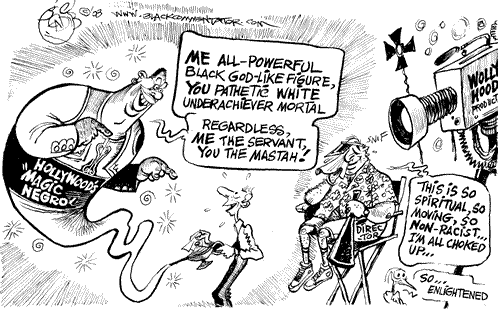
Magical Negros (not Barack Obama)

Regardless of Limbaugh's unintentional irony with his "Barack the Magic Negro"(his somewhat thick-headed defense being that "liberals did it first", failing or refusing to understand the actual intention, significance, and meaning of the term), the magical negro phenomenon is fantastically explained here. Basically, magical negro-ism is a tendency in certain narratives (movies, especially) to have a near-perfect black character, whose job it is to redeem the white main character. The problem with this, as the linked article points out, is that it deprives the black character of an inner life and their own narrative arc and agency.

This post is apropos of nothing, it was just mentioned in the context of this review of the movie Australia. Interestingly enough, Daktari has a similar post on sexism today. (Well, vaguely similar -- it's on sexism, but it's similar in that she's discussing the subtleties between sexiness, sexism, and pedophilic objectification.)

Anyway. The concept is well illustrated in the commentary's accompanying cartoon:


Laters.

Wednesday, November 05, 2008

Real Work for Obama: Winning, but not through War

This article by Clare Lockhart on Slate lays out what seems to me to be the most cogent, reasonable and concise outline of what needs/needed to be done in Afghanistan, ever. She emphasizes good governance, sovereignty, aid to the local government and using their structures over building parallel UN/US/coalition/donor governance institutions, and for the love of god giving the Afghanistan government the money it needs to function, with accountability strings attached, AND with a focus on local governments. As a quasi-political scientist (my thesis is on ecology & food policy, so I've spent the last several whatever doing poli sci analysis of "food institutions") her approach rings true, and is not what I've heard from Obama.

Troops will be needed to protect an effort such as Ms. Lockhart refers to. But Obama has talked about Afghanistan as the real central front on terror -- and his plan to me sounds not like winning hearts and minds, or much-more-freaking-importantly, giving Afghanistan the aid and reparations it needs and DESERVES, but to turning it into, essentially, Iraq.

I can't wait to see him take up the Lockhart agenda -- or a similar one. I hope he presents one soon (and apologies if he has presented something like this somewhere in his policy proposals, though it is significant to me that this is not what we heard him propose during debates, where wanted to look hawkish). It is people like Lockhart that give me hope (or at least, what she wrote there in Slate that I've read, which focuses on respecting aided countries as co-equals and partners in re-building, not freaking supplicants; there's always the possibility that she's horrible and I don't yet know it). Let's hope we see many, many people like her in the policy arena in years to come.

Tuesday, November 04, 2008

Kinsely comes dangerously close to something I agree with wholeheartedly

Michael Kinsley, founding editor of Slate writes a pretty good article about "Divided Government", and how a) people don't actually want it, and b) it's not actually that good an idea.

He points out the divided government comes from a small amount of ticket-splitters, while the overwhelming majority of people still vote relatively partisanly -- i.e., they vote for an undivided government. So unless you're speaking of a gestalt of people that disagrees with the people themselves, people don't want an undivided government, but rather, a small number of centrist or independent voters tip the balance in different directions in different branches of government, essentially creating divided government from to camps of the other 98% of people who DON'T want divided government.

It's an interesting, and I think, rather accurate viewpoint.

Kinsley goes on to praise parliamentary systems, where you vote for the party, not the person, and the head of government, the Prime Minister, is of the legislative body. We've praised the genius of checks and balances with our three branch government, but even ignoring the fact that most countries get by without them, Kinsley's point is that having undivided legislature-executive power means that each election allows a party to come into power and try out their ideas effectively, rather than being able to blame an obstructionist president or obstructionist Congress. Thus, when election time comes, it's actually a referendum on what they've done, rather than on what they promise to do, if they just get a majority this time or get the presidency back.

I'm rather a fan of that proposition, though I haven't spent much time thinking it over yet. In terms of a referendum on actual policies, I think that's important. As Kinsley says
Unfortunately, politicians in a system without accountability get elected by promising to ignore all these inevitable trade-offs. "Yes, we can" will come back to haunt Barack Obama, because often we can't. Inspiration is no match for mathematics. So the Democrats who now control the agenda face a moral dilemma: Should they do what is right or do what they promised?

Part of my repeated point about Obama and the Democrats more generally is that if leftists insist that being realistic means always voting for the Dems (assuming the likely case that the Republicans continue being, at the very least, identifiably less progressive), then there continues to be no way to have a referendum on Democratic politics. People are excited about Obama, it's true, and let's give him that he's awesome, we'll assume that. Now -- if the Democrats had nominated a piece of toast, would it then be ok to vote for a 3rd party? If they nominated, say, Joe Lieberman, a hawk and McCain supporter? The point is, we may be lucky to have Obama, he's positive, exciting, and more, but people saying that leftists *must* vote for him -- is that in some way different than every other race ever from this perspective of being "realistic"? It just rather seems to me that a strategy that doesn't involve changing tactics with changing circumstances just can't be an effective one.

I know, I'm raining on parades and not embracing the historicness of the moment. But I just can't get excited about a vote that from a mainstream leftist perspective was a fait acompli, was decided before even the Democratic primaries. The point of the excitement is that we did not get a piece of toast, or Lieberman, of course, but that almost worries me more -- because Obama is potentially great, but he will only be great if we make him. And if we lose sight of this because of how good he makes us feel, we will miss a greater historic chance than tonight itself. We must find a way to make voting a true referendum, whatever happens with Obama. Because even it he's fantastic in all ways, they won't all be winners, and I seriously don't want to feel coerced to vote for a piece of toast next time 'round, 2010, 2012, 2016, or on and on. Some time, someone's gotta explain to me what the long-term plan on the "realism" ticket is such that we don't get toast next time 'round.

And ignore the sturm and drang here if you would; I am a bit thesis-related crazy tired. I'm optimistic, but cynically so. Go "O", and let's see this through, this history in the making and change on the horizon.

Wednesday, October 22, 2008

Bob Woodward on Colin Powell in W: More credit than he deserves

I don't actually like pooping on supposed national heroes (or former national heroes on their way to redemption), but as a member of the reality-based community, it does twist my britches some to see the impressive, but ultimately (in my mind) quite tragically flawed and not-heroic-enough Powell lionized because he did the somewhat brave thing and endorsed Obama. (After, it is only somewhat cynical to note, Obama has taken a clear lead, and long after McCain made it obvious that his military outlook as he has enunciated it looks more like Bush's than Powell's during the latter's time as SecState, and a good bit after many more conservative conservatives had jumped ship over the exquisitely underqualified Palin.)

Bob Woodward, on Slate's so-far ho-hum "Diary on W" between himself, Oliver Stone, Ron Suskind, and Jacob Weisberg (who cares!), had this to say on Jeffrey Wright's excellent portrayal of Powell:
Jacob, you make note of the scene in W. where Bush and his advisers debate whether to go to war. In it, the Colin Powell character makes his case against the invasion. The problem is, as best I can tell, no such meeting ever took place. The president never called the National Security Council and the top advisers together to have a real knock-down, drag-out, come-to-Jesus meeting. It gives Powell more credit than he deserves. This is the broad meeting that Bush should have had to hash it out among his advisers. Powell's plea to the president in August 2002, which he recently affirmed, was that the administration needed to look at the consequences of war, but he never argued openly to the president that he should not invade Iraq.

(spoil-sporty, cynical, "Is nothing sacred?!?" emphasis added)