Friday, April 17, 2009

Republican Revolt: WTF?

I haven't been closely following the mainstream news recently, but while I know Olbermann & Maddow have been covering the Republican/conservative grassroots-ish Fox News supported TeaBagging rallies, I haven't found much in the way of satisfying analysis on-line. On the other hand, I haven't looked very hard -- but Slate hasn't covered it closely, let's say. The Daily Show, on the other hand:

Jon Stewart Slams Hannity, Bachmann, And Beck: Defeat Is 'Supposed to Taste Like a Sh*t Taco'

Stewart: Yes, tyranny. A.K.A. our democratically elected President. You know what guys....I think you might be confusing tyranny with losing. And I feel for you because ah...I've been there. A few times. In fact one of them was a bit of a nail biter. But see, when the guy that you disagree with gets elected, he's probably going to do things you disagree with. He could cut taxes on the wealthy. Remove government's oversight capability. Invade a country that you thought should not be invaded but that's not tyranny. That's democracy. See now you're in the minority. It's supposed to taste like a s#%t taco. And by the way, if I remember correctly when a disagreement was expressed about that President's actions when ya'll were in power I believe the response was "Why do you hate America?". "Watch what you say." "Love it or leave it." "Suck on my truck nuts." ..... For god's sake guys. You've been out of power for ten f*%#ng weeks. You've got a mid-term election in twenty months. Pace your rage! (h/t C&L)


Yesterday night, and previously, in the paragraph linked above, The Daily Show has been pointing out the wild WILD crazy hypocrisy of this Republican Uprising. Perhaps John Oliver only interviewed the craziest of the crazies on yesterday's show, but they argued that the Obama Administration was worse than England's rule over The Colonies (with Oliver hilariously defending England's imperial fiendishness, with its torture, tyranny and wiping out of the Native Americans), and called the prospective couple % increase in tax rates -- to still far LOWER than it was under, say, Reagan, much less Kennedy -- taxation without representation. Even though, as John Oliver pointed out, they do have representation. And Stewart, at some point, I don't remember what day, pointed out -- in democracy, yes indeed you have the right to voice and support positions and politicians representing these. But these CrazeFuck Wackaloons seem to have confused the right to representation for the right to always win. WHAT. THE. FUCK.

Stewart highlighted Fox News peeps' hypocrisy over all this, what with their ridiculing of lefty protesters in years gone by and warning leftiest that their language and anger and criticism was unpatriotic or even "dangerous" or incitations of violence, yet now Bill O'Reilly talked in front of a graphic saying "The protests are perfectly valid: arguing about government size is perfectly valid." Sure, yeah, great -- where was all this assurance of "validity" for lefty protesters? Where is the Hannity that criticized an activist for advocating "anarchy on the streets of Washington" as being a threat of violence, yet two days ago agreed with a righty activist that what we need is "a revolution" right now against this government?

What TYRANNY are they talking about? In the name of all that's right and good -- is it really the prospect of a tax increase? Is it really the money given to the self-same market capitalists that have had the Right's backing (and the Left in government as well, actually) for decades that is pissing them off? While I agree that this money to the banks et al. is shady at best and downright intellectually and morally bankrupt on the O administration's part at worst (see commentary at Talking Point Memo on how the assumptions behind giving insolvent banks money to get a recovery are a bit facile at best), this is not a new tyranny. And in what world is this worse than the Wars in Iraq and Afghanistan where, by any count, thousands of innocent civilians have died and we've spent billions of dollars and lost or had wounded thousands of our citizens? In what world is this worse than support for Israel despite its contravention of the nuclear weapons treaty (Israel is not an openly nuclear state, though it's widely agreed that they nonetheless have nuclear weapons and are therefore in violation of the relevant treaties) yet pressuring Iran to obey the same rules we don't require of our allies? (Of course, that makes perfect realpolitik sense, but realpolitik also often includes telling the truth about one's utilitarian motivations)? In what world... well, I could go on. But in sum: this is RE-FUCKING-GOD-DAMNED-DUNCULOUS. Argh.

Sorry. I just lose it every time I see the women interviewed on the Daily Show that, well, refused to be interviewed because Jon Stewart has a communist agenda. It's not so much that she hates Jon Stewart (or at least his agenda), it's WHAT THE FUCK DOES THIS HAVE TO DO WITH COMMUNISM? DO YOU EVEN KNOW WHAT THAT MEANS? AHHHHHHHHHH!

Cheeses fuck, but our country is home to some messed up political dynamics.

Sunday, March 29, 2009

Truth in advertising: Republicans are focused "on the harm health care reform might bring to private health insurers"

Pretty damn good article here by Slate's Timothy Noah, one of the few decent journos at Slate, in J's opinion. One might almost go so far as to call him a J-fave, but that would be stretching it perhaps. Or at least, giving credit on a sliding curve; he's not as left as I am, despite that seeming to be the logical conclusion from many of his articles (from my point of view, of course), but he's at least pretty consistently in the "Democratic wing of the Democratic party" to crib from Howard Dean.*

Anyway. Noah analyzes how the Republicans aren't even pretending to be for the average American anymore, instead fretting about private health insurers' profits. Noah:
Eschewing any pretense that their primary concern is for medical consumers and taxpayers, they focus on the harm health care reform might bring to private health insurers... The reasoning was (and remains) that holding the line on government spending is socialism. Letting the government pay in excess of the market price is capitalism. Surrendering to such Alice in Wonderland reasoning is insanity.


This follows a pretty good earlier column by Slater Christopher Beam -- who's somewhere below Noah but higher than average as far as Slaters in J's esteem -- about how Republicans are trying to use the language of "universal health care" to rebrand their same brand of "gee, if you have money, you can get access to it -- what's not universal about that?" Indeed, they refuse to define what universal even means to them, but Beam gives us a hint:
Under a [traditional] Republican plan, "universal access" means anyone can buy insurance if they want it, but they don't have to. The problem is, "access" is a slippery concept. George W. Bush famously said that "people have access to health care in America. After all, you just go to an emergency room." By that definition, "universal access" already exists.


It's worth noting that Noah also points out that Obama is not really seeming geared up to provide universal health care, in the article linked above, as well as in a month-old column here (first installment of Obama Soft-on-Health-care-watch here.

In news of something more completely different, Fire Mickey Kaus takes a brief jaunt from its primary, and quite laudable, goal (of firing Mickey Kaus), to ask WTF is up with Slate's XX Factor, a nominally female-perspective blog of various Slatesters. Suffice it to say, FMK is about as impressed with XX Factor as we here at Anekantavada are. (To be clear, that level of impressedness == not very. The best thing I can say about their average quality is that it allowed me to use the wonderful word "gormless" in context for the first time.

*To be clear, you don't have to be as Left as J to be a J-Fave, but left-liberal authors like Noah who are clearly smart enough to see the world as it is and who make trenchant criticisms of both parties yet still pretend that either party is an honest broker... I guess what I'm trying to say is, you have to be intellectually consistent, and Noah's points are so insightful and indicting of the current system sometimes, that I feel like it's a total cop-out for him to still back much of the mainstream system. Perhaps he's afraid to go farther within his own mind, for the sake of his job, or he really doesn't see what I perceive to be the gaping chasm between his analysis of US Politics and anything like even qualified support of the status quo, but, yeah... I feel like something's holding him back from truly revolutionary writing, as opposed to someone who really is completely consistent and logical within their own worldview. But that's just me, mayhaps.

Wednesday, March 25, 2009

Sound and fury, signifying nothing? Activism, Government, and Crowd-sourcing Schmrowd-sourcing

Interesting blog post from Jon Stahl here: "Chaotic, cacophonous, well meaning efforts that will inevitably add up to nothing" on crowd sourcing and the activism of the new generation, so to speak. Stahl and some people he quotes at length note the limitations of the "new" activism, Obama's millions-strong "constituency" and recommends some steps on real change -- including understanding that volunteerism, while laudable, will not alone make things better, and that philanthropy can't replace making the government work.

So interesting ideas. The post is a big old, but worth reading and ruminating on.

Monday, March 23, 2009

Clear-headed, sobering words on food

Fantastic interview with UK food policy researcher Tim Lang here from GRAIN's 2008 issue of Seedling. He says the world is "sleepwalking" its way through the food crisis, expresses his belief/analysis that the present crisis is not a "blip" as others were but rather presages long-term change for the worse (though in the short-term food prices may again lower for some brief period), lays out the 8 interconnected features under threat with today's "productionist" food system and politics, and expresses hopeful cynicism about the ability of humanity to change the system for the better before a dire and harsh shock to the system comes about in the form of even worse crises.
I used to think, until about five years ago, that an orderly transition was possible. I now wonder if we’ve missed the moment. I hope not. But events are now determining the room for manoeuvre. It’s more likely now that shock will change things. As a rationalist, I want that least. Shocks are messy with dire consequences. But certainly, it looks likely that we might be sleep-walking into a world in which blood flows, metaphorically and at times actually, due to mistakes over food policy. All of us need to raise our voices and our game to prevent those mistakes going unnoticed. Ultimately we have to side with food democracy over food control.


Read the rest of the insightful interview here; and if you're in the upstate New York area in a couple weeks, come see him give the Plenary talk at Visible Warnings: The World Food Crisis in Perspective, April 3 & 4 at Cornell University in Ithaca, NY.

Wednesday, March 18, 2009

Government's "Angry-come-lately" on AIG

A seemingly good article by Steven Pearlstein at the WaPo on various ways we could've avoided paying the AIG bonuses without causing a crisis in the rule of law, as has been implied or even said by Wall Street, various members of the O Administration, and the media. The thing that gets me about this whole deal is that it obviously wasn't an unanticipated problem -- they (AIG) knew about the bonuses beforehand, and had to have known how it would play, and various articles have pointed to commentary from within the government with various officials having said things to the effect of "we knew about it earlier, but we couldn't really do anything so we didn't." Pearlstein makes some very commonsense articles that it was within both the government and AIG's power to take some reasonable steps much earlier to have avoided this whole shennanigan. For one thing, since the US Gov helped stop AIG from going into bankruptcy, Pearlstein points out:
Call me a cockeyed optimist, but I suspect that when confronted with the prospect of a bankruptcy and a prolonged and public investigation, the sharpies in London and Connecticut might have been receptive to the idea of renegotiating those bonuses in favor of new contracts -- contracts that increased their base pay but tied their bonuses to success in reducing future taxpayer liabilities at AIG. Unfortunately, none of this seems to have occurred to Eddie "Good Hands" Liddy, the former Allstate executive who was supposedly brought in to dismantle AIG and sell it off in pieces for the benefit of the taxpayers and creditors. So far, all Eddie seems to have served up is a litany of complaints about what a bad hand he was dealt.


Read on the rest of "Wall Street's Dangerous Refusal to Learn" here.

Monday, March 16, 2009

Thomas Friedman's Dipshittery, Explained in 8 Panels

ZOMG.

Go here. A pithy summary of Thomas "My evidence is that it makes sense to me" Friedman. The cartoon is for this article which similarly disses Friedman, in a more effective-than not manner. I think Taibbi could've done better, and I don't know that that much snark is all that useful, but it's still damned funny, and damned accurate, in places.

Saturday, March 14, 2009

What part of self-evident doesn't Scalia understand, aka We hold this important shit to be obvious, you Wackaloon

Mad good post over at PhysioProf on "Constitutional Originalism, Natural Law, and The Ninth Amendment." Now, J is not a fan of Natural Law when it is taken literally, as is believed by some libertarians -- that some rights somehow derive from the very status and being of human beings and the universe, such as right to property. I firmly believe rights are human-made and thus human-determined; that doesn't mean I believe they're arbitrary per se. There are rights that we have come to recognize as fundamental for dignified human life, and I do believe these are fundamental, based on the sort common-sense humanism of them (the right against arbitrary/unreasonable search and seizure, freedom of religion, freedom of press, the right to food security/food sovereignty, unreasonable restrictions of movement, etc. etc., such as one might see in our Bill of Rights, the Universal Declaration of Human Rights, and the 1966 International Covenant on Economic, Social, and Cultural Rights, still not ratified by the US Congress, btw).

Anyway. Read on, read PhysioProf -- I don't think he even swears in this one.

Preview:
Conservative legal theorists spend a lot of time talking about how the text of the Constitution should be construed only as it was understood at the time of the Founding and Ratification. Building on this idea, they rail against “judicial activism” and the “creation of new rights” that are not “found in the text” of the Constitution. This provides a theoretical basis for conservative claims that there is no Constitutionally protected right to many things they despise: gay marriage, abortion, health care, housing, food, etc.

As I will describe below, this textual originalism is bad history and bad law. Furthermore, this theory only has any jurisprudential legs at all because of an unfortunate happenstance of 20th Century Supreme Court jurisprudence.

Tuesday, March 10, 2009

Republicans: Saving the economy ruins the economy (seriously?)

There's been a meme that's been getting bigger and bigger, much to my profound annoyance; that of the right/Republicans claiming that not only did FDR's New Deal not help end the Great Depression, but rather helped prolong it. The Heritage Foundation, some kooky hyper-libertarian on Colbert a couple months ago, Ron Paul on Bill Maher's Real Time with Bill Maher. (Not that Ron Paul isn't a kooky hyper-libertarian.)

David Sirota wrote at Salon two months ago about this, as part of a larger analysis of Obama's stimulus package.

Sirota:
[Obama rejected] conservatives' increasingly loud claims that the New Deal "prolonged the Great Depression" - claims that are demonstrably false. As Census data shows, the pre-WWII New Deal spending and regulatory agenda resulted both in robust GDP growth rates and the single biggest decline in the unemployment rate in American history. Unbelievably, conservative think tanks have resorted to quite literally lying about government data, claiming, as the Heritage Foundation has, that the "New Deal never drove unemployment below 20 percent." As you can see from the Census Bureau's verifiable data from 1936 and 1937, that claim is a patent lie - and it's great that Obama and his economic team seems to understand that.


Sirota also points out how raising taxes does not hurt productivity or GDP growth, according to, you know, research rather than rhetoric, and according to a Republican's analysis, GDP growth is larger from infrastructure building than from tax cuts. Of course, I myself could give a shit about GDP growth, for nine reasons from Sunday, but once again the work/blog balance calls out, and work, I must go to her.

But before I go, I got on to all of this by reading this article on The Root about the racism that barred the New Deal from helping Blacks anything remotely near as much as it helped Whites, the need for African-Americans today to vocally and forcefully act and support the stimulus, and its spending in the "blackest" states, like Louisiana and Mississippi, whose governors have threatened not to spend stimulus money sent to the state to provide aid to the unemployed and other programs to help the economically disadvantaged, despite the fact that "in two of the blackest states, both with governors threatening to reject the aid, Mississippi and Louisiana, the rate [of unemployment] is three times that of whites". So yeah, go read Michael Dawson's article, too.

So here are your talking points/marching orders/background information sources to go out there and fight the conservative unreality-based-community, because seriously, yo, this shit about the New Deal prolonging the Great Depression -- pending some SERIOUSLY stronger and more mainstream analyses -- is getting on my last mother-lovin' nerve.

Monday, March 09, 2009

Interesting and hopeful

An interesting and hopeful post by Hofstra political scientist David Michael Green here (h/t Counterpunch) on how the most significant achievements of a successful Obama presidency could potentially not be substantive policy change (though that would certainly be one element), but rather substantive changes in US's political culture to be intolerant of rampant military spending, empire, foreign adventurism, antipathy towards all things government and embracing of all things market, flippant standards for presidency like "who you might want to have a beer with" and admiring presidents who "decide from the guy", making big progress in healing the weeping wound that is US race relations, and more.

It seems wildly hopeful and vaguely unlikely to me, but I don't think Green is arguing it will all come true even if Obama's successful, but rather that one or more of these are possible, if not likely outcomes of a successful presidency. (I really only skimmed his article, but I think he's defining successful as essentially "popular" (well-liked) by the end of his term, re-elected, and effective enough to lead us in a direction of real recovery of jobs; he explicitly says that Obama's policies may end up being liberal or centrist, but that the real important long-term effects, the real hallmarks of the Obama age, could be changes in attitudes of the American electorate. I guess I posted this because I agree that these are possibilities, they would be incredibly important breakthroughs, and I see them as rather more likely than substantive progressive policy change from Obama, though if we get universal health care, I will definitely give it up for the big "O". Though if we get single-payer health care, I will give him mad props, big ups, and eat my hat. With some hot sauce perhaps. But I would eat it gladly.)

Saturday, March 07, 2009

Lobbyists, Obama, Gender politics, and Blue Penis

"Full of country goodness and green pea-ness."
--"Orson Welles", on Fox's The Critic

Great, if short post here on The American Prospect (h/t to Matthew Yglesias) on the -gasp- full blueal penis of Dr. Manhattan in the new movie, The Watchmen. (Which is getting consistent "mehs" it seems, somewhat disappointing to this comic book fan, but it was directed by the godforsaken director of 300, for god's sake.) In the post, Phoebe Connely does a brilliant job quickly summing up the double standards of today's gender politics, where female nudity is a matter of course, but some consistent Quantum Guy Junk warrants mentioning by every reviewer everywhere, apparently. It reminds of hearing of people complaining about Brokeback Mountain (which I still haven't seen, sadly) and "too much gay sex" when, from what I understand, there was more and more explicit straight sex. Apparently, it's always "too much" when it's not targeted towards your team, so to speak.

There's a lot to unpack there (heh... package), but I really don't feel like it, so discuss amongst yourselves: Dr. Manhattan's full frontal nudity was neither full nor frontal nor nudity: Discuss.

In other news, Matthew Yglesias makes a compelling argument that Obama's "no lobbyist on staff" policy does more harm than good, because
well-qualified individuals who registered as lobbyists while working for progressive non-profits find themselves shut out of jobs, and the administration finds itself understaffed.

The problem here has always been that the lobbyist/non-lobbyist distinction doesn’t track any meaningful goals. Goldman Sachs’ lawyer, for example, is not a lobbyist, and therefore not banned from office. A “lobbyist” is just someone who talks to members of congress about legislation. You can be a corrupt special interest and not be a lobbyist, and you can be a lobbyist who only works for good causes.

But dumb as the pledge was, it’s dumber still to stick with it. Flip-flopping will look bad, but nobody will care in 2012 about an old flip-flop. By contrast, lots of people will care by 2012 if we’re in the midst of a prolonged depression...


I'm loathe to agree that lobbyists aren't inherently bad, but that's because I think of lobbyists as inherently being for private interests. And I don't suppose he could just ban all lobbyists for private interests? Of course what's worse is that Obama made exceptions for this at first (and apparently every Democrat he has ever known has freaking tax problems) but, as far as I know, is holding to it now, despite the problems outlined by Yglesias. But I haven't been closely following the news recently; maybe I'm wrong? (Except: D'oh.)

-J

(postscript: even this seemingly insightful review equates Watchmen's director's missteps in screen translation with not properly dressing Big Blue; I don't know that a codpiece really represents the artistic problems of the film, but that may just be me -- and that I haven't seen the film)

Friday, February 27, 2009

Yikes! C'mon, Obama, I mean, seriously.

While I'm quickly tiring of the meme of the tone, "How could he?" in reference to various things the O-Administration has done with varying degrees of regressiveness, nefariousness, opacity, or incompetence -- simply because I think it was silly to expect him to be that different in the first place, and it is simultaneously too early to be decisively disappointed but not at all too early to push him with activism and indignation. "How could he?" is more shocked woah-is-me portrayals of personal betrayal, which I guess I share sometimes, but I really never thought O was more than, as J-Mom has said, "Perhaps the best you can get in terms of a mainstream politician" which means to me "Trust him as far as you can throw him... and then verify how far you've thrown him." A sense of personal betrayal, while noble in politics in that it means you felt a personal connection and promise form someone, also seems rather naive to me, and in any case, it's not the same as activism (though it can motivate action, so I shouldn't be so down on it.)

Anyway, point is, according to this story (which I must admit I somewhat trust but have not verified from other stories),
Alaska prosecutors do not dispute that advanced DNA testing could prove Osborne's innocence beyond any doubt. But for nearly a decade, they've refused to allow him to do this testing.
To my great disappointment, recent news reports indicate that the Obama Justice Department has decided not to reverse the Bush administration's decision to weigh in on Alaska's side in the case, District Attorney's Office for the Third Judicial District v. Osborne. As has been said many times, the Justice Department's mission is to do justice. It is not to seek a conviction—or to uphold one—at all costs.


Former FBI Director William Sessions continues in his Slate article, that
Alaska's primary argument is that testing is unnecessary because non-DNA evidence demonstrates Osborne's likely guilt... Alaska contends that evidence of innocence does not, by itself, matter once a person has been convicted, or if the trial was free of constitutional and other defects. That goes too far in elevating the principle of finality over basic justice.


Certainly this doesn't seem like the side O's Justice Dept. should be on. Am I wrong? Is Sessions wrong? Is this just a brain fart on the Administration's part? Is Darth Vader Osborne's father? Please, J-fans, let me know.

El primero presidente negro-indígeno de América del Norte?

Interesting piece forwarded by J-friend SY, here, about Mexico's first black president (you know, the one before their second black president, Juan Alvarez). After some digging (so you don't have to!), the main advocate of recognizing Vincente Guerrero the first black Mexican president (and Juan Alvarez the second) is Ted Vincent, apparently a former historian at UC Berkeley. He is apparently of sufficient scholarship and repute that his books have been published by both HarperCollins (a popular publisher) and University Press of Florida (the joint university press of the Florida university system, seemingly no slouch). I researched his "repute" because recognizing these two as black presidents seems to be something primarily championed by himself, and various independent outlets (like the Berkeley Daily Planet) that have reprinted his work. There's no indication that his analyses are incorrect, and indeed, his analysis has an explanation for why we've not heard this before in this manner:
[The Mexican] congress had made it near impossible to organize against racial injustice through their passage of Law No. 310 that, though ostensibly in the spirit of equality, prohibited mention of anyone’s race in any public document or in the records of the parish church. One consequence of this law has been that knowledge of the racial attitude of the elite toward Guerrero’s African roots are relegated to private letters and anonymous pamphlets against “the black,” and many a modern history identifies him merely as of “peasant”or “laboring-class” background.


I find all this interesting, because Vincent's piece is one of those that, like works from Chomsky and Zinn (for me, at least), seem to make history make much more sense, they put what I've already learned in a context that seems so much more internally consistent rather than a disjointed collection of facts, and are sufficiently challenging to the ideas of US centrality and supremacy that it makes sense that they're expunged from our history lessons as a matter of course, with no doubt reasonable-sounding protestations of their ancillary importance. While Mexico is certainly no racial haven, the greater degree of intermarriage/intermixing in their population over the years makes them having had a black president seem like a logical probability (according to Vincent, they've actually had 3 presidents with strong African heritage), and Guerrero's actions and abolition of slavery (and the popular support keeping this abolition in place even after Guerrero's execution and rescinding of many of his reforms) make the secession of Texas from Mexico make all the more sense. (Remember, Texas threatened war on the US if the US didn't make them part of the US. That's gumption. And by gumption, I mean... Texas, ho boy, Texas.)

So anyway, in the waning days of Black History Month, which I believe I usually do SOMETHING for on the J Continuum, read Vincent's article, and if the spirit moves you, also read about Paul Robeson, why don't you, cuz from what good J-friend KC and I can tell, he appears to have been one of the best people ever, and we don't hear SHIT about him. (You know, spoke 25 languages, third African American ever accepted at Rutgers, first accepted to Columbia Law School, I think, lettered in like 7 college sports*, black actor who broke the color line and was adored by many white fans before his radical politics came about, helped striking Detroit autoworkers get better pay AND helped black autoworkers get closer to pay parity, told the House Committee on Un-American Activities to go take a flying fuck at itself, not in so many words, etc. etc. I mean, 16,000 people or so tried to attend an event for his 46th birthday -- his 46th! Not even a milestone birthday. So go, seek, Google. And while you're at it, read about James Baldwin in last year's J-entry for Black History Month.

--J

*He actually lettered in 15 varsity sports, apparently. In case you were wondering, J really would like to name his future son Robeson, should he ever have a son. Though there's some wiggle room, this is a potential deal breaker should the future J-significant other disagree on this point.

Sunday, February 15, 2009

Viejito, pero bueno

A missive from Cuban ex-president Fidel Castro, from almost one year ago, hardly of the character we've been led to believe in:

(Disponible también aqui: http://www.granma.cubaweb.cu/2008/02/19/nacional/artic10.html)

Subject: Message from the Commander in Chief


Message from the Commander in Chief

Dear compatriots:

Last Friday, February 15, I promised you that in my next reflection I would deal with an issue of interest to many compatriots. Thus, this now is rather a message.

The moment has come to nominate and elect the State Council, its President, its Vice-Presidents and Secretary.

For many years I have occupied the honorable position of President. On February 15, 1976 the Socialist Constitution was approved with the free, direct and secret vote of over 95% of the people with the right to cast a vote. The first National Assembly was established on December 2nd that same year; this elected the State Council and its presidency. Before that, I had been a Prime Minister for almost 18 years. I always had the necessary prerogatives to carry forward the revolutionary work with the support of the overwhelming majority of the people.

There were those overseas who, aware of my critical health condition, thought that my provisional resignation, on July 31, 2006, to the position of President of the State Council, which I left to First Vice-President Raul Castro Ruz, was final. But Raul, who is also minister of the Armed Forces on account of his own personal merits, and the other comrades of the Party and State leadership were unwilling to consider me out of public life despite my unstable health condition.

It was an uncomfortable situation for me vis-à-vis an adversary which had done everything possible to get rid of me, and I felt reluctant to comply.

Later, in my necessary retreat, I was able to recover the full command of my mind as well as the possibility for much reading and meditation. I had enough physical strength to write for many hours, which I shared with the corresponding rehabilitation and recovery programs. Basic common sense indicated that such activity was within my reach. On the other hand, when referring to my health I was extremely careful to avoid raising expectations since I felt that an adverse ending would bring traumatic news to our people in the midst of the battle. Thus, my first duty was to prepare our people both politically and psychologically for my absence after so many years of struggle. I kept saying that my recovery “was not without risks.”

My wishes have always been to discharge my duties to my last breath. That’s all I can offer.

To my dearest compatriots, who have recently honored me so much by electing me a member of the Parliament where so many agreements should be adopted of utmost importance to the destiny of our Revolution, I am saying that I will neither aspire to nor accept, I repeat, I will neither aspire to nor accept the positions of President of the State Council and Commander in Chief.

In short letters addressed to Randy Alonso, Director of the Round Table National TV Program, --letters which at my request were made public-- I discreetly introduced elements of this message I am writing today, when not even the addressee of such letters was aware of my intention. I trusted Randy, whom I knew very well from his days as a student of Journalism. In those days I met almost on a weekly basis with the main representatives of the University students from the provinces at the library of the large house in Kohly where they lived. Today, the entire country is an immense University.

Following are some paragraphs chosen from the letter addressed to Randy on December 17, 2007:

“I strongly believe that the answers to the current problems facing Cuban society, which has, as an average, a twelfth grade of education, almost a million university graduates, and a real possibility for all its citizens to become educated without their being in any way discriminated against, require more variables for each concrete problem than those contained in a chess game. We cannot ignore one single detail; this is not an easy path to take, if the intelligence of a human being in a revolutionary society is to prevail over instinct.

“My elemental duty is not to cling to positions, much less to stand in the way of younger persons, but rather to contribute my own experience and ideas whose modest value comes from the exceptional era that I had the privilege of living in.

“Like Niemeyer, I believe that one has to be consistent right up to the end.”
Letter from January 8, 2008:

“…I am a firm supporter of the united vote (a principle that preserves the unknown merits), which allowed us to avoid the tendency to copy what came to us from countries of the former socialist bloc, including the portrait of the one candidate, as singular as his solidarity towards Cuba. I deeply respect that first attempt at building socialism, thanks to which we were able to continue along the path we had chosen.”

And I reiterated in that letter that “…I never forget that ‘all of the world’s glory fits in a kernel of corn.”

Therefore, it would be a betrayal to my conscience to accept a responsibility requiring more mobility and dedication than I am physically able to offer. This I say devoid of all drama.

Fortunately, our Revolution can still count on cadres from the old guard and others who were very young in the early stages of the process. Some were very young, almost children, when they joined the fight on the mountains and later they have given glory to the country with their heroic performance and their internationalist missions. They have the authority and the experience to guarantee the replacement. There is also the intermediate generation which learned together with us the basics of the complex and almost unattainable art of organizing and leading a revolution.

The path will always be difficult and require from everyone’s intelligent effort. I distrust the seemingly easy path of apologetics or its antithesis the self-flagellation. We should always be prepared for the worst variable. The principle of being as prudent in success as steady in adversity cannot be forgotten. The adversary to be defeated is extremely strong; however, we have been able to keep it at bay for half a century.

This is not my farewell to you. My only wish is to fight as a soldier in the battle of ideas. I shall continue to write under the heading of ‘Reflections by comrade Fidel.’ It will be just another weapon you can count on. Perhaps my voice will be heard. I shall be careful.

Thanks.


Fidel Castro Ruz
February 18, 2008
5:30 p.m.

Friday, February 06, 2009

Obama DNI pick: Try not to leak on our torturers...

Nice article here by Ray McGovern on Consortium News, an indie news website founded journalist Robert Parry, "one of the reporters who helped expose the Iran-Contra scandal for the Associated Press in the mid-1980s."

McGovern speaks of how Obama nominees for CIA Director (Leon Panetta) and Director of National Intelligence (DNI; Dennis Blair) bend over backwards to accomadate Republican Senators, even to the point of eliding the truth and allowing several prevailing lies to continue ("everyone in the world thought there were WMDs in Iraq", for one), which was disproven by a report in the Senate itself, and now they seem more eager to prosecute potential leakers than torturers:
It is a measure of Washington that there is a bipartisan consensus on the need to prosecute leakers to set an example for others, but not to prosecute torturers.


[sigh] Oi vei.

Tuesday, February 03, 2009

Colbert's pithy defense of Affirmative Action (kinda)

Watching Colbert Report tonight, he was just discussing the recently-passed Lilly Ledbetter act. This act essentially provides for a return to the status quo in Equal Opportunity Employment and discrimination cases, where when an employee feels they may have been discriminated against, the statue of limitations on an anti-discrimination case starts from the moment of the last discriminatory act -- which in the case of pay inequality, would now be the last received paycheck. This is opposed to (and overturns) the Roberts' Supreme Court judgment finding that the statue of limitations begins at the *first* act of discrimination, i.e. the "first" discriminatory paycheck. (Oddly, supporters of the court's decision argued that this would reduce frivolous lawsuits -- whereas it seems this would have provided perverse incentive to sue ASAP in any POSSIBLE chance of discrimination, the all-feared frivolous lawsuits that Republicans are always tilting against.)

In any case, Colbert pointed out that because provides a corrective to potential discrimination against women, women therefore stood to gain more from it than men -- and it is therefore sexist! This is, of course, exactly the same theory apparently behind anti-Affirmative Action calls of discrimination/reverse discrimination, which I tend to think of as self-serving bunk or crazy-eyed delusion.

I'm illin' (in the literal sense) and gotta get to bed, so this is a link-free post, and I'm'a headin' off now. But remind me to tell y'all the anecdote from my Private Sector days about "discrimination" for those who have been discriminated against.

Sunday, February 01, 2009

Touchdown!!!!!

Big gay touchdown that is. And by touchdown, I mean Prime Minister. And by big, I mean Icelandic. And by gay, I mean gay.

Jóhanna Sigurðardóttir has, apparently, become the world's first openly gay head of government.*

Yay! It's a year -- um, or at least, a year-long period going back to last November -- of firsts.


*For pure confusionary fun, try to distinguish head of government and head of state. I keep reading the wiki entries, and the distinction keeps falling out of my head.

Thursday, January 29, 2009

Good reads

For those interested in racial politics in the US, I highly recommend spending some time browsing Slate spin-off "The Root". I read a bunch of good articles in short order, even though I disagreed with most of them in part. (Which is natural, I'm just being pedantically clear.) But their analyses are, from my point of view, succinct, eloquent, relatively comprehensive in terms of at least touching on the major elements of the story in question, and insightful in a way that makes what may be opaque about African American perspective clear.

So. Read them. Now. Especially D. (Just cuz she's expressed interest in this area and these seem like better than average further primers.)

Addressing and Undressing the Race Problem, Charlayne Hunter-Gaul

A Nash'nul Conversashun 'Bout Race? O-Tay, Jack "Ironically Named" White

The GOP's Next (Black) Idea?, Casey Lartigue

Grand White Party, Dayo Olopade (and the subtitle here bears repeating, perhaps: "Can the Republicans get down with the brown?"

I read these in reverse order that you see here, which I only mention because they seemed especially lucid in that order, but that might be just me.

I recommend browsing around the rest of the Root: I don't like all of their articles, but their average is pretty high quality -- slightly higher than Slate probably. Indeed, "The Root" probably looks something like the print version of what I think NPR's News & Notes should be like (instead of being like a NPR's "All Things Considered" -- or worse yet, like a CNN news/talk show -- with black people. The range of views on N&N is approximately the same as on ATC, and the analyses seem to me to be often be as facile; what's the use of having African American voices if they sound (in types and range of questions) pretty much like Noah Adams and Linda Werthheimer and Tom Ashbrook talking?) I wrote in comments that "mainstream" Slate should have The Root writers and XX Factor Fraysters write the actual articles -- both seem to have better analyses than many of Slate's (and certainly NPR) regulars. (I'm looking at you, David Plotz on the Gabfest.)

Tuesday, January 27, 2009

Walk like a New Dealer

(offensive version of this title: Walk like FDR)

Another, wait for it... Slate article, this time about Obama's Economic Stimulus Package. According to the figures from the Congressional Budget Office (as I've seen reported at least), only half of the hundreds of billions to be spent will be spent in the next two years; in the article Tim Noah (J-fave) points out that only one tenth of it will be spent during the current fiscal year (of which over half is still left). And supposedly, about one eighth will go to corporate goodies that do nothing for the economy (much less the Johanna the Average Person). (From Noah: "$212 billion [of the $816 billion plan] will be given out as tax cuts (of which close to half are corporate goodies of dubious value to economic recovery).)

Noah compares this to FDR's administration, and notes that he created in months the number of jobs Obama proposes to create in years, by directly contracting people in Public Works rather than through 3rd party (private) contracts -- that is, he didn't outsource, as Obama plans to. I'm sure there are good arguments for outsourcing* -- or at least politically rational ones -- but Noah's conclusion seems to be that effectiveness is not one of these arguments (with which I'd tend to agree). Noah observes that the program listed as an example of why the government must go slowly and carefully here is a program loaning money to auto companies for energy efficient vehicles, of which no money has been spent; Noah hypothesizes this is an example of why this is not the time to privately subcontract the work of creating jobs.

Considering the Republican/Conservative/Libertarian orthodoxy that FDR a) only incidentally helped end the recession, b) FDR didn't really affect the Depression, or c) FDR prolonged the Depression through his programs that didn't work such as Public Works representing counterproductive government intervention, I can't imagine, even in these more pro-government-intervention times that it would be terribly politically feasible for Obama to directly contract a bunch of Americans for Public Works projects as Employees of the United States Government. I don't even really blame him, politically. But it rather seems like "business as usual" in that, if one agrees with the Slate analysis or the proposition that FDR helped end the Depression, it presents "business as usual" and "non-change that we cannot believe in" to settle for an approach that will be inefficient and ineffective because an effective solution is a politically treacherous one.
---------------

* Of no import whatsoever, I note here that from my understanding, "terceirização" is the Brazilian Portuguese term for outsourcing/subcontracting. (Lit. "thirdization")

If I had world enough and time...

...my impulse to back-blog and catch up on any number of useful blog topics would be divine.

Also, I don't and so it's not.

So rather than weighing in on the weighty hot topics of the moment, let me weigh in on one weighty oft-hot topic that slips in and out of primary focus in the American mind: health care.

In brief, a good article at Slate argues that, gee, this is another case where market competition can drive extremely bad results without careful, careful planning. The point the authors make in this article is that, without restraint and (government) involvement, the health care industry would naturally and has become a competition not for best health outcomes, but for most lucrative patients -- those illnesses with the highest profit margin. So, apparently, cancer is a winner, even though diabetes may kill you just as dead, it's a B-list malady. And commonplace emergency room problems? Hypertension? General medicine? Please -- Kathy Griffin don't have nothing on them.

"The market" as the Fourth member of the Holy Christian Trinity (Father, Son, Holy Ghost, and Invisible Hand) seems to be fading fast... hopefully, it will be weak enough soon that, as an ideology, we can drive a stake through its heart.

As my graduate advisor said a class he teaches each year, (to paraphrase) "Markets exist and are good at certain things. It is pure faith, an ideology, to say that it is good at all things and always yields the correct answers -- treating it as an omniscient and omnipotent force is no different than religion, and is not a scientific approach."

Wednesday, December 31, 2008

Raj Patel's Apology

Raj Patel "apologizes" to Obama for a number of presumptuous assumptions about what "change" meant.

A brilliant ironic letter, much in keeping with how I feel about it all.

Happy New Year to All!!!!!

Friday, December 19, 2008

Your... Bible is a. Lie...

The title of this post is brought to you in ShatnerVision (tm).

There are many things to be said about Obama's choice of Rick Warren to provoke, er, invoke, er, deliver the invocation at his inauguration. Sarah Posner says some of them in the Nation:
There was no doubt that Obama, like every president before him, would pick a Christian minister to perform this sacred duty. But Obama had thousands of clergy to choose from, and the choice of Warren is not only a slap in the face to progressive ministers toiling on the front lines of advocacy and service but a bow to the continuing influence of the religious right in American politics. Warren vocally opposes gay marriage, does not believe in evolution, has compared abortion to the Holocaust and backed the assassination of Iranian President Mahmoud Ahmadinejad.


And. The hits. Just keep on! Coming!

J-Mom (aka J-Mom, PhD aka Dr. J-Mom aka Prof. J-Mom) had this excellent hypothesis: since Obama is enjoined from saying too much about the Blagojevich scandal (hey-oh! did I spell that right on my first try?) and people keep trying to hang it around O's neck somehow, despite much proof of anything substantive to hang, he used his political savvy and determined that starting a tempest in a teapot was a wise way to go. Something to distract people from a circumstance beyond his control about which he can do little, by giving them something else to get outraged at. Now, to be sure, I am among the camp that thinks his choice of Warren is substantively bad and an affront to gays and those who support equal rights for humans of all flavors regardless of what other consenting adult they wish to marry, but strategically, it is a tempest in a teapot. That is, it sends a signal that is worrying, but if it really were a "wag the dog" type move, it would be in the knowledge that while this may cause discomfort, he can win back those he loses on the Left through actual substantive action later on. Which is absolutely true -- this is affronting, but if he follows with actively promoting gay rights when his administration actually starts, well, all wouldn't be forgiven, but enough would be that this would be a wise wager on his part.

I don't know that J-Mom, Phd is correct, but I don't know that she's wrong, either. It's a fascinating hypothesis, and one practically unresolvable barring a personal admission from P-E B. H. O.

Monday, December 08, 2008

Doctor J, I presume...

Hoo-RAY! Just finished my PhD -- well, mostly. The oral defense and most of the writing. Still re-drafts to go (#!@#$!!) but that's a pittance compared to the hallucinatorily difficult process of getting here. Still don't believe it's true.

Anyway, in other "Just can't believes..." Could Obama please nominate SOMEONE progressive to his Cabinet? I know I didn't really expect him to be very actually change-ful, c'mon, now. I wonder how my friends that were very pro-Obama feel about all this -- though I suspect they (fairly) are still taking a bit of a "wait and see" approach, since who you appoint doesn't completely determine what you do. Nevertheless, though, who you appoint does have a big significance, or can, because it doesn't seem that the Prez typically gets too involved deep down in the details of Cabinets. That has mixed effects, being that a lot of day-to-day Cabinet work is not of a big great huge political nature, and that Cabinets have lost much of their power (though it depends on who the Sec is and what the prez's approach to Cabinets is), but on the other hand, the technocrats within the Cabinet influence what happens in the future through the groundworks they lay in terms of philosophy and research and therefore solutions and ideas available at later dates.

I think. I may be making all that up.

Anyway, GREAT article here on how O has seemingly snubbed Joe Stiglitz, probably one of the best mainstream economists there is from my point of view. (He's no heterodox, not really, but close enough for government work, as it were.) Stiglitz, author of "Globalization and its Discontents", was one of the few Clintonites to not only NOT jump on the globalization-free-trade IMF-bull-shitting on the developing countries horse hockey, but he actually OPPOSED it. (And his Nobel-Prize winning research contradicts its theoretical foundations. According to the article, no less a free marketeer than Milton Friedman admitted Stiglitz was right on Russia's conversion to capitalism -- that sound institutions and regulatory regimes should be the first priority -- and Friedman himself was wrong in having suggested primarily "Privatize, privatize, privatize.)

Anyway. Stiglitz is yet another example of a perfectly acceptable, incredibly qualified mainstream-type progressive-ish choice Obama could make, but he's reportedly out in the cold. This is boding poorly, my friends, very poorly indeed.

Tuesday, November 25, 2008

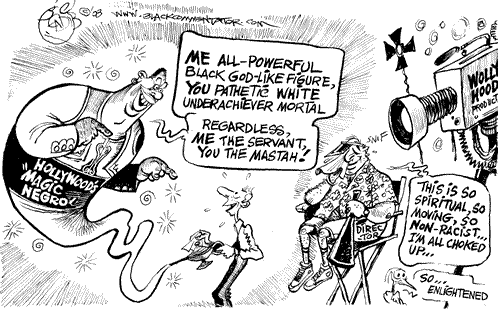
Magical Negros (not Barack Obama)

Regardless of Limbaugh's unintentional irony with his "Barack the Magic Negro"(his somewhat thick-headed defense being that "liberals did it first", failing or refusing to understand the actual intention, significance, and meaning of the term), the magical negro phenomenon is fantastically explained here. Basically, magical negro-ism is a tendency in certain narratives (movies, especially) to have a near-perfect black character, whose job it is to redeem the white main character. The problem with this, as the linked article points out, is that it deprives the black character of an inner life and their own narrative arc and agency.

This post is apropos of nothing, it was just mentioned in the context of this review of the movie Australia. Interestingly enough, Daktari has a similar post on sexism today. (Well, vaguely similar -- it's on sexism, but it's similar in that she's discussing the subtleties between sexiness, sexism, and pedophilic objectification.)

Anyway. The concept is well illustrated in the commentary's accompanying cartoon:


Laters.

Monday, November 24, 2008

Worthy of Note

Posting this here, without much more comment -- too much to do right now, I'm afraid.

From July 28, 2008 Democracy Now!:

Remarks by journalist Ryan Lizza

RYAN LIZZA: Look, you have to remember, Obama was from Hyde Park. It’s one the most liberal State Senate districts in Illinois. He could have been as left-wing, as liberal as he wanted. But he wasn’t. He was always—and, you know, there are various reasons he wasn’t. I think genuinely he’s—he was a little to the right of some of his constituents. But I also believe that he had his eye on higher office, and he was careful not to be pigeonholed as too far out on the left.

And his speech at the antiwar rally is a good example of that. And just like redistricting, I think you can argue that if he hadn’t opposed the war in Iraq, he would not have been a plausible presidential candidate, because that was the key distinction, of course, with Hillary Clinton. But the speech was not a—what you might call a typical antiwar speech. He started off by talking about wars that he supported: the Civil War—he talked in almost glorious terms about the Civil War and World War II. Now, nobody opposes the Civil War and World War II, so they’re not exactly the riskiest things to support. But he was in front of a pretty, you know, partially pacifist crowd, and it is an antiwar rally, and he was very careful to point out that—where he disagreed with folks in that crowd. In other words, he was trying to push off the left a little bit. He was trying not to be defined as strictly an antiwar candidate.

At the same time, he made a—if you read it today, it still stands up very well. He made a very powerful case against the Iraq war at a time when a lot of Democrats weren’t doing that. But there were certainly some politics in mind. And if you talk to some of the people who were in that audience that day, one of the common things you hear is, “Wow, this guy is not just talking to us, he’s talking to either some statewide or national crowd. This speech seems pointed for the—seems more like for the history books than just for us here at this antiwar rally.” And this comes up throughout Obama’s political history. He often had his eye on the next rung of the ladder, if you know what I mean.


Also, balanced, interesting, and challenging comments from Cornel West on DN! here.

AMY GOODMAN: Who else would you like to see in President Obama’s cabinet?

CORNEL WEST: In terms of various other positions?

AMY GOODMAN: Sure.

CORNEL WEST: God, that’s a good question. I mean, I haven’t really thought about it. I just want to see some progressives. I just want to see some folk who are willing to take a stand for working people, take a stand for poor people, willing to talk about poverty. I mentioned some of economists themselves—

AMY GOODMAN: Right.

CORNEL WEST: —the Kuttners and the others, but I don’t have a—

AMY GOODMAN: How about your colleague at Princeton University, Paul Krugman?

CORNEL WEST: Oh, Paul Krugman. Oh, my god. Yes, indeed, indeed. Paul is probably even a little bit too progressive and prophetic. He probably needs to stay outside, like myself, and be Socratic and prophetic and just tell the truth to the people in power. But he’s my very dear brother and comrade, and of course I salute his Nobel Prize. It’s rare that you see a progressive economist receiving a Nobel Prize in that way.

AMY GOODMAN: Well, why is it that the names you’ve just named of progressives are not being bandied about in any way as possible people in his cabinet?

CORNEL WEST: That’s a good question.

AMY GOODMAN: And the names that you named, like Larry Summers, Robert Rubin, these are the closest advisers to Barack Obama.

CORNEL WEST: You know, I fear that Brother Barack might be challenged by what Bill Clinton was. When you have been an outsider to the establishment, you want to make the establishment feel secure, and therefore, you want to recycle names that the establishment feels are legitimate names. And therefore, you’re reluctant to step out too far, because you’ll be unable to proceed and unable to govern with a smoothness that you think ought to be characteristic of your regime. And so, he ends up selecting people who the mainstream are going to herald as legitimate, rather than make that break and acknowledge this is a new day, and it ought to be the age of everyday people, the age of ordinary people. That’s what I think. And it’s ironic, because there’s a sense in which Brother Barack Obama might be reluctant to step into the new age of Obama and remains looking backward to the end of the Clinton moment. And I say, no, we need to break free. Now, it could be like FDR: he’s just reluctant, and we’ll have to push him. And that’s fine.

AMY GOODMAN: And how will that pushing take place, do you think, with such tremendous passion—

CORNEL WEST: We’ve got to organize—yes.

AMY GOODMAN: —supporters—passionate supporters of Barack Obama, who pushed him from the outside?

CORNEL WEST: That’s right.

AMY GOODMAN: Now that he is the state, how do people organize?

CORNEL WEST: Well, we use, in many ways, his own words. He says that he wants the bottoms up. That’s fine. We organize, we mobilize. We don’t look simply for a top down. The Clintonites have often been top down. It’s the bottom up. We organize, we mobilize. We consolidate our organizations. And in the end, of course, we may have to take to the streets. That’s how people’s power is expressed, but it’s expressed in a critical and, for me, in a loving way.

I do still support Brother Barack Obama gaining access to the White House, because he was the best that America could do at this particular moment in the midst of imperial occupation in Iraq, war in Afghanistan, financial Katrina, legacy of Katrina in New Orleans, wealth inequality, dilapidated housing in chocolate cities, disgraceful school systems, unacceptable levels of unemployment and underemployment, not enough access to healthcare for fellow citizens across race and region, not enough access to childcare. At this moment, the best America could do was Brother Barack Obama, liberal, centrist.

Will he govern like a progressive Lincoln? Will he triangulate like Clinton? Will he be an experimentalist like FDR? Those are the challenges. I hope he’s a progressive Lincoln. I plan to be—aspire to be the Frederick Douglasses against, to put pressure on him.

Sunday, November 09, 2008

Been brown so long, thought it was green: A true(r) green proposal

From an email forward. Interestingly similar to my answer when one friend asked me what I would do, environmentally speaking, if I had a magic wand. I said: widespread and affordable national and local mass transportation. Seriously. That would be pretty fucking nice. Especially because planes are genuinely god-awful environmentally, but it's hard to be a (well-traveled) citizen of the US, much less the world without them (and cars, which you know, are bad, but still not as bad as freaking PLANES, which originally surprised me).

Subject: 2 Year Proposal to Create 2 Million Green Jobs & Reduce Carbon


Here is some food for thought for those of you wanting to create a national Green platform to forward to President-Elect Obama:


On Sept 9th, 2008 a new report on Carbon Reduction & Green Jobs/Economy was released which has some positive proposals that are distinctly different when compared to most green think tanks and green organizations

See page 27 for the $ figures for each state & number of jobs created

1. It calls for the elimination of tax breaks & subsidies for gas & oil companies (it should also include coal & nuclear as well)

2. It puts retrofitting buildings at the top of the solutions list-which is the fastest way to reduce CO2 (along with phase out of all coal plants) cheapest, fastest job creator, most easily implementable solution-the lowest hanging of the low hanging fruit

3. It puts public transit & freight rail among the 6 top solutions-including reducing public transit fares by massive federal support

4. Fuel efficient motor vehicles are NOT on the list-

The green think tanks & national green organizations' absolute OBSESSION with fuel efficient motor vehicles: plug-ins, hybrids, biofuel, hydrogen, etc. is a major diversion and roadblock to solutions which are much more important, create many more jobs and reduce carbon much faster.

This point on cars will provoke a response from many, but before you respond take 5 minutes to research how much CO2 is generated by the creation of cement-it is one of the most CO2 intensive industrial/chemical processes on earth.

What we need to do is massively expand the public transit infrastructure-double it in 5 years & reduce the absolute number of cars ASAP and begin to tear up some roadways once a public transit infrastructure is in place

For those of you in places like Chicago, where flooding will be more frequent & severe (like occurred in August), at least 10% of concrete & asphalt will have to be eliminated in the next 10 years to recreate some of Chicago's original natural wetland/swamp to absorb the water from huge deluges which are part of climate change that has already begun for the upper midwest

This report is far from perfect-it still calls for cap & trade & lists biofuels as one of the 6 priorities without explaining much about them

& the end of the report are John Podesta's (former Clinton chief of staff) views including a pitch for "clean coal" one of greatest oxymoron's every created

However, there is no perfect world (yet) so we must take the positive and build on that

Here is the link & preface to the report with the report to follow:

http://www.americanprogress.org/issues/2008/09/green_recovery.html

"The Center for American Progress releases a new report by Dr. Robert Pollin and University of Massachusetts Political Economy Research Institute economists. This report demonstrates how a new Green Recovery program that spends $100 billion over two years would create 2 million new jobs, with a significant proportion in the struggling construction and manufacturing sectors. It is clear from this research that a strategy to invest in the greening of our economy will create more jobs, and better jobs, compared to continuing to pursue a path of inaction marked by rising dependence on energy imports alongside billowing pollution.

The $100 billion fiscal expansion that we examined in this study provides the infrastructure to jumpstart a comprehensive clean energy transformation for our nation, such as the strategy described in CAP’s 2007 report, “Capturing the Energy Opportunity: Creating a Low-Carbon Economy.” This paper shows the impact of a swift initial investment in climate solutions that would direct funding toward six energy efficiency and renewable energy strategies:

* Retrofitting buildings to increase energy efficiency
* Expanding mass transit and freight rail
* Constructing “smart” electrical grid transmission systems
* Wind power
* Solar power
* Advanced biofuels

This green recovery and infrastructure investment program would:

* Create 2 million new jobs nationwide over two years
* Create nearly four times more jobs than spending the same amount of money within the oil industry and 300,000 more jobs than a similar amount of spending directed toward household consumption.
* Create roughly triple the number of good jobs—paying at least $16 dollars an hour—as spending the same amount of money within the oil industry.
* Reduce the unemployment rate to 4.4 percent from 5.7 percent (calculated within the framework of U.S. labor market conditions in July 2008).
* Bolster employment especially in construction and manufacturing. Construction employment has fallen from 8 million to 7.2 million over the past two years due to the housing bubble collapse. The Green Recovery program can, at the least, bring back these lost 800,000 construction jobs.
* Provide opportunities to rebuild career ladders through training and workforce development that if properly implemented can provide pathways out of poverty to those who need jobs most. (Because green investment not only creates more good jobs with higher wages, but more jobs overall, distributed broadly across the economy, this program can bring more people into good jobs over time.)
* Help lower oil prices. Moderating domestic energy demand will have greater price effects than modest new domestic supply increases.
* Begin the reconstruction of local communities and public infrastructure all across America, setting us on a course for a long-term transition to a low-carbon economy that increases our energy independence and helps fight global warming. Currently, about 22 percent of total household expenditures go to imports. With a green infrastructure investment program, only about 9 percent of purchases flow to imports since so much of the investment is rooted in communities and the built environment, keeping more of the resources within the domestic economy.

Our report looked at investments that were funded through an increase in near-term government spending, which could ultimately be repaid by future carbon cap-and-trade revenues. These sources of new investment included the following funding mechanisms:

* $50 billion for tax credits. This would assist private businesses and homeowners to finance both commercial and residential building retrofits, as well as investments in renewable energy systems.
* $46 billion in direct government spending. This would support public building retrofits, the expansion of mass transit, freight rail, smart electrical grid systems, and new investments in renewable energy
* $4 billion for federal loan guarantees. This would underwrite private credit that would be extended to finance building retrofits and investments in renewable energy."

Friday, November 07, 2008

An interesting piece

From the NYT: An Eternal Revolution. I don't 100% agree with it, but it makes many thoughtful points.

And yes, I am feeling more excited about the whole thing.

Various points:

Seeing Bush walk out of the White House to congratulate President-Elect Obama (yes, I too like the sound of that!) -- it made me realize that these next several months mark the end of seeing, not just that man, but any white man walking out of the White House to take his place at the podium and address people as the Prez. For four years -- likely eight years -- every day will be an historic occasion, as Barack Obama arises and conducts the affairs of state. That will be nice -- it's Democrat+. By which I mean, I usually consider having Dems in power nice in that I can hear things I believe in, even if they promptly go on to do many things I do not believe in. But at least they don't insult my intelligence, they give me soothing lies, which is something. But this will be a plus -- soothing soundbites that don't reflect reality, I'm sure, but the additional plus of seeing someone whose public image, at least, people can respect and children admire and look up to, especially young black children, who now have a powerful counter to all the silly portrayals of blacks on TV. That is powerful. Yes, I know, I'm late to the game -- blame it on my thesis (Daktari did =p

I guess my resentment is the feeling among some that "this changes everything", which I can't abide by, cuz it kinda doesn't. The end of slavery didn't "change everything", nor did 9/11 -- but they opened up the possibilities, they changed the long term trajectory of change, and that's worth crowing about. I mean, also in the NYT, Judith Warner wrote a touching but absolutely silly article in some places, in that she says
his moment of triumph marks the end of such a long period of pain, of indignity and injustice for African-Americans. And for so many others of us, of the trampling and debasing of our most basic ideals, beliefs that we cherished every bit as deeply and passionately as those of the “values voters” around whose sensibilities we’ve had to tiptoe for the past 28 years

Umm... it can't possibly be the end of pain, indignity, and injustice if there still exists disproportionate pain, indignities, and injustice for black people. Last I checked, we did not all achieve equality of capabilities, and this brilliant, if cynical/snarky peace did not come true:
What does this promise land look like? This Obamerica? Shortly after Obama is sworn in, the police, instead of subjecting blacks and Hispanics to capricious traffic stops, will only stop them to offer free tickets to the policeman's ball. Throughout the country, they will address blacks and Hispanics as sir and ma'm. The overcrowding prison problem will end, because all of the blacks and Hispanics who've been sent there as a result of prosecutorial and police misconduct - probably half - will be set free. And all of those police who have murdered unarmed blacks only to be acquitted by all-white juries will be retried. Blacks will have the freedom to shop in department stores without being watched.

In the media, all of the black Hispanic and Native American and Asian American journalists, who, according to the Maynard Institute's media watcher, Richard Prince, are being "shown the door," will be rehired. The progressive media will spend as much time on the torture of black suspects in Chicago, New York and Los Angeles as they do torture at Gitmo. Blacks will be liberated from the crime, entertainment and sports pages exclusively and appear in other sections. More cerebral sections as scientists, engineers, astronomers. Jonathan Klein and other cable producers will stop managing black opinion so that it doesn't alienate its white audience and voices other than those of black correspondents from Rev. Moon's church will be awarded air time. Global warming denier Michelle Bernard will be replaced by Jill Nelson.

Jesse Jackson will be appointed lead editorial writer for The Wall Street Journal. and Al Sharpton will assume duties at The National Review. Rush Limbaugh will inaugurate a series called "Great African American Inventors." Spike Lee will be invited to run Columbia Pictures and Amy Goodman will take over at NBC. The Newspaper Society of America will apologize for the lynchings and civil disturbances caused by an inflammatory media over the last one hundred or so years. A choked up Rupert Murdoch will read the statement on behalf of his colleagues.

God, I love that list.

Anyway.

I believe the possible trajectory for what we can do changed on Tuesday. The otherwise largely steady stream of racial status quo had been flowing for a long time, here murkier, here clearer,** one could be excused for thinking it wasn't going to change course. And then it did, a l'il bit. But the possibility of large trajectory changes is there, and that is a good thing, and something to be excited about. (God, maybe D was right about the thesis and my curmudgeonliness... but no, come to think of it, I always get more cynical when I feel like people are getting too overjoyed about something really important... curse my metal heart... =)

You know when the impact of what we have done hit me again, besides the fact that we will see O-fucking-bama* come out of the White-fucking-House every day soon? It was this 'un, on a friend's Facebook page as their picture:


As a friend of mine who's not given to superlatives said when she finished her thesis: "Fuck yeah."

Speaking of finishing theses...

*(These are "good fucks", not bad fucks. Of course, according to the FCC and perhaps the Supreme Court, I apparently inextricably and certainly mean that the O is fucking the Bama and Whites are fucking the House.)

**(Here more eutrophied, here less... couldn't resist, sorry.)

Wednesday, November 05, 2008

DC Larson: You are how you vote

DC Larson: You are how you vote

You must read this, and now. It is an encapsulation of how I feel, and why I felt let down in myself when I voted for Obama yesterday.

My sister, and others, tell me that you can't live in Fantasy-Land, you have to live in reality. And my belief in the unreality of the change Obama brings is interpreted as cynicism -- when I view it is optimism of a rather different sort. As Larson points out, by the standards of political realism, those who wished to stop slavery had no hope, and for a long time, no candidate. Larson says
...if in your heart you feel your true beliefs are at great variance with Obama's record and apparent sympathies, then I would submit that you have a moral duty to express yourself honestly, by voting for an alternative candidate who better reflects your opinions.

In that way, political cultures change. Causes like ending slavery, womens's suffrage, the trade unionist movement, and racial civil rights all began in the streets and with political outsiders. Who today would argue that persons advocating those interests should have ignored principle and accepted contrary conventional political realities?

During a 1924 debate on the death penalty, opponent Clarence Darrow noted the many torturous forms of punishment once common. "Gradually, the world has been lopping off these punishments," he said. "...[T]he only way we got rid of these laws was because juries were too humane to obey the courts."

Just so, electoral progress in the public interest begins with appropriately-voting citizens.


Now, I don't expect my friends to agree with me. But as I see their point, I wish they would see mine as something other than "fantasy land" or wistful thinking or waiting for perfection or engaging in an absolutism of progressive politics. If indeed was must be audacious, as Obama says, should I not be audacious enough to hope that a candidate in line with my beliefs should have a chance some day? That someone like Nader or Kucinich, with whom I have disagreements but of a radically lesser extent than with the people who actually lead us would have a chance? Is that naive? Or is it hopeful? Who gets to decide when I'm following Obama's message of hope and when I am being too silly, too demanding, too audacious for change?

I can be happy for what today represents, but I guess it's hard for me because I feel lonely in my feeling of what was also lost for me personally in my vote. I believe in what Larson is saying, and I can be happy for symbolism if others would take the time to accept and respond to Larson's and other's point other than dismissing it is, essentially, hogwash or extremism. I go out of my way not to dismiss the legitimate reasons for voting for Obama, maybe I don't succeed and I sound too dismissive. But simply being called cynical or starry-eyed is not a very satisfying or encouraging response. When I say what I say about Obama, people don't talk to me about (with one exception -- Go D!) going forward together to get to changes I see, they talk about accepting what is today. They talk about how much worse McCain would be. That's all well and good, but you know what? I will be inspired and hopeful despite my feelings on the somewhat futility of symbolism if people who disagree with me, rather than expressing bewildering bemusement, tell me how we can work with and on Obama to not simply slow down things going wrong, or have a moderate agenda, but rather when they tell me they will work with me to accomplish our wildest dreams, to push for a world where our "progressive" candidate is not menacing Pakistan and backing free trade rather than fair trade. When we say we will work together to make hunger a bigger issue than terrorism, while millions of children die each year from hunger in a world with surplus food while thousands of people die from the no less, but no more tragic incidences of terrorism.

I thank D for that, for being pumped about it, and trying to keep me pumped about it -- for, essentially, making the positive case on meeting our ideals. But as far as I can tell, she's the only one so far, the only one who doesn't say "But look who we have now!" or "Be real!" or "You can't achieve perfection!" or simply ignore or shrug off the history even our most "liberal" presidents have of ending up unindicted war criminals (like Carter helping Indonesia wipe out a bunch of its indigenous population).

I, myself, am going to have the audacity to hope for perfection. And as my many accomplished friends know, you don't get to "good" or "very good" by shooting for them; you get to be great by shooting for awesome, and get to awesome by shooting for the stars. I believe that, "Yes, we can!" reach the stars. If I can believe you're with me, then I can believe in the triumph of today.

Real Work for Obama: Winning, but not through War

This article by Clare Lockhart on Slate lays out what seems to me to be the most cogent, reasonable and concise outline of what needs/needed to be done in Afghanistan, ever. She emphasizes good governance, sovereignty, aid to the local government and using their structures over building parallel UN/US/coalition/donor governance institutions, and for the love of god giving the Afghanistan government the money it needs to function, with accountability strings attached, AND with a focus on local governments. As a quasi-political scientist (my thesis is on ecology & food policy, so I've spent the last several whatever doing poli sci analysis of "food institutions") her approach rings true, and is not what I've heard from Obama.

Troops will be needed to protect an effort such as Ms. Lockhart refers to. But Obama has talked about Afghanistan as the real central front on terror -- and his plan to me sounds not like winning hearts and minds, or much-more-freaking-importantly, giving Afghanistan the aid and reparations it needs and DESERVES, but to turning it into, essentially, Iraq.

I can't wait to see him take up the Lockhart agenda -- or a similar one. I hope he presents one soon (and apologies if he has presented something like this somewhere in his policy proposals, though it is significant to me that this is not what we heard him propose during debates, where wanted to look hawkish). It is people like Lockhart that give me hope (or at least, what she wrote there in Slate that I've read, which focuses on respecting aided countries as co-equals and partners in re-building, not freaking supplicants; there's always the possibility that she's horrible and I don't yet know it). Let's hope we see many, many people like her in the policy arena in years to come.

Tuesday, November 04, 2008

I'll Admit It

I smiled.

Oh, how glorious to hear "Yes we can" right now (especially instead of Drill baby Drill!!!!)

Goodbye Sarah Palin and John McCain!!!!

Goodbye (soon) GWB!!!

And hello to the ability to saying "My country isn't racist; one its best presidents was black!" <'/tongue planted firmly in cheek'> =}

Oh man -- Jesse Jackson crying. That choked me up a bit.

Oh -- here's mom, yelling "In my lifetime! In my lifetime!"

Congrats to us all.

Now comes the audacity and the action. Vamos, pues! Si, se puede!

Kinsely comes dangerously close to something I agree with wholeheartedly

Michael Kinsley, founding editor of Slate writes a pretty good article about "Divided Government", and how a) people don't actually want it, and b) it's not actually that good an idea.

He points out the divided government comes from a small amount of ticket-splitters, while the overwhelming majority of people still vote relatively partisanly -- i.e., they vote for an undivided government. So unless you're speaking of a gestalt of people that disagrees with the people themselves, people don't want an undivided government, but rather, a small number of centrist or independent voters tip the balance in different directions in different branches of government, essentially creating divided government from to camps of the other 98% of people who DON'T want divided government.

It's an interesting, and I think, rather accurate viewpoint.

Kinsley goes on to praise parliamentary systems, where you vote for the party, not the person, and the head of government, the Prime Minister, is of the legislative body. We've praised the genius of checks and balances with our three branch government, but even ignoring the fact that most countries get by without them, Kinsley's point is that having undivided legislature-executive power means that each election allows a party to come into power and try out their ideas effectively, rather than being able to blame an obstructionist president or obstructionist Congress. Thus, when election time comes, it's actually a referendum on what they've done, rather than on what they promise to do, if they just get a majority this time or get the presidency back.

I'm rather a fan of that proposition, though I haven't spent much time thinking it over yet. In terms of a referendum on actual policies, I think that's important. As Kinsley says
Unfortunately, politicians in a system without accountability get elected by promising to ignore all these inevitable trade-offs. "Yes, we can" will come back to haunt Barack Obama, because often we can't. Inspiration is no match for mathematics. So the Democrats who now control the agenda face a moral dilemma: Should they do what is right or do what they promised?

Part of my repeated point about Obama and the Democrats more generally is that if leftists insist that being realistic means always voting for the Dems (assuming the likely case that the Republicans continue being, at the very least, identifiably less progressive), then there continues to be no way to have a referendum on Democratic politics. People are excited about Obama, it's true, and let's give him that he's awesome, we'll assume that. Now -- if the Democrats had nominated a piece of toast, would it then be ok to vote for a 3rd party? If they nominated, say, Joe Lieberman, a hawk and McCain supporter? The point is, we may be lucky to have Obama, he's positive, exciting, and more, but people saying that leftists *must* vote for him -- is that in some way different than every other race ever from this perspective of being "realistic"? It just rather seems to me that a strategy that doesn't involve changing tactics with changing circumstances just can't be an effective one.

I know, I'm raining on parades and not embracing the historicness of the moment. But I just can't get excited about a vote that from a mainstream leftist perspective was a fait acompli, was decided before even the Democratic primaries. The point of the excitement is that we did not get a piece of toast, or Lieberman, of course, but that almost worries me more -- because Obama is potentially great, but he will only be great if we make him. And if we lose sight of this because of how good he makes us feel, we will miss a greater historic chance than tonight itself. We must find a way to make voting a true referendum, whatever happens with Obama. Because even it he's fantastic in all ways, they won't all be winners, and I seriously don't want to feel coerced to vote for a piece of toast next time 'round, 2010, 2012, 2016, or on and on. Some time, someone's gotta explain to me what the long-term plan on the "realism" ticket is such that we don't get toast next time 'round.

And ignore the sturm and drang here if you would; I am a bit thesis-related crazy tired. I'm optimistic, but cynically so. Go "O", and let's see this through, this history in the making and change on the horizon.

Can We?: A deep feeling of squick

So, I cast my vote today... and was ashamed to wear my "I voted" sticker. Because I voted for Obama.

Let me explain, kind of.

Given the discourse in the US, it seemed to me that simply no one would listen to me or take me seriously, or not no one, but few people on the left, including my friends, would listen if I voted instead for McKinney or Nader. Apparently it's still Nader's fault that, among other things, Gore didn't challenge the vote in the entire state of Florida, which consensus now says he would've won.

So I essentially voted for Obama in order to not be marginalized. It seems too-clever-by-half, but it also seems to me that the thought process of people I know would be "If you can't see that it was vital to vote for Obama, I can't even possibly understand what you're thinking." With this peer-pressure vote, I get the feeling that the internal narrative will be "Well, I'm skeptical of what he's saying, he's crazy, but at least he voted for Obama, so I'll humor him." And of course, once you humor someone by listening to them, you end up actually listening to them eventually. Usually.

Look, here's my deal. I just spent 15 minutes with my sister explaining myself -- which makes me feel all kinds of squick because hope is important, and I don't to crush hope, nor do I want to be viewed as "living in a dreamworld" as my sister and J-friend MZ and J-friend Becky have accused me of (and will no doubt continue to accuse me of). (Which, by the by, drives me crazy -- I ask people to sit down and analyze the arguments, I don't tell them their idea is fanciful and la-la-land; at least, I don't say that to my good friends, typically.) But let's set aside my problems with Obama*, I think the real source of my squick is the excitement for Obama. For two reasons: 1) sure, it's symbolic, but substance matters to me more than symbols, and while it will be amazing to have a black president, what will be more important is the 2nd black president, the 3rd... because a symbol without follow-up stands for little, and a symbol by itself doesn't mean that reality has changed; we've seen how many opposed to a black president there are, and we've (I've) talked about the much subtler and quite prevalent problems of institututional racism, and 2) he's a politician. Despite claims to the contrary, I can't see how one can argue that he represents a new kind of politics; he's an extraordinary and inspiring orator, who didn't perhaps stoop so low as the lowest lows in negative campaigning. But he has distorted, probably lied, and spun as much as any good politician, as I implied in an earlier post:
The other bit for today, to cut the other way, are two articles critiquing Obama -- or really, the important one is the one in the Houston Press News (that I found via this article) about what the reporter sees as Obama's long-established careerism and political aspirations keeping him from doing as much as he could to help his own district in Chicago, as a community organizer and as a politician, and it's the first actually somewhat concrete proof of what I've heard several times: that he rose in no small part (as anyone in that climate would have to) through the Illinois' political machine's machinations. Interestingly, the reporter still finds him inspiring, even after being chewed out and fair-weather-unfriended by Obama. Of course, I guess I should be understanding -- I think Obama's going to be/is as much of a politician as anyone, and I still find him inspiring. I may even vote for him yet -- McCain is growing scarier by the day, and it would be nice to have someone in the White House that says the things I believe in, even if -- and this is my basic analysis of Democrats -- they continue to DO all the things I don't believe in. At least they can make it sound good. [emphasis added]

Why do I bring this up? Because I just can't get into the excitement about Obama. I had, I want to, but driving to vote, I remembered: the FISA bill, no gay marriage (yes civil unions), no single payer health care (yes a complicated alternative), and a bunch of stuff below at the *. And it's not that this doesn't still leave him better than McCain -- it's that people swallowed this stuff and forgot and forgave and moved on. It's important to be excited, to be pumped, to be mobilized, but we musn't forget, this isn't about Obama. Even he's said, it's us. We're the change we've been looking for -- meaning that voting for him isn't the end. It's not even the middle -- it's the middle of the beginning. If people don't stay mobilized, Obama will be as ineffectual and disappointing as the majority-Dem Congress he's coming from. If people don't get over their love affair with him, people on the Left, in order to criticize him as harshly or more harshly than we would anyone else when he strays from his agenda, he will not amount to much. My Mom, following his campaign more closely, has said he admitted that -- that he wouldn't do anything we didn't make him to, so we have to make him to. I can't imagine he was that stark, but I believe and understand and agree with the sentiment.

I'm fine, I guess, with the love affair with Obama for today. It will be exciting when he wins, and to hear someone cogent as president. But we must must must by ready and waiting to cajole, complain, pressure, and pursue a President Obama on the change we want to see, because, as my mom says, he may be close to the best a politician can be, but he's still a politician and she doesn't expect him to do anything positive we don't force him to do. So I will join you all in celebrating for tonight, if you will join me in amping not just our cheer and applause but also our eyes and ears, and knives if the need may be -- to cut Obama up in our opinions and speeches and conversations when necessary to keep him on track for change, to howl much, much more loudly if Obama the President signs into law something like the FISA bill Obama the Senator helped pass, to get to the streets and protest if Obama the President rattles the sabers at Iran, to knock on doors and send letters if we end up sending troops to Afghanistan and it causes more destruction, not less. Do these things, and I will gladly cheer when he comes into office, and when he lives up to the change I believe in. His record during this race, where he rapidly moved from a different kind of politician to a rampant centrist, and, to me, less cogent debater than Kerry (who has a horrible presence, but made better points in his debates in 2004 I thought) leads me to believe we will need more of the former than latter. May time prove me wrong, and may we celebrate the end of a horrible era, and move into an era of hope -- but an era of hope that will require as much activism, as much anger and passion, both laudatory and critical, as the past 8 years. Without it, my vote for him is a lost vote, as bad if not worse as you may think a vote for Nader may have been. Stay mobilized, stay active, and push each other, push me, challenge me and yourself and your family and friends and Obama as much we have been pushing during the Bush years -- and more! -- and we will have been audacious enough to deserve the hope.


*(achem, voting for FISA bill i.e. continued broad spectrum dubious-to-warrantless wiretapping with telecommunications companies shielded from prosectution for violating the rights of their clients; achem, saying he believes in civil unions but not gay marriage, which is completely politically understandable and expedient but not consistent with "change", "audacity," or intellectual honesty if you presume the US is not a theocracy; achem, saying we would invade and bomb Pakistan if necessary, speaking of unfortunate miltarism and a certain familiar unilateralism; achem, saying we should intensify our troops in Afghanistan by taking the from Iraq, even though it appears the primary outcome of that could be to turn Afghanistan into some place as bloody as Iraq; achem, saying we might have to attack Iran and that if they have a nuclear weapon they pose an existential threat, despite the fact that of Pakistan, India, the US, Russia, probably North Korea, Israel and several other countries, only the US has used nuclear weapons, AND Israel continues to have nuclear weapons in complete violation of international treaties and the US, including Obama, says nothing about it; achem, supporting Israel -- all well and good -- but not spending much time pointing out that the Palestinian terrorities are the poorest in the world and 3 times as many Palestinians are dying in the conflict with Israel than Israelis; achem, saying we should put child rapists to death and disagreeing with the Supreme Court that it's not constitutional; achem, opposing the DC handgun ban)