Thursday, September 18, 2008
Is this a warranted case of guilt by association?
The significance, of course, is that, as Dickson points out, campaign speeches are meticulously planned and (usually?) well-researched. The McCain camp has tried to re-habilitate Pelger in order to use his quote endorsing good, small-town folks. Maybe it doesn't mean anything in the larger scheme, but it certainly seems impolitic to use such a hateful person's words to try and proclaim the goodness and wisdom of small-town US; one could go back farther to Will Rogers perhaps -- except he ended up a Democrat and Roosevelt supporter; one could appropriate the words of seemingly gentle humorist, womanizer, creepy-ish old guy and oddly polarizing (and at times oddly vitriolic) radio personality Garrison Keillor, except for -- well, except for all that stuff I just wrote about him, AND the fact that he's a Democrat; one could go for Jim Hightower or the late and dearly lamented Molly Ivins, but daggum it, doesn't it just figure -- they are/were Democrats as well.
Of course, it'd be silly to maintain small-town people are all Democrats, or that folksy wisdom is a Democratic monopoly -- sort of like how it'd be silly to maintain that Republicans are all cigar-smoking, wine and brandy drinking, rich self-centered people who pretended to be folksy in order to convince people that, despite Ivy League educations or great wealth, they're all down-homey, too. No, that's just all the leaders of their party. (One good stereotype deserves another).
Anyway, Counterpunch is an online magazine more like Newsweek than Slate or a scholarly journal, where things tend to be better sourced, so I always approach their articles with a sort of eagerness with a thin slice of dubiousness on top -- so go check it out for yourself.
Wherein Everyone Looks Bad
daily online magazine that provides thought-provoking commentary on today's news from a variety of black perspectives. The site also hosts an interactive genealogical section to trace one's ancestry through AfricanDNA.com, a DNA testing site co-founded by Henry Louis Gates, Jr., who is also The Root's Editor-In-Chief.
<digression> I present here their first paragraph from their "About Us," because just saying it's Slate's "Black Issues" online magazine diminishes it, the effort, and the intention too much (i.e. it makes it sound like it's a specialist magazine, whereas it's actually general commentary, just oriented around race in America; it makes it sound like stories by or about black people are just FOR black people, and insinuates that "black issues" or race issues only concern black people, where in reality, race is a dynamic between multiple groups, and therefore "black issues" are actually "societal issues" that we all should be concerned with).</digression>So anyways. Voter disenfranchisement, Republican dirty tricks, right here in my own backyard in Michigan: unimaginable, I know.</sarcasm> (It's worth noting that in the last link there, under the "know", Greg Palast points out that it's not a strictly party thing, he argues that in Cook County, Ill., -- County-of-J's-youth -- black disenfranchisement helps keep the Daley machine in office (which is rather totally believable).
The other bit for today, to cut the other way, are two articles critiquing Obama -- or really, the important one is the one in the Houston Press News (that I found via this article) about what the reporter sees as Obama's long-established careerism and political aspirations keeping him from doing as much as he could to help his own district in Chicago, as a community organizer and as a politician, and it's the first actually somewhat concrete proof of what I've heard several times: that he rose in no small part (as anyone in that climate would have to) through the Illinois' political machine's machinations. Interestingly, the reporter still finds him inspiring, even after being chewed out and fair-weather-unfriended by Obama. Of course, I guess I should be understanding -- I think Obama's going to be/is as much of a politician as anyone, and I still find him inspiring. I may even vote for him yet -- McCain is growing scarier by the day, and it would be nice to have someone in the White House that says the things I believe in, even if -- and this is my basic analysis of Democrats -- they continue to DO all the things I don't believe in. At least they can make it sound good. (And please note: McCain's increased scariness is pushing me more towards the "safe" option of Obama, but it's not as if I've even briefly considered voting *for* McCain in 2008; not to shock everyone, but I just hadn't previously planned on voting Democratic either. Guess I'm that all-important political independent... funny, for some reason the news doesn't usually characterize independents as being socialists...)
(Extra super special duper side note: I can back up the Houston reporter's reporting of Obama chewing him out, swearing at him, etc. -- an acquaintance of mine worked relatively high up in the Clinton campaign, and the acquaintance tells me that when she met Barack Obama, he said something to the effect of "Why the fuck are you working for her?" -- being that, I guess, she's black. This was without provocation, and wayyyyy before Hilary looked out of the race and was staying in by the skin of her teeth. I know this acquaintance pretty well and have no reason to disbelieve her. She, having been in DC a long time, said that in person, behind-the-scenes, he's not actually that nice of a guy. There's no reason to think he's any less nice than many other politicians, among whom there are undoubtedly many SOBs, I'm sure, but still...)
Tuesday, September 16, 2008
White Like Him
A BUZZFLASH GUEST CONTRIBUTION
by Tim WiseFor those who still can’t grasp the concept of white privilege, or who are constantly looking for some easy-to-understand examples of it, perhaps this list will help.
White privilege is when you can get pregnant at seventeen like Bristol Palin and everyone is quick to insist that your life and that of your family is a personal matter, and that no one has a right to judge you or your parents, because "every family has challenges," even as black and Latino families with similar "challenges" are regularly typified as irresponsible, pathological and arbiters of social decay.
White privilege is when you can call yourself a "fuckin’ redneck," like Bristol Palin’s boyfriend does, and talk about how if anyone messes with you, you'll "kick their fuckin' ass," and talk about how you like to "shoot shit" for fun, and still be viewed as a responsible, all-American boy (and a great son-in-law to be) rather than a thug.
White privilege is when you can attend four different colleges in six years like Sarah Palin did (one of which you basically failed out of, then returned to after making up some coursework at a community college), and no one questions your intelligence or commitment to achievement, whereas a person of color who did this would be viewed as unfit for college, and probably someone who only got in in the first place because of affirmative action.
White privilege is when you can claim that being mayor of a town smaller than most medium-sized colleges, and then Governor of a state with about the same number of people as the lower fifth of the island of Manhattan, makes you ready to potentially be president, and people don’t all piss on themselves with laughter, while being a black U.S. Senator, two-term state Senator, and constitutional law scholar, means you’re "untested"...
You really should read the rest.
Readers, especially my white readers, should perhaps note that White Privelege is not, in itself, an accusation or indictment. I learned in some valuable diversity seminars (seriously, they were good) at my old job that it takes quite a bit of work for a group of people of different races and backgrounds to come to believe and understand simultaneously that: a) there is still racism, which has likely negatively affected minorities in the group (including women -- "minorities" in this sense means groups whose sociopolitical power is "minor to" their proportion in the population), and b) it is not personally accusatory for it to be said or believed that racism is still at work within an institution. Indeed, there's a phrase for it: institutional racism.
As with White Privelege, the point is not that White People Are Bad or some similarly simplistic message ("This Is Your Fault"), but rather that the system we've inherited, incontrovertibly, was built on a racist heritage. White people, normatively speaking (being that they are normatively better off) are better off in no small part because of past discrimination. I think of it this way, in part: if my grandfather stole your grandfather blind, and was able to raise my father in a better environment and send him to a better school (or was able to help found, support and build a better school), then I have benefitted from the ill actions of my grandfather, and your family has been hurt by it. Property law certainly can be interpreted to mean that I owe you what was stolen, since I have gained from it -- whether or not it was my fault, my success is in at least some part due to an ill-gotten heritage -- but more important than property law is, I believe, an obligation to help those who are worse off, especially if the source of their difficulties is in some part tied to the source of my advantages.
The point of all this is that responsibility doesn't start, or end, at guilt, but rather that fighting racism doesn't simply mean not being actively racist oneself, but also fighting the vestiges and inequalities today that it generated. The fact that one is Priveleged does not mean one is Guilty, but I would argue it does morally impel one to Responsible Action to work to remedy the source of such privelege, regardless of personal, individual responsibility for that source. Some people (achem, i.e., libertarians) ignore or disagree with these view to responsibility, as apparently there is a statute of limitations such that if I can rip you off and get away with it, once I can pass it to my kids, it's not their problem and you or your kids don't deserve anything despite the wrong against you (see Dick 2, 2 Hank 4, and Hank 5 -- that is, Shakespeare's Richard II, Henry IV Part 2, and Henry V).
Anyway. Sarah Palin. More bad stuff. White privelege. And did you freaking hear about the rape kits -- Palin's city of Wasilla's former policy of charging raped women for their rape kits? Even the conservative National Review Online sees this as pretty egregious, and though it argues that there's no evidence Palin knew about it, they do concede that she had a responsbility as mayor to have known what her Police Chief was doing and put a stop to it. It is interesting that the NRO reporter engages in what can only be called moral relativism, in that he tries to excuse the situation by saying: other places have charged for rape kits, and (more non sequitirly) Obama voted "present" on an importnat bill on child abuse. (I was inclined to examine and defeat that last claim by the NRO, but for now it suffices to say that this is irrelevant as to the question the article is nominally about -- Palin, Wasilla, and rape kits -- and that I somehow doubt that the implied characterization of Obama's vote is wholly accurate or impartial.)
Sunday, September 14, 2008
Friday, September 12, 2008
Oh, Barf. And I'm not talking about the famous Mog played by the late John Candy.
I'm sure one can find similar items in Obama's campaigning -- indeed, I think PolitiFact itself does if you explore the website -- but of course, a) it's not like I think O's a saint, and b) saying everyone who may be president tells outrageous lies is not a defense, it's a cause for seppuku.
But seriously: ew, just, just, ew. Jonny Mac should be ashamed of himself; if he ever did think of himself as an honorable politician or a reformer, he shouldn't now. But I guess if you spend that much time up Bush's ass, you're bound to end up covered in shit.
Oh noes.
Gumshoe Jack Shafer at Slate has a good analysis -- but the question is, will people care? Probably those who already like her -- no. But there's a good chance those on the fence who aren't already swayed by her "Leave it to Beaver" aw-shucks "charm" will, you know, actually care about the substance of what she's saying and this virtuoso performance of lack of substance (unless by substance you mean "politically savvy in obfuscation and answering a different question than you were asked, intentionally and repeatedly) should help sway such Independents and Doubting Clarence Thomases* away from her...
(Disclaimer: I say this because the pun appealed to me, and not because I have for one moment swayed in my belief that Thomas is an apparatchik nubbin on the deformed judicial flipper of the Republican machine.)
Thursday, September 11, 2008
Its You're Problem
I'm kind of a spelling diva, but I usually at least manage to keep it to myself, since it matters naught 75% of the time, and barring rampent crayzee miss pellyings, it doesn't (in my at least circles) correspond with a lack of erudition or learning, and the meaning is usually clear nonetheless, so why worry about it unless you simply enjoy worrying for its own sake? As Language Log often points out, "It's just the rules!" by itself is an unconvincing and senseless argument (not to mention whenever people say that about grammar at least, they seem to usually be wrong, in accordance with Muphry's Law).
Damned Tootin'
Safe at any scale? Food scares, food regulation, and scaled alternatives
Author(s): DeLind LB (DeLind, Laura B.), Howard PH (Howard, Philip H.)
Source: AGRICULTURE AND HUMAN VALUES Volume: 25 Issue: 3 Pages: 301-317 Published: SEP 2008
The 2006 outbreak of E. coli O157:H7, traced to bagged spinach from California, illustrates a number of contradictions. The solutions sought by many politicians and popular food analysts have been to create a centralized federal agency and a uniform set of production standards modeled after those of the animal industry. Such an approach would disproportionately harm smaller-scale producers, whose operations were not responsible for the epidemic, as well as reduce the agroecological diversity that is essential for maintaining healthy human beings and ecosystems. Why should responses that only reinforce the problem be proffered? We use the framework of accumulation and legitimation to suggest corporate and government motives for concealing underlying problems and reinforcing powerful ideologies of individualism, scientism, and centralizing authority. Food safety (or the illusion of safety) is being positioned to secure capital rather than public welfare. We propose implementing the principle of subsidiarity as a more democratic and decentralized alternative. Because full implementation of this principle will be resisted by powerful interests, some promising intermediate steps include peer production or mass collaboration as currently applied to disease prevention and surveillance, as well as studying nascent movements resisting current food safety regulations.
The journal can be found here: Agriculture and Human Values, though I'm sorry to say it's behind a subscription wall. Your tax dollars at work -- keeping you from knowing the research you've helped subsidize. =]
The article seems to be following the tact suggested a while back by noted political scientist and food policy researcher Ken Dahlberg of Western Michigan University and more recently by Michael Pollan of The Omnivore's Dilemma fame. (Yes, I'm too lazy/busy to look up the link to Amazon or whatnot for The O's D for you. Deal. =) That is, local food isn't just better for the environment, it's better for food safety -- because with centralization, an outbreak at one center could mean the whole Eastern Seaboard gets salmonella poisoning; if you get your meat from John or Joan the Butcher or Jacob or Jackie the Farmer, if they fuck up, perhaps tens, hundreds of people are affected, max -- and they also know where to look. That is, the accountability structure doesn't break down. Either John, Joan, Jacob and Jackie were negligent -- in which case, they're going to lose a lot business, and rightly so -- or it was a legitimate mishap beyond their controlling or at least within reasonability, and their customers will stay loyal out of personal faith and trust that this was an exception. (Plus, the 4 Js will probably give you a discount for a while.) Meanwhile, accountability for recent break-outs has been diffuse, confusing, uncertain, and hard to follow, to the point where it's mostly gone from the public mind again, yet I doubt many think the system that produced such an outbreak has substantively reformed (much less a negligent company going out of business, or firing anyone for the mistake other than the lowest people on the line).
Schlosser, Pollan and others attempting to be the Upton Sinclairs of our times seem to have made an impact, but we're still not getting it. Perhaps they're not socialist enough.
Oldies by AAAAAAHHHies
From Democracy Now!, February 11, 2008
Report: Over 23,000 Business Leaders Working With FBI and Homeland Security
The Progressive magazine is reporting that more than 23,000 representatives of private industry are working quietly with the FBI and the Department of Homeland Security. The business leaders form a group known as InfraGard that receives warnings of terrorist threats directly from the FBI before the public does. We speak with the the reporter who broke the story and the editor of The Progressive, Matt Rothschild.
US Embassy in Bolivia Tells Fulbright Scholar and Peace Corps Volunteers to Spy on Venezuelans and Cubans in Bolivia (Which is patently unethical and against the spirits, and the exact signed agreements, at the core of these programs -- J)
An American Fulbright scholar and Peace Corps volunteers in Bolivia say the US embassy told them to spy on Venezuelans and Cubans in Bolivia. We go to Bolivia to speak with the Fulbright scholar Alexander van Schaick and Jean Friedman-Rudovsky, the reporter who broke the story for ABC News.
Report: U.S. Funding Opposition Groups in Bolivia
The US embassy in Bolivia has been using American taxpayer money to help fund opposition groups, according to an article in The Progressive magazine. We speak with journalist Benjamin Dangl, who broke the story.
It's worth quoting this last report at length, and noting that this is definitively the same type of thing you see from the US, under Democratic OR Republican presidencies -- and it's the type of thing that shows me that Barack Obama's rhetoric doesn't match his stated principles. Because if it did -- these common practices are something he would have to, imho, focus on, castigate, and promise to stop... instead, I hear mainly crickets in that area.
BENJAMIN DANGL: Right. In the four main rightwing-led departments in Bolivia, which geographically looks kind of like a half-moon on the eastern part of the country, they’re very rich in natural resources, gas wealth. A lot of the land that’s set to be redistributed by Morales is based in Santa Cruz. And these leaders in these departments are working to decentralize the power of the government and work to redirect the funding, the profits from a partially nationalized gas reserve, to their departments. The constitutional—the changes in the new constitution have also been protested by this rightwing, and the various demands for autonomy are pushing for—against the changes that the government is advocating. And the main banner that these rightwing groups are holding up is this demand for autonomy, which USAID has explicitly supported.
AMY GOODMAN: You say, Benjamin Dangl, in your piece in The Progressive, “Undermining Bolivia”—your conversation with Raul Prada, who’s sitting with you eating ice cream. His face is black and blue. What happened to him? What’s he saying?
BENJAMIN DANGL: Well, he had been beaten up in Sucre while the constitutional assembly was meeting there. And Sucre was the place of—was the site of a lot of violence in November of last year, where rightwing groups were attacking MAS assembly members, like Raul Prada. And he explained to me that he believed that the USAID was also—has also been organizing with rightwing governors, working to build the infrastructure of these governor positions and basically empower them in this very polarized political setting in Bolivia, and in some cases capacitate assembly members for their work in the assembly.
AMY GOODMAN: You quote Evo Morales at a diplomatic gathering in La Paz, saying, “I cannot understand how some ambassadors dedicate themselves to politics, and not diplomacy, in our country. . . . That is not called cooperation. That is called conspiracy,” says the Bolivian president.
Wednesday, September 10, 2008
A Cogent Analysis of MSNBC's Olbermann/Matthews Bullshit
And of course, the worst of it is that the most rightward folks, from the Falwells and Dobsons and Norquists through the David Brookses of the world gets time on TV, far more often than the Amy Goodman, Tariq Ali, Noam Chomsky, or Ralph Naders of the world. As I've long maintained, there is no far that is too far Right to be on TV (except, I suppose, people who openly advocate killing, say, blacks, Jews, and gays -- though especially the latter is only sometimes considered unacceptable), but woah-ho-HOOO! Chris "Mission Accomplished Gave Me a Woody" Matthews and Keith Olbermann -- left and an intelligent and sharp critic, but no Goodman, Ali, Chomsky, Nader or Moore -- they got to GO! Way too left!
What the fuck.
Tuesday, September 09, 2008
Random Bit from the Internet
Radically Elementary Wisdom on Education
It's just crazy enough to work -- and to never, ever get tried, broached, or seriously considered in the way the linked Slate article implies happened in Britain, here at home. (And yet more evidence that our Democrats are what would be considered "Center Right" politicians in almost everywhere in the world but here, leaving us without what would be a more universally understood "Leftist" politics.)
Oi!
Monday, September 08, 2008
Word. Clay/McCain '44! "Bomb bomb bomb, bomb bomb the whales..."
Sunday, September 07, 2008
Hah! For all my Melittologists, what what! Plus: Apis Samanthas
Bee Dance.
(Though should really all be chicks. Chick bees, that is. You know what I mean.)
And speaking of Anthophila, our favorite Apis via Feministing, Samantha Bee on... um... decisions... um... what was it? Alternatives?... for Bristol... at the RNC...
Why the impulse to vote for "That dude/tte I can have a beer with" makes sense: a progressive perspective
Now, certainly this comes in part from the anti-education strain of "progressiveness" in the Republican propaganda, and some of it is a naive "he's a person, just like me, who understands my troubles." (And certainly, in the case of, say, Bush, it's completely artifice since he comes from a family with deep roots in Eastern elitism, wealth, Ivy League, etc.)
But in talking to J-Mom, I remembered myself of just eight years ago; before I became a news junkie, I assumed that basically the US system was ok, and just needed some mild reform to fix. Sure, politicians were politicians, but there wasn't a rot at the core. And I don't think I used to be a purely dumb person -- I just hadn't done the research, in effect.
Just like it takes a certain disposition to be ok with atheism -- to come face to face with that existential crisis of "this is all there is" and to accept it -- it takes a certain disposition (and exposure) to be ok with the fact that our government really, really ISN'T basically ok. That is, pretty much all of our politicians are out for themselves, and not the public good, to a greater or lesser extent. AND, our government has done some pretty horrific things in our names (Iraq is just the latest; cf. the Contra War/Iran-Contra, overthrowing Mossadegh and installing the Shah in Iran, intervention in Haiti, the "Spanish-American War," support for Augusto Pinochet, the Viet Nam war and the Gulf of Tonkin, etc. etc.). (This is not to say that people are inherently out for themselves; I don't believe in "human nature" in that manner of speaking (we're also not inherently cooperative; we're both at the same time, far more complex and more/less reassuring) -- but politicians, by the nature of what they have to do to get where they are, are overwhelmingly out for themselves, imho.) Having taught a class highlighting these actions by our government (as well as going through my own realizations) I know how hard it is to accept that the US is not "#1", unless we mean "#1 at looking at for ourselves using heavy artillery." We're just not a nice people on the world stage.
Any road -- it's much easier to accept that our government is made of good people who occasionally err, than that the elected politicians are basically out to preserve the status quo of American Empire. And if you do believe that there are forces out to preserve the advantages of the elites, it makes far more sense to try and find someone "normal," who won't betray your interests, because they share your optimism, your jingoism, your sense of being slighted, your religion. Basically -- Republicans. It's not just an appeal to prejudices (though that's part of it) -- it's an appeal to the belief that we are in control of our own government; that we can believe in something, and that the scary prospect of fundamental change in the system needn't be so seriously considered. After all, if our government is so cynical, we are complicit in it -- and who needs that on top of other problems?
So I get it, on a certain level. It requires me to remember who I was before, when I was an occasional news watcher, and didn't realize "how deep the Rabbit Hole went". As I've said to many people, I read several hours of news a day to get the understanding I have -- who among us can do that? Of course people buy a lot of bullshit, I'm sure I do too, but being a professional researcher with more flexibility than any non-academic worker, it's not that I'm smarter, it's that my training is in doubting everything and verifying it with 8 sources. (It is true that we are trying to avoid teaching critical thinking to our kids -- as Paulo Freire said -- paraphrased -- you can't expect the system that oppresses people and uses them as workers to educate these same people about the true nature of the system and how to fight it. So while we're all complicit in this, and every person has some responsibility to educate themselves, there's also the odds stacked against them.)
I came to these ideas in part because it also explains the PUMA phenomenon, that is, those that identified Hillary's struggles with their own and thus continue, or continued to support her, despite the fact that their background is as similar to hers as Bush's is. What they shared was a sense of aggrievement -- and it seems to have clearly (from non-PUMA's perspectives) overshadowed all of their goddamned sense, since the last thing a Clinton stood for was real change. (Implicit in all this is my belief that Obama won't, alas, bring real change either, but at this point, it is refreshing to hear someone voice true ideals I believe in, even if I am extremely skeptical they'll follow them.)
Of course, this strain of discourse flows from, I believe, a deeply cynical place, a place right at our founding where, Howard Zinn convincingly argues, there was not the same strain of deep racism, as class lines held people together more closely. He gives evidence in his fascinating (if hard to slog through sometimes) People's History of the United States that the Color Lines separating the interests of poor whites and poor blacks were not only not preexisting, but consciously constructed, rather than the result of some kind of natural racial antipathy.* This is, interestingly, possibly the same font as the invention of "White Trash," a construction I read about briefly from a book on the floor of J-Friend Lindsay's place, left there by one of her roommates. Knowledge comes from the darndest places -- it argued essentially that White Trash was a consciously employed derogatory term to further separate White and Black class interests in common. But... digress.
So I can understand the impulse to have someone "just like you," rather than an elite who will preserve elite interests, as they always have. And I understand the willfull self-delusion to construe political figures as being normal folks, rather than believing the alternative -- that they're deeply cynical, self-serving elites deploying cultural signals to appear like you, though they are not you. It's hard to admit that, and not forget that -- because doing so gives up the last vestiges of easy control over a system gone awry, and few wish to look into that abyss...
And seriously, PUMAs? If Dems can convince themselves that the real sexism Hillary faced means her elite background has something in common with the trials of everyday women/folks, then I can have some sympathy for the delusions necessary to believe Palin's moose-skinning is pertinent to the dream of having someone who knows your troubles be in charge. (Even if I believe in the end that it is deeply, deeply... wrong.)
* From Zinn's People's History, Chapter 2:
In spite of such preconceptions about blackness, in spite of special subordination of blacks in the Americas in the seventeenth century, there is evidence that where whites and blacks found themselves with common problems, common work, common enemy in their master, they behaved toward one another as equals. As one scholar of slavery, Kenneth Stampp, has put it, Negro and white servants of the seventeenth century were "remarkably unconcerned about the visible physical differences."...
...[Historian Edmund] Morgan concludes: "Once the small planter felt less exploited by taxation and began to prosper a little, he became less turbulent, less dangerous, more respectable. He could begin to see his big neighbor not as an extortionist but as a powerful protector of their common interests."
We see now a complex web of historical threads to ensnare blacks for slavery in America: the desperation of starving settlers, the special helplessness of the displaced African, the powerful incentive of profit for slave trader and planter, the temptation of superior status for poor whites, the elaborate controls against escape and rebellion, the legal and social punishment of black and white collaboration.
The point is that the elements of this web are historical, not "natural." This does not mean that they are easily disentangled, dismantled. It means only that there is a possibility for something else, under historical conditions not yet realized. And one of these conditions would be the elimination of that class exploitation which has made poor whites desperate for small gifts of status, and has prevented that unity of black and white necessary for joint rebellion and reconstruction.
Saturday, September 06, 2008
Why Tuesday is Worth Thinking About
But anyway, give it a look, see what you think.
Friday, September 05, 2008
Am I on to something?
Perhaps besides from lowering their efficacy, all this separating out and dosing of processed foods with exotic and/or heavily re-processed and purified nutrient isolates, as well as all the derived flavor/color/etc. isolates, is part of the problem. That is, as part of its whole, original food given potential allergens wouldn't be recognized as such, but isolating and re-introducing them into different food contexts decreases the body's adaptive mechanisms of recognizing appropriate and not-appropriate antigens? (Or simply, perhaps, the number of spices and veggies that we're not eating as much and instead are getting in processed or nutrionized extract forms are undermining various and many yet-to-be-understood detox pathways? Cf. aflatoxin and apiaceous vegetables?)
I may be off base, or maybe onto something I'm not enunciating well. Or maybe I'm crazy like a fox... in any case, gotta go.
Vasopressin made me do it, baby -- NOT.
LL had one of the most sensible suggestions EVER for reporting on genetic studies. Read it. Read it NOW.
Essentially, like the post on infidelity, they point out that so-called science journalism should point out, when they find a "gene for,"
[a]) the proportion of the case subjects with the genomic variant in question; and ([b]) the proportion of the controls with the genomic variant in question.Because
That is, the research on infidelity showed that guys with The Gene (334 allele of AVPR1a) will be perhaps 6% more likely to be be rated as having a worse relationship with their partner than average guys without the gene. 6% more likely. That's the state of "gene for" research and reporting these days, folks. Sigh. 6% more likely to get a lower score on one particular evaluation of relationships than people without the gene. (And this was the result from the 41 (out of 1,104) guys who were homozygotic -- had two copies of this gene -- for ONE of the ELEVEN different types of this gene (alleles) at ONE of THREE areas in the genetic makeup that the scientists examined.If you know what "effect size" means, you'll recognize that [the BBC's reporting on the study] can be translated as
"If you pick a random man with the 334 allele of the AVPR1a gene and a random man with a different allele, the 334 guy will get a higher score from his partner for strength of relationship bond about 47% of the time, and a lower score about 53% of the time.
Genetic determinism, my left detached earlobe.
Wednesday, September 03, 2008
Sarah Palin just made me barf. Plus: French ticklers!
WTF? When was being a community organizer a crazy socialist idea? Isn't the Republican ideal a "welfare" system based entirely on the goodwill (or lack thereof) of your neighbors to get together and build the less fortunate a house? I mean, that's what they SAY, that communities should take care of such affairs, not the state, but apparently DOING it is just SILLY. It's one of those things you just say and don't mean, like "I'll call you back," or "I'll get lavish federal funding to help you out here by building a very expensive bridge to an airport on a road that doesn't exist yet."
Oh, wait:
One year later, Ketchikan's Republican leaders said they were blindsided by Palin's decision to pull the plug... Palin's 2007 press release announcing her change of course came just a month after McCain himself slammed the Ketchikan bridge for taking money that could have been used to shore up dangerous bridges like one that collapsed in Minnesota... Mayor Weinstein said many residents remain irked by Palin's failure to come to Ketchikan since that time to defend her decision -- despite promises that she would.And this is the same woman who just criticized Barack Obama for saying one thing to small town Americans and then doing another.
AHHHHHHHHHHHHHHHHHHHHHHHHHHHHHHHHHHHHHHHHHH!
Republicans aren't just not bothered by hypocrisy. They pull hypocrisy on like a French Tickler and go at Truth from behind while sticking a finger in her ass. (Don't ask how long it took me to come up with that. But I think it was worth it.)
I'm (still) afraid of Republicans...
But I don't think so... especially when Giuliani praises how Obama was able to make himself a successful man, something "that could only happen in America" -- and everyone laughed. They laughed -- because...? I got the vague impression it's because they view his success as not due to his skill but, what, his luck at being black? Or perhaps his luck at being black in America? Cuz, yeah, that's great shakes. (There're worst places to be, but it's not for nothing that noted black intellectuals and performers moved to Europe when they could naught but a couple decades ago, when either you or your parents were undoubtedly already around.) In any case, RG seemed as confused as I was, and sort of shrugged and moved on.
This redmeat red-state crowd scares the fUCK out of me.
RG complains that the Dems have rarely mentioned 9/11 in this campaign... YIKES. I know 9/11 was the centerpiece of his campaign, but way to turn your demagoguery into a flaw on the other side. Yikesy McYikeserson.
Well, it's back to work. I can't handle looking at the blinding Whiteness on screen jeering at things I believe in and chanting something like "Drill, baby, drill! Drill, baby, drill!"... for energy independence. (Essay question: better or worse than their "Zero" chant for Obama, assumedly representing his supposed zero experience and qualification? How about the "USA USA" chant? Do they think we don't realize it? Are they under the illusion that we're the only democracy and need to celebrate our fortune at not being French. (Probably.))
Is Susan Stamberg on Crack?
Now, there's nothing wrong with being enchanted by Wyoming; every state has its charms. And Stamberg had apparently visited all other 49 states, but had never been to Wyoming in her years of travel, for journalism or otherwise. Ok -- great -- sure. But she got there, and thrilled on-air to hear those three words she'd been waiting for decades to hear -- "Well, howdy, ma'am."
WTF?
Apparently, Wyoming = Old West to Stamberg, and she was charmed to have her feelings confirmed. She went to some small town that had a stagecoach and Westy-type stuff "for tourists," and was told that the town wasn't really Wyoming, but it was the closest she'd get. Huh? Presumably, the closest to some imagined Old West Wyoming, since it was in the state of Wyoming after all -- so I'm pretty sure that counts. But certainly, if you want to go get a tourists'-eye view of your preconceptions of a state, your options are limited to certain tourist spots disdained by all the states' "real" residents. (Heaven forfend you, as a journalist, stretch yourself and report on anything about the rest of the state, rather than a navel-gazing travelogue purely about your own reaction to the state, not about the state itself.)
She was thrilled to -- what the hell? -- go to a "roh-DAY-oh," she said, only realizing afterwards that it was pronounced "roh-DEE-oh." She explained to those Wyomingites that heard her mispronounce "rodeo" that she "was from the East," which she said she ended up having to explain a lot, she said. Umm... I've been to the Wild East Coast of this here nation, and I didn't notice that ro-day-oh was the accepted pronunciation. Or that Stamberg had apparently never watched any show about ANY western/southwestern state for more than 5 minutes, with the sound down. Ro-day-oh? Who is she, Paris Hilton? I mean, sure, there's California's "Ro-day-oh" Drive, but, um, Stamberg's not from California... plus she supposedly had visited 49 other states, of which I'm thinking at least several of them pronounced it with the "dee" sound. (It is "roh DAY oh" in Spanish, but as far as I know, we don't all pronounce our appropriated words in the original tongue here in the Civilized East, or, er, Midwest either.)
She followed this with wondering at the buffalo walking across the road, just hanging out, eagerly pointing and asking her hostess to slow down so she could clearly see them. She may have never seen them, but it's still clearly weird to me that that was a big part of her "Wyoming" experience -- considering Bison have more famous herd/enclaves/protected populations in various other states.
Why am I going on about this? Just because the juxtaposition of Fred Dalton Thompson's Southern drawl and Stamberg going "Oooo! He called me 'ma'am'! Can I take a picture of him in front of that buffalo?" was a bit too much -- it was the ultimate in the portrayal of the East and West...ern United States as foreign Others. And her excusing her practical ignorance with "Sorry, I'm from the East," seems support attempts to show that the East and The Liberal Media are elitist, out-of-touch, and out-of-step with "real" people. It's the ultimate "East Coast Liberals are wide-eyed and totally out of touch with reality, too busy sipping their lattes." Now, it's not Stamberg's fault that there's that perception, or that she had glee at Wyoming's, um, perceived stereotypical quaintness I guess, but seriously... was she THAT out of touch that buffaloes, sheriffs, rodeos, and "Howdy ma'am," was the Wyoming experience she wanted, that she'd REALLY never found anywhere else in the US? It's not just a little disheartening, it seemed like bad journalism to go somewhere just to have your cookie-cutter images of someplace confirmed, and play out the segment with "Happy Trails." There's so much else that could be learned about or commented on from Wyoming, but apparently, it really IS just Big Sky Country... oh, wait, that's Montana. So Stamberg experienced the REAL Wyoming the... um... Equality state. Er, um, the Park state. Oh, oh! Ok, it's ALSO the "Cowboy State." Apparently, of the three state nicknames, Stamberg had to choose one and just go with it. So thank goodness we got to confirm our biases, and not learn anything new in that 5 minute segment. Thanks NPR, I had nothing better to do than learn that Stamberg has remained incredibly naive for someone who visited 49 states already, and then to, er, grouse about it for 15 minutes.
Seriously, if this is the Red State/Blue State divide, I am living in an entirely different set of states from everyone else, cuz I can pronounce rodeo AND drink lattes...
Tuesday, September 02, 2008
The VP to Nowhere
I was watching CNN last night (a truly rare occasion), and on Larry King Live, there was James Carville, DNC strategist and the voice of Foghorn Leghorn*, and some Congressional Republican woman with a face so immobile she made Nancy Pelosi's look life-like, debating about Sarah Palin, McCain's VP pick.
Carville kept pointing out that Palin was neither experienced nor qualified to be a VP, having only been governor of Alaska for less than 2 years, and having been mayor of a town of 7,000 people. (Someone had given him a copied or faxed picture of the town hall of Wasilla, the town, which was a modest one-floor building resembling a mini-mall outlet. Carville sputtered, at his most Foghorn-Leghornest, "It, it, uh, it, uh, it looks like a BAKE SHOP, for Pete's sake!") The Republican womanimatronic kept saying she was eminently qualified, tough, and a reformer -- one who had cut budgets and gotten rid of the outrageous Bridge-to-Nowhere, baby of Alaskan Sen. Ted "Indictment Smash!" Stevens.
Well, turns out that actually:
Weinstein noted, the state is continuing to build a road on Gravina Island to an empty beach where the bridge would have gone -- because federal money for the access road, unlike the bridge money, would have otherwise been returned to the federal government.Because, you see
But, thenCongress eventually removed the earmark language but the money still went to Alaska, leaving it up to the administration of then-Gov. Frank Murkowski to decide whether to go ahead with the bridges or spend the money on something else.
In September, 2006, Palin showed up in Ketchikan on her gubernatorial campaign and said the bridge was essential for the town's prosperity.
She said she could feel the town's pain at being derided as a "nowhere" by prominent politicians, noting that her home town, Wasilla, had recently been insulted by the state Senate president, Ben Stevens.
[...] "I think we're going to make a good team as we progress that bridge project."
One year later, Ketchikan's Republican leaders said they were blindsided by Palin's decision to pull the plug... Palin's 2007 press release announcing her change of course came just a month after McCain himself slammed the Ketchikan bridge for taking money that could have been used to shore up dangerous bridges like one that collapsed in Minnesota...Meanwhile
Mayor Weinstein said many residents remain irked by Palin's failure to come to Ketchikan since that time to defend her decision -- despite promises that she would.So... tough... reformer... how? Er, yeah... about that...
Now, since I've made such expansive use of the article in a bit of a stretch of fair use, you really should go read the whole original Anchorage Daily News article.
In other news, Daktari asks an interesting question about my views on why a two-party system sucks and a multi-party system would be better, but I'll have to demur to answer any more than I have for today.
Monday, September 01, 2008
Saturday, August 30, 2008
Love Pita Update: Feministing On Palin
Anyway. The usual brilliant analysis from Feministing on Republican VP Nominee Sarah Palin.
And by the by, PhysioProf has finally managed to make even me flinch with his hate-laden assessment of Palin, but as I told J-Friend Becky, it's also (usually) reassuring to have someone not afraid to show righteous indignation over things that deserve it. People who sort of nod sagely and say ponderous things about Iraq, for example, or admit freely admit they spend more time being concerned with political horserace than substance do make me want to puke my fucking guts out. So I feel PhysioProf has his place, even if he does verge too far -- in my mind, better too far that way than not outraged enough. (And there does seem to be a gendered aspect to it, that is, more women seem to find PP's tone worrisome/too much/vile than men, on average. I think this has to do with the almost universally bad part unrestrained aggressive male aggressive power has played in our society, especially vis-a-vis feminism, or, say, war, and also the cultural imperatives for women to exactly NOT be like this, lest they be "shrill" or a bitch, making PP's tone beyond the pale for, well, any polite discourse, but especially a woman's. That is, a man could feasibly talk like this to another man without being perceived as being a horrible person; such a display from a woman would go so against gender norms it'd be hard to deal with, no matter what the context. An interesting topic, pursued somewhat in the comments during PhysioProf's Guest blogging on Feministe. But I -- that's right kids -- I digress.)
If She Can See Farther Than Others... Daktari on Palin
Go read Daktari's blog. There've been a series of sharp and probing posts recently that I really haven't had the time to fully process and react to. But that doesn't mean you shouldn't go read her excellent summary post of VP Nominee and Republican Wackaloon Sarah Palin. Daktari's rounded up a good number of links and primary/secondary sources about Palin's abject horribleness by any progressive feminist standard.
Apparently Daktari will not be part of Samantha Bee's Love Pitas for Palin, the gynecologically-inclined issue* voters, those women voting not with The Big Head, but The Little Hood.
----
*Apparently that issue is: "Does someone on the ticket have a vagina?", not "Does the Party/Ticket/Nominee represent anything I believe in?" Substantive issues, it seems, are NOT for pussies.
Hah! I slay me.
But seriously: even J-Fave Slate's Today's Papers jumps on the pre-determined narrative bandwagon, saying that
"Choosing Palin undercuts the argument that Barack Obama is too inexperienced, raising questions about John McCain's age and judgment. But it could pay off: Palin—an NRA member and staunch pro-lifer—is energizing evangelicals and tempting Hillary Clinton voters to defect."If one bothers to read the linked WaPo article, a paragraph worthy of note (more than halfway through the article, natch) reads
"Interviews with women who supported Clinton suggested that the fact that McCain picked someone as conservative as Palin will be reluctant to vote for McCain, even for those who have been flirting for months with the idea of defecting to the GOP ticket"only then followed by a quote from one Clinton supporter who has decided to defect. It could be a real phenomenon, but they don't know -- Slate, and to a lesser extent, the WaPo here are making up the narrative before the facts. Not new for The News, but nonetheless, egregious. Objective media my left ass cheek.
I tend to agree with those that charge McCain with thinking Women Candidates Are Interchangeable, though of course as with any modern "identity politics" argument, somehow those who see sexism in the events of the day are themselves charged with misunderstanding feminism.
Friday, August 29, 2008
You're Rich, Bitch!
There's a good discussion in Slate's Fray about the article (and good discussions there these days are rarer than a teen Hollywood star who waits until s/he's 21 to drink, or say, snort cocaine). One of the points that is important to note is that the assets different income-earners in the US have is an important factor missed when you just look at wages, as is debt. So indeed, not all 10% and up-rich people are created the same; if you owe $1,000,000 on your $250,000/yr salary, you're very different than someone sitting on $1,000,000+ from your family or past business or investments and making the same amount. Though to be frank, compared to the average person, you're probably still culturally rich, in that you not only have the high income, but the worries you have about debt may be similar in proportion to people making less, but likely over somewhat different things -- the poor and middle-class may own a more expensive home than they can afford, or a nice car, but probably not the same kind or scale of luxuries or vices that someone making 250K might be owing their debtors over.
Anyway. A quick and dirty class analysis by another Frayster also makes the useful distinction between rich and wealthy -- and the lie of the American Dream that you can work your way into the super-rich. The posit that this lie is what makes the hard-working align with the super-rich -- the misunderstanding that the super-rich have worked to be there, when most of them may have worked, but received huge benefits from their family (cough cough, Bush family, cough cough).
The Once-in-a-while Blog for Natural Argumentation Enhancement
There are, of course, much more important things going on, like my thesis writing, though I also here there was some kind of thing in Denver that was kind of a big deal.
(No, honestly, I watched a lot of C-SPAN yesterday and was inspired and uplifted, despite knowing that none of these fools actually supported the dismantling of the American Empire and our blatant exploitation of the rest of the world. They mainly support making our exploitation less blatant, but nevertheless real. So mainly what they accomplished, as far as the J is concerned, is making me remember how comparatively relaxing it is to have a president and politicians who can talk the talk, even as they are not only not walking the walk, but have sold the walk and hired lower-paid foreigners with no rights to labor protections to pretend to do the walk, while gently persuading with a carrot and a gun their home countries to open their borders to a flood of American investment and capital and Boys what went to Chicago that disadvantages their own people and impoverishes their public finance system, education, and infrastructure.)
Wednesday, August 27, 2008
(Hillary) Clinton's Speech and News Media
The comments section gets into the interesting (to J) debate about media and its attitude (or complete disregard for) actual facts.
J Mother might be happy to see this blog entry; 3/4 of the J Family was nonplussed by the fact that, to us, Hillary's speech was fine and did everything it needed to, while the entire media seemed to be pretty sure that she did it wrong. I know that they would critique it no matter what she said -- but that's the point, if it's wrong no matter what she does just so a more interesting story can be generated, that's to J the media equivalent of criminal negligence.
Yikes. Hillary Clinton's vagina unexpectedly ate someone on South Park. I am amazed by their ability to constantly find new ways to not just go over, but build a nice summer home over the line. Considering that it was an effectively anti-racial-profiling 24 rip-off, I'm trying to decide if I can overlook the lurking misogyny. South Park's trying-too-hard-by-half take-downs of everyone and everything are perceived by some people as spreading it around fairly; this ignores the fact that attacking discriminated against groups really isn't the same as attacking the hegemonic groups in POWER, but I might get past my curmudgeonlyness this time.
On the other hand... is it a coincidence Comedy Central re-ran this episode today...?
Thursday, August 21, 2008
Do you like the crotch on my blog?
In other news, I like how Slate's XX Factor manages to work a mention of "the glint of [Michael Phelp's] hairless body in the spotlight" into a piece on the pretty inarguably sexist request for skimpier Olympic Table Tennis uniforms (no irony intended). Next, the Ping Pong Politburo will appeal to our lower denominators via an overhyped appearance by Christopher Walken. That seemed to work well enough for distinctly not Olympic-grade movie making.
Finally: I am also totally gay for Rachel Maddow. Despite some distinctly less stellar analyses here and there, she's an excellent analyst, kind of in the Jon Stewart mold of a) know what you're talking about, b) if it's crazy shit happening/being said by politicians, don't be afraid to call it crazy shit.
I liked her before it was cool.
RIP, Unfiltered! What what! [poors a beer on the ground]
P.S. 80 points to anyone who can turn "Gotcha so wet, it's like a rainforest/ Like Jurassic Park except I'm your sexasaurus" into a viable meme.
Friday, August 15, 2008
Better double-bag it. You don't know where that vote's been.
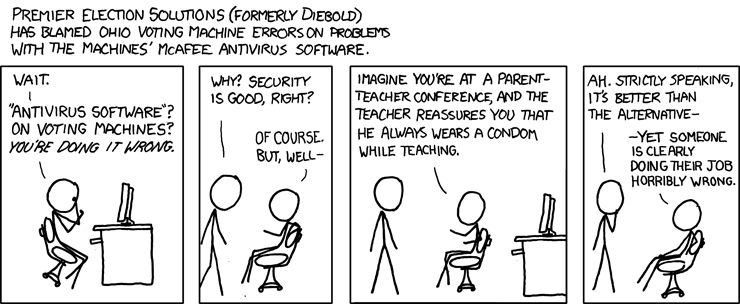
True story (metaphorically speaking), from another brilliant comic from xkcd's Randall Monroe. (Click for larger version.)
Saturday, August 02, 2008
On The Media should get On Its Knees and blow me
Case in point: I recently was annoyed and disappointed to learn more and more of the heavy hand of editing and "fiction" in the primarily and nominally non-fiction "This American Life." (There is apparently also a growing -- and by growing I mean I've now heard it from 4 people rather than 3 -- backlash against the "cool" ironic hipster style of TAL. It never occurred to me to be bothered by this, because I felt that Ira Glass was knowingly twee and ironic in a way similar to that of many people I know -- indeed similar to many of the people who dislike him/TAL so. I didn't get it, but I'm starting to -- I think it's because he is always twee and ironic, and that he makes all the stories twee and ironic, so that not only does it ring false, it IS false, because all of life is not composed of arms-length irony, and such a diversity of stories can't all be meant to be told in the same way. But I get ahead of myself.) I have read that Glass edits the pieces down to the exact number of seconds or parts of seconds that makes the perfect ironic pause, the ideal hesitation, the most of the recently revived art of discomfort humor from preternaturally long awkward pauses. That rather bothered me, but I managed to ignore it. But then came Malcolm Gladwell.
In this piece, Gladwell comes across as a big bit of a dick to me, a feeling I shared with a friend on Facebook, who rather felt that people should know enough not to trust reporters, and that as a reporter his particular or special obligation to clarify when he's joking/lying and when he was less significant than the idea that "we" shouldn't take "anything at face value." The real shame was on us for believing, and anyway, Malcolm Gladwell (and James Frey) didn't really matter in the scheme of things.
Ok. So I admit I may be an over-serious killjoy. Check, moving on.
I feel that as a big-name star reporter, Gladwell has obligations. Journalists are, after all, a specially Constitutionally protected group. Rights have responsibilities with them, imho. So Gladwell had a segment on TAL where he basically said that as a cub, naive reporter he found out he could influence events and have fun by making up bits of stories -- that he once (accidentally) caused a 10-point fall in a stock by misreporting a company's earning, and that he realized he could do whatever he wanted, like fabricating possible sights for convention so that he could go on vacation where he wanted to covering said convention.
Except that his story, this part and others, are largely untrue. And he has the flimsy but real excuse that he told the story in a place where people often spin tall tales. But Glass put it on TAL in front of 1.7 million listeners.
In an article I largely agree with, Slate's Jack Shafer reports:
This American Life host Ira Glass gives no indication that any part of Gladwell's performance is fictional when he breaks in to end the Gladwell segment. Instead, he encourages young listeners not to follow Gladwell's example.
"By the way, if there is any ambiguity in here at all, young journalists, please note, putting false information into the newspaper is wrong," Glass says.
Gladwell... adds that they promised to run a disclaimer.
<...>
Ira Glass of This American Life says via e-mail that the show agreed to include a comment at the end—about The Moth being a place where "people come to tell both true stories and occasional tall tales"—to indicate that the talk "contained elements of exaggeration or untruth."
As disclaimers go, Glass' is weak, something he acknowledges.
"It seemed best for the story if this were kept a little vague," writes Glass. "I thought it would be lousy and undermining and killjoyish if—at the end of a story—a radio host came on and said 'that wasn't true.' Seemed nicer and more artful to simply raise the possibility that it might or might not be true. I figured: the audience is smart. A little goes a long way."
So what's got my boxers in a bunch? This constant pedantic "I know better than thou,"-cum-inverse condescension. "People are smart enough to know better" -- which has the quite clear converse that if you don't, you're not smart. "On the Media" -- the original target of my rant -- pulls similar and quite annoying shit:
NPR's Executive Producer for Training Jonathan Kern is overseeing a year-long project on news standards, which will likely result in the network providing listeners with more information on production techniques. But he doesn't see much utility for the public in adding transparency for transparency's sake.
JONATHAN KERN: Do they really want to know how we edited every actuality and whether there were internal edits? I would say no, they probably don't want to or need to know that. Would it be a good idea occasionally to explain how it's done? Absolutely.
FUCK YOU! "Transparency for transparency's sake?" Isn't that the point of transparency? Simply to be open with what you're doing? It's not as if transparency is meant to be reserved for only when you actually HAVE committed a crime or impropriety; the whole point is that one shouldn't be forced to let YOU (in this case, NPR) decide for yourself what's proper. Transparency is for the sake of others to make their own decisions about methods and approach; when you start picking and choosing based on your perception of what we "need to know," that's hardly transparency any more. RRrrrgh. I mean, no one/nothing can be completely transparent, but this attitude of "Well, only a pedant would find this concerning" when quite clearly that's not so (earlier in the article on OTM, it's mentioned that "NPR's Ombudsman Jeffrey Dvorkin believes trust in television news has declined in part because viewers see it as over-produced entertainment. Is it possible that the fact listeners are unaware of how much production is involved has helped retain their trust in NPR News?"). It can't possibly simultaneously be a cause for a decrease in trust in television news, and unworthy of being transparent about. (For the other reason OTM pissed me off, see this PoorMojo rant by Pappy Hants here, titled "NPR Allows Caller to Put His Dick in My Ear, Parts I & II.")
That's what gets me, in the end. Glass, Gladwell, and OTM act as if they KNOW that what they're doing is as least plausibly questionable. But they cover it with the concept that anything questionable they do is either already known by or irrelevant to the audience... without explicitly asking the audience. (Certainly a colleague of mine buys into their world view; I leave it as an exercise for the reader to guess my stance.) As Shafer says in his piece:
Gladwell's spiel works not because the stories are particularly funny but because of his reputation as a reliable, meticulous journalist. Puncture the illusion that he's telling the truth, and the laughs leak into the ether.Virginia Heffernan of the NYT makes what I believe is the unwarranted assumption that since most random people don't tell interesting stories, and since Glass works so hard to mold "everyday" stories into amusing ones, that perhaps indeed, "[A]lmost no one has a bona fide story, though most have arguments to make, consolations to offer and widgets to sell." (I think this is bullshit, but it would take too long to get further into it here.) BUT Heffernan's point that Glass' methods on TAL are "A way to take the wheel of stories when it’s clear that the everyman he’s recruited isn’t saying exactly what the producers want him to." As she says of the TAL story she reviews, "Ultimately it’s maddening to watch Mr. Glass force this point on Ralph and Sandra, two fascinating people whose dual intimacy with the fading art of ranching and the ascendant art of cloning should have earned them the microphone for the full hour. But Mr. Glass apparently can’t help himself. Only one person really has a story to tell here."
A storyteller can't have it both ways, instructing listeners to "look it up" while stretching the yarn beyond the breaking point or claiming that smuggling the "baffling" phrase into Post copy became "literally" an "obsession." Gladwell's method, and his decision to let This American Life air his tale, raises … well, new and troubling questions about his attitude toward his audience...
On March 13, after I interviewed him, Gladwell had second thoughts about his Moth talk, qualifying it on his blog with these words:
There is a disclaimer at the end of the This American Life broadcast, to the effect that the Moth is a place where "people come to tell both true stories and occasional tall tales." As I think should be obvious if you listen to it, my story definitely belongs to the "tall tale" category. I hope you enjoy it. But please do so with a rather large grain of salt.
The problem isn't just that, as my TAL-loving friend asserts, that there is artistry in Glass' manipulation that has its own worth, different (greater than?) the worth of true stories told truly without an overriding outside point of view, it's that Glass seems defensive about this idea, that not only is it true but that it doesn't matter. It's more fun if you believe it's true and not heavily filtered, and it's unimportant or killjoyish to let you know that it's not and it is, respectively. It's that this point of view doesn't seem restricted to Glass; it's the official point of view of NPR. They admit that, unlike TV, you can't even see the cuts, deceptive or not. But ultimately, they assure us, their version of reality is close enough, that we should know it's reality presented with their own opinion of fealty to the source, and that -- this is my favorite (ugh) part -- not only do we not need to know that explicitly, but truly, we don't want to. Of course, that's just their opinion -- but what does that mean when they feel that their point of view is more important than reality?
*****
One might ask "What's the alternative?" -- to which I would say that at least as far as "real news" goes, journalistic integrity and the advantages of the web would mean that they could post full, unedited versions of interviews -- raw transcripts, as are published for such venerable and truthful institutions as Fox News for many of their shows. True, they do this primarily for Talk Shows -- news-light angry folks like O'Reilly -- but NPR could innovate it with raw transcripts of interviews, at least, if not audio and/or video of interviews and raw transcripts for their reporters. (The OTM piece reveals that they sound so intelligent, urbane, pithy, and concise because the reporters are also edited such that the "uhs' and "ums" come out; apparently this is what some people "appreciate" about NPR -- it's polishness. I could give two shits for polish -- I'd rather see it as it was. All communication is a lie, in a way -- nothing can be communicated in absolute true purity -- but that doesn't mean all alterations are the same, or irrelevant. In general, the more alteration, the further one gets from reality, so it seems to me that a minimum of editing and alteration should be the goal. I'll give you editing for time -- an artifice but a necessary one. But not "polish", which is pure aesthetics. Beauty may be truth to some, but I prefer my truth with morning breath and frizzy hair, not truth that's been groomed enough to appear on America's Next Top Model.)
Monday, July 21, 2008
New Rule/Explanation for the use of the word "Nigger"
Anyway, there has been in recent years (or decades, rather) a sort of push-back on, "How come blacks can use it talk about each other but it's verboten for everyone else?" Leaving aside the fact that I don't think blacks should use it to refer to each other endearingly as a general rule (this being my least favorite part about the mostly-otherwise-brilliant animated version of The Boondocks) it nonetheless is different when "we" use it rather than white people or others using it pejoratively. On Feministe recently, this post by J-fave PhysioProf briefly discusses this point in a pretty enlightened way, though two posts, here, and here make the excellent points. The first, from "Holly", ends with
Of course, I don’t think it’s that most people don’t get it. At this point they do — they just don’t like black folks being allowed to do something that they can’t.Lauren's, the latter, references this excellent post by Ta-Nehisi Coates (I have no idea who this nigger* is), in which he says
never thought that because Toby Keith made a record called White Trash With Money, that somehow gave me the right to address random white people in the fashion. I never thought the fact that there was a magazine called Heeb gave me the right to address my Jewish buddies as such. More to the point--I never wanted to. So this is what I don't understand--What's the big beef? Why is that in "Blackworld" the normal laws of human interaction somehow don't apply? I don't get white people who have a hard time with this--you call your mother "Mom," I call her Ms. Phillips--same deal here. Nigger means one thing when used amongst a group of people with similar experiences, and something else when used by people outside of that experience. Nigger when used by black people, is a lovely, lovely thing. I will believe that till the end of my days. It can be beautifully ominous ("Nigger, what?") and just plain beautiful ("Ta-Nehisi, that's my nigger").
Just my $0.02 -- though I don't quite believe the use of the word nigger is a "lovely, lovely thing." It can be said to be amusing versatile at times, like the word "Fuck," though. (I know that's a lame conclusion, but I have work to be doing.)
*I do also, incidentally, think using the words "nigger" or "nigga" ironically or in jest is fine between two people who understand each other. For example, my friends often wonder if they can even say it in front of me in that way, even though we say all sorts of terrible things about other people and groups, expressly because we know each other well enough to understand it's not meant. On the other hand, it does seem to be a still much-charged word in my circles; I can't help but to feel that this is in no small part due to the fact that I am perhaps the only close black friend of many of my friends, or at least, one of the few. I can understand here extra hesitation, and identify with it (I don't usually use the word even in jest around my white friends, or indeed, around anyone usually). What I think is the case is that the de facto segregation that has led to many of my fellow suburban-raised friends having only one or a few black friends puts too fine a point on the wages of US' history to make joking about something like that comfortable. If you're curious as to why/how it may be different, in some opinions, in regards to Italians, Irish, Jews, and other historically discriminated-against classes, see Karen Brodkin's How Jews Became White Folks. Scanning Amazon, there appear to be a number of valid criticisms against it, but I found the chapter I read for a class at least to be a revelatory socio-political analysis of US racial politics, at least for one not already immersed in the literature of that field.
Tuesday, July 01, 2008
How I Learned to Stop Worrying and Love the Veggie
I love meat. I LOVE meat. Part of the hard part of giving up meat is the contented feeling it gives me -- it's one of those things where I'm near guaranteed to feel happy, if not after then at least during. And it's hard to intentionally deprive oneself of happiness, no? Indeed it is.
But reading Raj Patel's excellent blog post on meat eating I am reaffirmed in my desire to emulate him, and to fulfill really the logical implications of my personal beliefs and my research agenda in food security, both of which tell me that most of the meat produced and consumed in the US is bad for the environment, bad for public health, bad for my personal health, excessive, contributing to antiobiotic resistance, usually unnecessarily torturous to the food animal, part of the corporate over-infrastructure that I abhor, and monstrously inefficient use of water and food resources (i.e. tons of grain fed to animals each year that could go towards feeding many times the same number of people -- the grain fed to livestock in the US alone could theoretically feed 800 million people rather than, say, 1/4 to 1/8 that number, and the 100,000 Liters of water required to produce each kilogram of beef -- see work by Cornell's David Pimentel among other sources, such as Michael Pollan's relatively excellent Omnivore's Dilemma).
But on the other hand, I've wildly failed each time I've tried this. Well, perhaps not always wildly -- sometimes I only gradually failed. But perhaps I can do it this way -- no cold, er, turkey, but rather cutting at least the all-round worst offender from my diet.
Can I stop eating beef?
Well, ok, to be honest my goal is even more modest still.
Can I stop eating non-grass-fed beef? (Grass-fed beef is likely far, far far more efficient and better for you than its grain-fed industrial equivalent.) That's my first challenge. WHEN I conquer that, we'll try cutting out, well, either all beef, or perhaps rather cut out all non-free-range/sustainable chicken.
It's not much, but it's an important (re)start.