Wednesday, December 31, 2008

Raj Patel's Apology

Raj Patel "apologizes" to Obama for a number of presumptuous assumptions about what "change" meant.

A brilliant ironic letter, much in keeping with how I feel about it all.

Happy New Year to All!!!!!

Friday, December 19, 2008

Your... Bible is a. Lie...

The title of this post is brought to you in ShatnerVision (tm).

There are many things to be said about Obama's choice of Rick Warren to provoke, er, invoke, er, deliver the invocation at his inauguration. Sarah Posner says some of them in the Nation:
There was no doubt that Obama, like every president before him, would pick a Christian minister to perform this sacred duty. But Obama had thousands of clergy to choose from, and the choice of Warren is not only a slap in the face to progressive ministers toiling on the front lines of advocacy and service but a bow to the continuing influence of the religious right in American politics. Warren vocally opposes gay marriage, does not believe in evolution, has compared abortion to the Holocaust and backed the assassination of Iranian President Mahmoud Ahmadinejad.


And. The hits. Just keep on! Coming!

J-Mom (aka J-Mom, PhD aka Dr. J-Mom aka Prof. J-Mom) had this excellent hypothesis: since Obama is enjoined from saying too much about the Blagojevich scandal (hey-oh! did I spell that right on my first try?) and people keep trying to hang it around O's neck somehow, despite much proof of anything substantive to hang, he used his political savvy and determined that starting a tempest in a teapot was a wise way to go. Something to distract people from a circumstance beyond his control about which he can do little, by giving them something else to get outraged at. Now, to be sure, I am among the camp that thinks his choice of Warren is substantively bad and an affront to gays and those who support equal rights for humans of all flavors regardless of what other consenting adult they wish to marry, but strategically, it is a tempest in a teapot. That is, it sends a signal that is worrying, but if it really were a "wag the dog" type move, it would be in the knowledge that while this may cause discomfort, he can win back those he loses on the Left through actual substantive action later on. Which is absolutely true -- this is affronting, but if he follows with actively promoting gay rights when his administration actually starts, well, all wouldn't be forgiven, but enough would be that this would be a wise wager on his part.

I don't know that J-Mom, Phd is correct, but I don't know that she's wrong, either. It's a fascinating hypothesis, and one practically unresolvable barring a personal admission from P-E B. H. O.

Monday, December 08, 2008

Doctor J, I presume...

Hoo-RAY! Just finished my PhD -- well, mostly. The oral defense and most of the writing. Still re-drafts to go (#!@#$!!) but that's a pittance compared to the hallucinatorily difficult process of getting here. Still don't believe it's true.

Anyway, in other "Just can't believes..." Could Obama please nominate SOMEONE progressive to his Cabinet? I know I didn't really expect him to be very actually change-ful, c'mon, now. I wonder how my friends that were very pro-Obama feel about all this -- though I suspect they (fairly) are still taking a bit of a "wait and see" approach, since who you appoint doesn't completely determine what you do. Nevertheless, though, who you appoint does have a big significance, or can, because it doesn't seem that the Prez typically gets too involved deep down in the details of Cabinets. That has mixed effects, being that a lot of day-to-day Cabinet work is not of a big great huge political nature, and that Cabinets have lost much of their power (though it depends on who the Sec is and what the prez's approach to Cabinets is), but on the other hand, the technocrats within the Cabinet influence what happens in the future through the groundworks they lay in terms of philosophy and research and therefore solutions and ideas available at later dates.

I think. I may be making all that up.

Anyway, GREAT article here on how O has seemingly snubbed Joe Stiglitz, probably one of the best mainstream economists there is from my point of view. (He's no heterodox, not really, but close enough for government work, as it were.) Stiglitz, author of "Globalization and its Discontents", was one of the few Clintonites to not only NOT jump on the globalization-free-trade IMF-bull-shitting on the developing countries horse hockey, but he actually OPPOSED it. (And his Nobel-Prize winning research contradicts its theoretical foundations. According to the article, no less a free marketeer than Milton Friedman admitted Stiglitz was right on Russia's conversion to capitalism -- that sound institutions and regulatory regimes should be the first priority -- and Friedman himself was wrong in having suggested primarily "Privatize, privatize, privatize.)

Anyway. Stiglitz is yet another example of a perfectly acceptable, incredibly qualified mainstream-type progressive-ish choice Obama could make, but he's reportedly out in the cold. This is boding poorly, my friends, very poorly indeed.

Tuesday, November 25, 2008

Magical Negros (not Barack Obama)

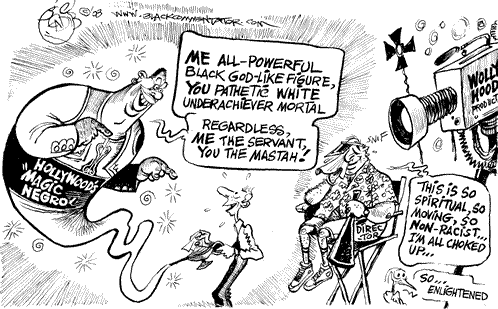
Regardless of Limbaugh's unintentional irony with his "Barack the Magic Negro"(his somewhat thick-headed defense being that "liberals did it first", failing or refusing to understand the actual intention, significance, and meaning of the term), the magical negro phenomenon is fantastically explained here. Basically, magical negro-ism is a tendency in certain narratives (movies, especially) to have a near-perfect black character, whose job it is to redeem the white main character. The problem with this, as the linked article points out, is that it deprives the black character of an inner life and their own narrative arc and agency.

This post is apropos of nothing, it was just mentioned in the context of this review of the movie Australia. Interestingly enough, Daktari has a similar post on sexism today. (Well, vaguely similar -- it's on sexism, but it's similar in that she's discussing the subtleties between sexiness, sexism, and pedophilic objectification.)

Anyway. The concept is well illustrated in the commentary's accompanying cartoon:


Laters.

Monday, November 24, 2008

Worthy of Note

Posting this here, without much more comment -- too much to do right now, I'm afraid.

From July 28, 2008 Democracy Now!:

Remarks by journalist Ryan Lizza

RYAN LIZZA: Look, you have to remember, Obama was from Hyde Park. It’s one the most liberal State Senate districts in Illinois. He could have been as left-wing, as liberal as he wanted. But he wasn’t. He was always—and, you know, there are various reasons he wasn’t. I think genuinely he’s—he was a little to the right of some of his constituents. But I also believe that he had his eye on higher office, and he was careful not to be pigeonholed as too far out on the left.

And his speech at the antiwar rally is a good example of that. And just like redistricting, I think you can argue that if he hadn’t opposed the war in Iraq, he would not have been a plausible presidential candidate, because that was the key distinction, of course, with Hillary Clinton. But the speech was not a—what you might call a typical antiwar speech. He started off by talking about wars that he supported: the Civil War—he talked in almost glorious terms about the Civil War and World War II. Now, nobody opposes the Civil War and World War II, so they’re not exactly the riskiest things to support. But he was in front of a pretty, you know, partially pacifist crowd, and it is an antiwar rally, and he was very careful to point out that—where he disagreed with folks in that crowd. In other words, he was trying to push off the left a little bit. He was trying not to be defined as strictly an antiwar candidate.

At the same time, he made a—if you read it today, it still stands up very well. He made a very powerful case against the Iraq war at a time when a lot of Democrats weren’t doing that. But there were certainly some politics in mind. And if you talk to some of the people who were in that audience that day, one of the common things you hear is, “Wow, this guy is not just talking to us, he’s talking to either some statewide or national crowd. This speech seems pointed for the—seems more like for the history books than just for us here at this antiwar rally.” And this comes up throughout Obama’s political history. He often had his eye on the next rung of the ladder, if you know what I mean.


Also, balanced, interesting, and challenging comments from Cornel West on DN! here.

AMY GOODMAN: Who else would you like to see in President Obama’s cabinet?

CORNEL WEST: In terms of various other positions?

AMY GOODMAN: Sure.

CORNEL WEST: God, that’s a good question. I mean, I haven’t really thought about it. I just want to see some progressives. I just want to see some folk who are willing to take a stand for working people, take a stand for poor people, willing to talk about poverty. I mentioned some of economists themselves—

AMY GOODMAN: Right.

CORNEL WEST: —the Kuttners and the others, but I don’t have a—

AMY GOODMAN: How about your colleague at Princeton University, Paul Krugman?

CORNEL WEST: Oh, Paul Krugman. Oh, my god. Yes, indeed, indeed. Paul is probably even a little bit too progressive and prophetic. He probably needs to stay outside, like myself, and be Socratic and prophetic and just tell the truth to the people in power. But he’s my very dear brother and comrade, and of course I salute his Nobel Prize. It’s rare that you see a progressive economist receiving a Nobel Prize in that way.

AMY GOODMAN: Well, why is it that the names you’ve just named of progressives are not being bandied about in any way as possible people in his cabinet?

CORNEL WEST: That’s a good question.

AMY GOODMAN: And the names that you named, like Larry Summers, Robert Rubin, these are the closest advisers to Barack Obama.

CORNEL WEST: You know, I fear that Brother Barack might be challenged by what Bill Clinton was. When you have been an outsider to the establishment, you want to make the establishment feel secure, and therefore, you want to recycle names that the establishment feels are legitimate names. And therefore, you’re reluctant to step out too far, because you’ll be unable to proceed and unable to govern with a smoothness that you think ought to be characteristic of your regime. And so, he ends up selecting people who the mainstream are going to herald as legitimate, rather than make that break and acknowledge this is a new day, and it ought to be the age of everyday people, the age of ordinary people. That’s what I think. And it’s ironic, because there’s a sense in which Brother Barack Obama might be reluctant to step into the new age of Obama and remains looking backward to the end of the Clinton moment. And I say, no, we need to break free. Now, it could be like FDR: he’s just reluctant, and we’ll have to push him. And that’s fine.

AMY GOODMAN: And how will that pushing take place, do you think, with such tremendous passion—

CORNEL WEST: We’ve got to organize—yes.

AMY GOODMAN: —supporters—passionate supporters of Barack Obama, who pushed him from the outside?

CORNEL WEST: That’s right.

AMY GOODMAN: Now that he is the state, how do people organize?

CORNEL WEST: Well, we use, in many ways, his own words. He says that he wants the bottoms up. That’s fine. We organize, we mobilize. We don’t look simply for a top down. The Clintonites have often been top down. It’s the bottom up. We organize, we mobilize. We consolidate our organizations. And in the end, of course, we may have to take to the streets. That’s how people’s power is expressed, but it’s expressed in a critical and, for me, in a loving way.

I do still support Brother Barack Obama gaining access to the White House, because he was the best that America could do at this particular moment in the midst of imperial occupation in Iraq, war in Afghanistan, financial Katrina, legacy of Katrina in New Orleans, wealth inequality, dilapidated housing in chocolate cities, disgraceful school systems, unacceptable levels of unemployment and underemployment, not enough access to healthcare for fellow citizens across race and region, not enough access to childcare. At this moment, the best America could do was Brother Barack Obama, liberal, centrist.

Will he govern like a progressive Lincoln? Will he triangulate like Clinton? Will he be an experimentalist like FDR? Those are the challenges. I hope he’s a progressive Lincoln. I plan to be—aspire to be the Frederick Douglasses against, to put pressure on him.

Sunday, November 09, 2008

Been brown so long, thought it was green: A true(r) green proposal

From an email forward. Interestingly similar to my answer when one friend asked me what I would do, environmentally speaking, if I had a magic wand. I said: widespread and affordable national and local mass transportation. Seriously. That would be pretty fucking nice. Especially because planes are genuinely god-awful environmentally, but it's hard to be a (well-traveled) citizen of the US, much less the world without them (and cars, which you know, are bad, but still not as bad as freaking PLANES, which originally surprised me).

Subject: 2 Year Proposal to Create 2 Million Green Jobs & Reduce Carbon


Here is some food for thought for those of you wanting to create a national Green platform to forward to President-Elect Obama:


On Sept 9th, 2008 a new report on Carbon Reduction & Green Jobs/Economy was released which has some positive proposals that are distinctly different when compared to most green think tanks and green organizations

See page 27 for the $ figures for each state & number of jobs created

1. It calls for the elimination of tax breaks & subsidies for gas & oil companies (it should also include coal & nuclear as well)

2. It puts retrofitting buildings at the top of the solutions list-which is the fastest way to reduce CO2 (along with phase out of all coal plants) cheapest, fastest job creator, most easily implementable solution-the lowest hanging of the low hanging fruit

3. It puts public transit & freight rail among the 6 top solutions-including reducing public transit fares by massive federal support

4. Fuel efficient motor vehicles are NOT on the list-

The green think tanks & national green organizations' absolute OBSESSION with fuel efficient motor vehicles: plug-ins, hybrids, biofuel, hydrogen, etc. is a major diversion and roadblock to solutions which are much more important, create many more jobs and reduce carbon much faster.

This point on cars will provoke a response from many, but before you respond take 5 minutes to research how much CO2 is generated by the creation of cement-it is one of the most CO2 intensive industrial/chemical processes on earth.

What we need to do is massively expand the public transit infrastructure-double it in 5 years & reduce the absolute number of cars ASAP and begin to tear up some roadways once a public transit infrastructure is in place

For those of you in places like Chicago, where flooding will be more frequent & severe (like occurred in August), at least 10% of concrete & asphalt will have to be eliminated in the next 10 years to recreate some of Chicago's original natural wetland/swamp to absorb the water from huge deluges which are part of climate change that has already begun for the upper midwest

This report is far from perfect-it still calls for cap & trade & lists biofuels as one of the 6 priorities without explaining much about them

& the end of the report are John Podesta's (former Clinton chief of staff) views including a pitch for "clean coal" one of greatest oxymoron's every created

However, there is no perfect world (yet) so we must take the positive and build on that

Here is the link & preface to the report with the report to follow:

http://www.americanprogress.org/issues/2008/09/green_recovery.html

"The Center for American Progress releases a new report by Dr. Robert Pollin and University of Massachusetts Political Economy Research Institute economists. This report demonstrates how a new Green Recovery program that spends $100 billion over two years would create 2 million new jobs, with a significant proportion in the struggling construction and manufacturing sectors. It is clear from this research that a strategy to invest in the greening of our economy will create more jobs, and better jobs, compared to continuing to pursue a path of inaction marked by rising dependence on energy imports alongside billowing pollution.

The $100 billion fiscal expansion that we examined in this study provides the infrastructure to jumpstart a comprehensive clean energy transformation for our nation, such as the strategy described in CAP’s 2007 report, “Capturing the Energy Opportunity: Creating a Low-Carbon Economy.” This paper shows the impact of a swift initial investment in climate solutions that would direct funding toward six energy efficiency and renewable energy strategies:

* Retrofitting buildings to increase energy efficiency
* Expanding mass transit and freight rail
* Constructing “smart” electrical grid transmission systems
* Wind power
* Solar power
* Advanced biofuels

This green recovery and infrastructure investment program would:

* Create 2 million new jobs nationwide over two years
* Create nearly four times more jobs than spending the same amount of money within the oil industry and 300,000 more jobs than a similar amount of spending directed toward household consumption.
* Create roughly triple the number of good jobs—paying at least $16 dollars an hour—as spending the same amount of money within the oil industry.
* Reduce the unemployment rate to 4.4 percent from 5.7 percent (calculated within the framework of U.S. labor market conditions in July 2008).
* Bolster employment especially in construction and manufacturing. Construction employment has fallen from 8 million to 7.2 million over the past two years due to the housing bubble collapse. The Green Recovery program can, at the least, bring back these lost 800,000 construction jobs.
* Provide opportunities to rebuild career ladders through training and workforce development that if properly implemented can provide pathways out of poverty to those who need jobs most. (Because green investment not only creates more good jobs with higher wages, but more jobs overall, distributed broadly across the economy, this program can bring more people into good jobs over time.)
* Help lower oil prices. Moderating domestic energy demand will have greater price effects than modest new domestic supply increases.
* Begin the reconstruction of local communities and public infrastructure all across America, setting us on a course for a long-term transition to a low-carbon economy that increases our energy independence and helps fight global warming. Currently, about 22 percent of total household expenditures go to imports. With a green infrastructure investment program, only about 9 percent of purchases flow to imports since so much of the investment is rooted in communities and the built environment, keeping more of the resources within the domestic economy.

Our report looked at investments that were funded through an increase in near-term government spending, which could ultimately be repaid by future carbon cap-and-trade revenues. These sources of new investment included the following funding mechanisms:

* $50 billion for tax credits. This would assist private businesses and homeowners to finance both commercial and residential building retrofits, as well as investments in renewable energy systems.
* $46 billion in direct government spending. This would support public building retrofits, the expansion of mass transit, freight rail, smart electrical grid systems, and new investments in renewable energy
* $4 billion for federal loan guarantees. This would underwrite private credit that would be extended to finance building retrofits and investments in renewable energy."

Friday, November 07, 2008

An interesting piece

From the NYT: An Eternal Revolution. I don't 100% agree with it, but it makes many thoughtful points.

And yes, I am feeling more excited about the whole thing.

Various points:

Seeing Bush walk out of the White House to congratulate President-Elect Obama (yes, I too like the sound of that!) -- it made me realize that these next several months mark the end of seeing, not just that man, but any white man walking out of the White House to take his place at the podium and address people as the Prez. For four years -- likely eight years -- every day will be an historic occasion, as Barack Obama arises and conducts the affairs of state. That will be nice -- it's Democrat+. By which I mean, I usually consider having Dems in power nice in that I can hear things I believe in, even if they promptly go on to do many things I do not believe in. But at least they don't insult my intelligence, they give me soothing lies, which is something. But this will be a plus -- soothing soundbites that don't reflect reality, I'm sure, but the additional plus of seeing someone whose public image, at least, people can respect and children admire and look up to, especially young black children, who now have a powerful counter to all the silly portrayals of blacks on TV. That is powerful. Yes, I know, I'm late to the game -- blame it on my thesis (Daktari did =p

I guess my resentment is the feeling among some that "this changes everything", which I can't abide by, cuz it kinda doesn't. The end of slavery didn't "change everything", nor did 9/11 -- but they opened up the possibilities, they changed the long term trajectory of change, and that's worth crowing about. I mean, also in the NYT, Judith Warner wrote a touching but absolutely silly article in some places, in that she says
his moment of triumph marks the end of such a long period of pain, of indignity and injustice for African-Americans. And for so many others of us, of the trampling and debasing of our most basic ideals, beliefs that we cherished every bit as deeply and passionately as those of the “values voters” around whose sensibilities we’ve had to tiptoe for the past 28 years

Umm... it can't possibly be the end of pain, indignity, and injustice if there still exists disproportionate pain, indignities, and injustice for black people. Last I checked, we did not all achieve equality of capabilities, and this brilliant, if cynical/snarky peace did not come true:
What does this promise land look like? This Obamerica? Shortly after Obama is sworn in, the police, instead of subjecting blacks and Hispanics to capricious traffic stops, will only stop them to offer free tickets to the policeman's ball. Throughout the country, they will address blacks and Hispanics as sir and ma'm. The overcrowding prison problem will end, because all of the blacks and Hispanics who've been sent there as a result of prosecutorial and police misconduct - probably half - will be set free. And all of those police who have murdered unarmed blacks only to be acquitted by all-white juries will be retried. Blacks will have the freedom to shop in department stores without being watched.

In the media, all of the black Hispanic and Native American and Asian American journalists, who, according to the Maynard Institute's media watcher, Richard Prince, are being "shown the door," will be rehired. The progressive media will spend as much time on the torture of black suspects in Chicago, New York and Los Angeles as they do torture at Gitmo. Blacks will be liberated from the crime, entertainment and sports pages exclusively and appear in other sections. More cerebral sections as scientists, engineers, astronomers. Jonathan Klein and other cable producers will stop managing black opinion so that it doesn't alienate its white audience and voices other than those of black correspondents from Rev. Moon's church will be awarded air time. Global warming denier Michelle Bernard will be replaced by Jill Nelson.

Jesse Jackson will be appointed lead editorial writer for The Wall Street Journal. and Al Sharpton will assume duties at The National Review. Rush Limbaugh will inaugurate a series called "Great African American Inventors." Spike Lee will be invited to run Columbia Pictures and Amy Goodman will take over at NBC. The Newspaper Society of America will apologize for the lynchings and civil disturbances caused by an inflammatory media over the last one hundred or so years. A choked up Rupert Murdoch will read the statement on behalf of his colleagues.

God, I love that list.

Anyway.

I believe the possible trajectory for what we can do changed on Tuesday. The otherwise largely steady stream of racial status quo had been flowing for a long time, here murkier, here clearer,** one could be excused for thinking it wasn't going to change course. And then it did, a l'il bit. But the possibility of large trajectory changes is there, and that is a good thing, and something to be excited about. (God, maybe D was right about the thesis and my curmudgeonliness... but no, come to think of it, I always get more cynical when I feel like people are getting too overjoyed about something really important... curse my metal heart... =)

You know when the impact of what we have done hit me again, besides the fact that we will see O-fucking-bama* come out of the White-fucking-House every day soon? It was this 'un, on a friend's Facebook page as their picture:


As a friend of mine who's not given to superlatives said when she finished her thesis: "Fuck yeah."

Speaking of finishing theses...

*(These are "good fucks", not bad fucks. Of course, according to the FCC and perhaps the Supreme Court, I apparently inextricably and certainly mean that the O is fucking the Bama and Whites are fucking the House.)

**(Here more eutrophied, here less... couldn't resist, sorry.)

Wednesday, November 05, 2008

DC Larson: You are how you vote

DC Larson: You are how you vote

You must read this, and now. It is an encapsulation of how I feel, and why I felt let down in myself when I voted for Obama yesterday.

My sister, and others, tell me that you can't live in Fantasy-Land, you have to live in reality. And my belief in the unreality of the change Obama brings is interpreted as cynicism -- when I view it is optimism of a rather different sort. As Larson points out, by the standards of political realism, those who wished to stop slavery had no hope, and for a long time, no candidate. Larson says
...if in your heart you feel your true beliefs are at great variance with Obama's record and apparent sympathies, then I would submit that you have a moral duty to express yourself honestly, by voting for an alternative candidate who better reflects your opinions.

In that way, political cultures change. Causes like ending slavery, womens's suffrage, the trade unionist movement, and racial civil rights all began in the streets and with political outsiders. Who today would argue that persons advocating those interests should have ignored principle and accepted contrary conventional political realities?

During a 1924 debate on the death penalty, opponent Clarence Darrow noted the many torturous forms of punishment once common. "Gradually, the world has been lopping off these punishments," he said. "...[T]he only way we got rid of these laws was because juries were too humane to obey the courts."

Just so, electoral progress in the public interest begins with appropriately-voting citizens.


Now, I don't expect my friends to agree with me. But as I see their point, I wish they would see mine as something other than "fantasy land" or wistful thinking or waiting for perfection or engaging in an absolutism of progressive politics. If indeed was must be audacious, as Obama says, should I not be audacious enough to hope that a candidate in line with my beliefs should have a chance some day? That someone like Nader or Kucinich, with whom I have disagreements but of a radically lesser extent than with the people who actually lead us would have a chance? Is that naive? Or is it hopeful? Who gets to decide when I'm following Obama's message of hope and when I am being too silly, too demanding, too audacious for change?

I can be happy for what today represents, but I guess it's hard for me because I feel lonely in my feeling of what was also lost for me personally in my vote. I believe in what Larson is saying, and I can be happy for symbolism if others would take the time to accept and respond to Larson's and other's point other than dismissing it is, essentially, hogwash or extremism. I go out of my way not to dismiss the legitimate reasons for voting for Obama, maybe I don't succeed and I sound too dismissive. But simply being called cynical or starry-eyed is not a very satisfying or encouraging response. When I say what I say about Obama, people don't talk to me about (with one exception -- Go D!) going forward together to get to changes I see, they talk about accepting what is today. They talk about how much worse McCain would be. That's all well and good, but you know what? I will be inspired and hopeful despite my feelings on the somewhat futility of symbolism if people who disagree with me, rather than expressing bewildering bemusement, tell me how we can work with and on Obama to not simply slow down things going wrong, or have a moderate agenda, but rather when they tell me they will work with me to accomplish our wildest dreams, to push for a world where our "progressive" candidate is not menacing Pakistan and backing free trade rather than fair trade. When we say we will work together to make hunger a bigger issue than terrorism, while millions of children die each year from hunger in a world with surplus food while thousands of people die from the no less, but no more tragic incidences of terrorism.

I thank D for that, for being pumped about it, and trying to keep me pumped about it -- for, essentially, making the positive case on meeting our ideals. But as far as I can tell, she's the only one so far, the only one who doesn't say "But look who we have now!" or "Be real!" or "You can't achieve perfection!" or simply ignore or shrug off the history even our most "liberal" presidents have of ending up unindicted war criminals (like Carter helping Indonesia wipe out a bunch of its indigenous population).

I, myself, am going to have the audacity to hope for perfection. And as my many accomplished friends know, you don't get to "good" or "very good" by shooting for them; you get to be great by shooting for awesome, and get to awesome by shooting for the stars. I believe that, "Yes, we can!" reach the stars. If I can believe you're with me, then I can believe in the triumph of today.

Real Work for Obama: Winning, but not through War

This article by Clare Lockhart on Slate lays out what seems to me to be the most cogent, reasonable and concise outline of what needs/needed to be done in Afghanistan, ever. She emphasizes good governance, sovereignty, aid to the local government and using their structures over building parallel UN/US/coalition/donor governance institutions, and for the love of god giving the Afghanistan government the money it needs to function, with accountability strings attached, AND with a focus on local governments. As a quasi-political scientist (my thesis is on ecology & food policy, so I've spent the last several whatever doing poli sci analysis of "food institutions") her approach rings true, and is not what I've heard from Obama.

Troops will be needed to protect an effort such as Ms. Lockhart refers to. But Obama has talked about Afghanistan as the real central front on terror -- and his plan to me sounds not like winning hearts and minds, or much-more-freaking-importantly, giving Afghanistan the aid and reparations it needs and DESERVES, but to turning it into, essentially, Iraq.

I can't wait to see him take up the Lockhart agenda -- or a similar one. I hope he presents one soon (and apologies if he has presented something like this somewhere in his policy proposals, though it is significant to me that this is not what we heard him propose during debates, where wanted to look hawkish). It is people like Lockhart that give me hope (or at least, what she wrote there in Slate that I've read, which focuses on respecting aided countries as co-equals and partners in re-building, not freaking supplicants; there's always the possibility that she's horrible and I don't yet know it). Let's hope we see many, many people like her in the policy arena in years to come.

Tuesday, November 04, 2008

I'll Admit It

I smiled.

Oh, how glorious to hear "Yes we can" right now (especially instead of Drill baby Drill!!!!)

Goodbye Sarah Palin and John McCain!!!!

Goodbye (soon) GWB!!!

And hello to the ability to saying "My country isn't racist; one its best presidents was black!" <'/tongue planted firmly in cheek'> =}

Oh man -- Jesse Jackson crying. That choked me up a bit.

Oh -- here's mom, yelling "In my lifetime! In my lifetime!"

Congrats to us all.

Now comes the audacity and the action. Vamos, pues! Si, se puede!

Kinsely comes dangerously close to something I agree with wholeheartedly

Michael Kinsley, founding editor of Slate writes a pretty good article about "Divided Government", and how a) people don't actually want it, and b) it's not actually that good an idea.

He points out the divided government comes from a small amount of ticket-splitters, while the overwhelming majority of people still vote relatively partisanly -- i.e., they vote for an undivided government. So unless you're speaking of a gestalt of people that disagrees with the people themselves, people don't want an undivided government, but rather, a small number of centrist or independent voters tip the balance in different directions in different branches of government, essentially creating divided government from to camps of the other 98% of people who DON'T want divided government.

It's an interesting, and I think, rather accurate viewpoint.

Kinsley goes on to praise parliamentary systems, where you vote for the party, not the person, and the head of government, the Prime Minister, is of the legislative body. We've praised the genius of checks and balances with our three branch government, but even ignoring the fact that most countries get by without them, Kinsley's point is that having undivided legislature-executive power means that each election allows a party to come into power and try out their ideas effectively, rather than being able to blame an obstructionist president or obstructionist Congress. Thus, when election time comes, it's actually a referendum on what they've done, rather than on what they promise to do, if they just get a majority this time or get the presidency back.

I'm rather a fan of that proposition, though I haven't spent much time thinking it over yet. In terms of a referendum on actual policies, I think that's important. As Kinsley says
Unfortunately, politicians in a system without accountability get elected by promising to ignore all these inevitable trade-offs. "Yes, we can" will come back to haunt Barack Obama, because often we can't. Inspiration is no match for mathematics. So the Democrats who now control the agenda face a moral dilemma: Should they do what is right or do what they promised?

Part of my repeated point about Obama and the Democrats more generally is that if leftists insist that being realistic means always voting for the Dems (assuming the likely case that the Republicans continue being, at the very least, identifiably less progressive), then there continues to be no way to have a referendum on Democratic politics. People are excited about Obama, it's true, and let's give him that he's awesome, we'll assume that. Now -- if the Democrats had nominated a piece of toast, would it then be ok to vote for a 3rd party? If they nominated, say, Joe Lieberman, a hawk and McCain supporter? The point is, we may be lucky to have Obama, he's positive, exciting, and more, but people saying that leftists *must* vote for him -- is that in some way different than every other race ever from this perspective of being "realistic"? It just rather seems to me that a strategy that doesn't involve changing tactics with changing circumstances just can't be an effective one.

I know, I'm raining on parades and not embracing the historicness of the moment. But I just can't get excited about a vote that from a mainstream leftist perspective was a fait acompli, was decided before even the Democratic primaries. The point of the excitement is that we did not get a piece of toast, or Lieberman, of course, but that almost worries me more -- because Obama is potentially great, but he will only be great if we make him. And if we lose sight of this because of how good he makes us feel, we will miss a greater historic chance than tonight itself. We must find a way to make voting a true referendum, whatever happens with Obama. Because even it he's fantastic in all ways, they won't all be winners, and I seriously don't want to feel coerced to vote for a piece of toast next time 'round, 2010, 2012, 2016, or on and on. Some time, someone's gotta explain to me what the long-term plan on the "realism" ticket is such that we don't get toast next time 'round.

And ignore the sturm and drang here if you would; I am a bit thesis-related crazy tired. I'm optimistic, but cynically so. Go "O", and let's see this through, this history in the making and change on the horizon.

Can We?: A deep feeling of squick

So, I cast my vote today... and was ashamed to wear my "I voted" sticker. Because I voted for Obama.

Let me explain, kind of.

Given the discourse in the US, it seemed to me that simply no one would listen to me or take me seriously, or not no one, but few people on the left, including my friends, would listen if I voted instead for McKinney or Nader. Apparently it's still Nader's fault that, among other things, Gore didn't challenge the vote in the entire state of Florida, which consensus now says he would've won.

So I essentially voted for Obama in order to not be marginalized. It seems too-clever-by-half, but it also seems to me that the thought process of people I know would be "If you can't see that it was vital to vote for Obama, I can't even possibly understand what you're thinking." With this peer-pressure vote, I get the feeling that the internal narrative will be "Well, I'm skeptical of what he's saying, he's crazy, but at least he voted for Obama, so I'll humor him." And of course, once you humor someone by listening to them, you end up actually listening to them eventually. Usually.

Look, here's my deal. I just spent 15 minutes with my sister explaining myself -- which makes me feel all kinds of squick because hope is important, and I don't to crush hope, nor do I want to be viewed as "living in a dreamworld" as my sister and J-friend MZ and J-friend Becky have accused me of (and will no doubt continue to accuse me of). (Which, by the by, drives me crazy -- I ask people to sit down and analyze the arguments, I don't tell them their idea is fanciful and la-la-land; at least, I don't say that to my good friends, typically.) But let's set aside my problems with Obama*, I think the real source of my squick is the excitement for Obama. For two reasons: 1) sure, it's symbolic, but substance matters to me more than symbols, and while it will be amazing to have a black president, what will be more important is the 2nd black president, the 3rd... because a symbol without follow-up stands for little, and a symbol by itself doesn't mean that reality has changed; we've seen how many opposed to a black president there are, and we've (I've) talked about the much subtler and quite prevalent problems of institututional racism, and 2) he's a politician. Despite claims to the contrary, I can't see how one can argue that he represents a new kind of politics; he's an extraordinary and inspiring orator, who didn't perhaps stoop so low as the lowest lows in negative campaigning. But he has distorted, probably lied, and spun as much as any good politician, as I implied in an earlier post:
The other bit for today, to cut the other way, are two articles critiquing Obama -- or really, the important one is the one in the Houston Press News (that I found via this article) about what the reporter sees as Obama's long-established careerism and political aspirations keeping him from doing as much as he could to help his own district in Chicago, as a community organizer and as a politician, and it's the first actually somewhat concrete proof of what I've heard several times: that he rose in no small part (as anyone in that climate would have to) through the Illinois' political machine's machinations. Interestingly, the reporter still finds him inspiring, even after being chewed out and fair-weather-unfriended by Obama. Of course, I guess I should be understanding -- I think Obama's going to be/is as much of a politician as anyone, and I still find him inspiring. I may even vote for him yet -- McCain is growing scarier by the day, and it would be nice to have someone in the White House that says the things I believe in, even if -- and this is my basic analysis of Democrats -- they continue to DO all the things I don't believe in. At least they can make it sound good. [emphasis added]

Why do I bring this up? Because I just can't get into the excitement about Obama. I had, I want to, but driving to vote, I remembered: the FISA bill, no gay marriage (yes civil unions), no single payer health care (yes a complicated alternative), and a bunch of stuff below at the *. And it's not that this doesn't still leave him better than McCain -- it's that people swallowed this stuff and forgot and forgave and moved on. It's important to be excited, to be pumped, to be mobilized, but we musn't forget, this isn't about Obama. Even he's said, it's us. We're the change we've been looking for -- meaning that voting for him isn't the end. It's not even the middle -- it's the middle of the beginning. If people don't stay mobilized, Obama will be as ineffectual and disappointing as the majority-Dem Congress he's coming from. If people don't get over their love affair with him, people on the Left, in order to criticize him as harshly or more harshly than we would anyone else when he strays from his agenda, he will not amount to much. My Mom, following his campaign more closely, has said he admitted that -- that he wouldn't do anything we didn't make him to, so we have to make him to. I can't imagine he was that stark, but I believe and understand and agree with the sentiment.

I'm fine, I guess, with the love affair with Obama for today. It will be exciting when he wins, and to hear someone cogent as president. But we must must must by ready and waiting to cajole, complain, pressure, and pursue a President Obama on the change we want to see, because, as my mom says, he may be close to the best a politician can be, but he's still a politician and she doesn't expect him to do anything positive we don't force him to do. So I will join you all in celebrating for tonight, if you will join me in amping not just our cheer and applause but also our eyes and ears, and knives if the need may be -- to cut Obama up in our opinions and speeches and conversations when necessary to keep him on track for change, to howl much, much more loudly if Obama the President signs into law something like the FISA bill Obama the Senator helped pass, to get to the streets and protest if Obama the President rattles the sabers at Iran, to knock on doors and send letters if we end up sending troops to Afghanistan and it causes more destruction, not less. Do these things, and I will gladly cheer when he comes into office, and when he lives up to the change I believe in. His record during this race, where he rapidly moved from a different kind of politician to a rampant centrist, and, to me, less cogent debater than Kerry (who has a horrible presence, but made better points in his debates in 2004 I thought) leads me to believe we will need more of the former than latter. May time prove me wrong, and may we celebrate the end of a horrible era, and move into an era of hope -- but an era of hope that will require as much activism, as much anger and passion, both laudatory and critical, as the past 8 years. Without it, my vote for him is a lost vote, as bad if not worse as you may think a vote for Nader may have been. Stay mobilized, stay active, and push each other, push me, challenge me and yourself and your family and friends and Obama as much we have been pushing during the Bush years -- and more! -- and we will have been audacious enough to deserve the hope.


*(achem, voting for FISA bill i.e. continued broad spectrum dubious-to-warrantless wiretapping with telecommunications companies shielded from prosectution for violating the rights of their clients; achem, saying he believes in civil unions but not gay marriage, which is completely politically understandable and expedient but not consistent with "change", "audacity," or intellectual honesty if you presume the US is not a theocracy; achem, saying we would invade and bomb Pakistan if necessary, speaking of unfortunate miltarism and a certain familiar unilateralism; achem, saying we should intensify our troops in Afghanistan by taking the from Iraq, even though it appears the primary outcome of that could be to turn Afghanistan into some place as bloody as Iraq; achem, saying we might have to attack Iran and that if they have a nuclear weapon they pose an existential threat, despite the fact that of Pakistan, India, the US, Russia, probably North Korea, Israel and several other countries, only the US has used nuclear weapons, AND Israel continues to have nuclear weapons in complete violation of international treaties and the US, including Obama, says nothing about it; achem, supporting Israel -- all well and good -- but not spending much time pointing out that the Palestinian terrorities are the poorest in the world and 3 times as many Palestinians are dying in the conflict with Israel than Israelis; achem, saying we should put child rapists to death and disagreeing with the Supreme Court that it's not constitutional; achem, opposing the DC handgun ban)

Wednesday, October 22, 2008

Bob Woodward on Colin Powell in W: More credit than he deserves

I don't actually like pooping on supposed national heroes (or former national heroes on their way to redemption), but as a member of the reality-based community, it does twist my britches some to see the impressive, but ultimately (in my mind) quite tragically flawed and not-heroic-enough Powell lionized because he did the somewhat brave thing and endorsed Obama. (After, it is only somewhat cynical to note, Obama has taken a clear lead, and long after McCain made it obvious that his military outlook as he has enunciated it looks more like Bush's than Powell's during the latter's time as SecState, and a good bit after many more conservative conservatives had jumped ship over the exquisitely underqualified Palin.)

Bob Woodward, on Slate's so-far ho-hum "Diary on W" between himself, Oliver Stone, Ron Suskind, and Jacob Weisberg (who cares!), had this to say on Jeffrey Wright's excellent portrayal of Powell:
Jacob, you make note of the scene in W. where Bush and his advisers debate whether to go to war. In it, the Colin Powell character makes his case against the invasion. The problem is, as best I can tell, no such meeting ever took place. The president never called the National Security Council and the top advisers together to have a real knock-down, drag-out, come-to-Jesus meeting. It gives Powell more credit than he deserves. This is the broad meeting that Bush should have had to hash it out among his advisers. Powell's plea to the president in August 2002, which he recently affirmed, was that the administration needed to look at the consequences of war, but he never argued openly to the president that he should not invade Iraq.

(spoil-sporty, cynical, "Is nothing sacred?!?" emphasis added)

Tuesday, October 21, 2008

Incidentally, another great post on racism in Pennsylvania

On Slate, here. "Swing-State Rednecks: What Murtha and Obama get wrong about race and class in western Pennsylvania," by Dennis B. Roddy. Read one of the few pieces of evidence that Slate hasn't gone completely to shit (though it's NOT by a regular writer, by the by).

For she has become Death, Destroyer of Parties

Good article here on the crisis -- not the economic one, but the one within the Republican party, as catalyzed, to a great extent, by Sarah Palin.

The former Reagan economic adviser Bruce Bartlett predicts, indeed, that the Republican primaries will turn into a Palin/Gingrich steel-cage death match (from his lips to God’s ears, I say).

But history suggests that the rebuilding of the party, whether that means a rejuvenation of conservatism or its root-and-branch reformation, will take much longer than a single election cycle.
I have to, cynically and selfishly, agree on the "from your lips to God's ears" element (I try generally to be conciliatory to the everyday Republicans one may meet, or have a reasonable debate with on the internet, and I certainly hate it when they proclaim glee at the Dems internecine warfare). On the other hand, I wonder where this guy was in 2004. That is, after the 2nd Bush win (aka the first time Bush was at least arguably elected, and at least got the popular vote). Democrats were said to be in the woods then, in search of direction, turned against themselves, between centrists and, I guess, my people on the "far left" (which seems, if nothing else, to have a more flexible meaning than "far right," which most, I think, take to be hard core libertarians, survivalists, and theocrats, whereas far left includes everyone from Olbermann and MoveOn and Kucinich to people like the younger William Ayers who would use violence against the system). More accurately, I suppose, it was centrists vs. staunch anti-war progressives, for the most part. But the party didn't figure out its complete incoherence; it just found a charismatic centrist to bring all back into the fold. (Partly, I have to say, by somehow conning a huge amount of my friends and other progressives into the idea that he truly is a Progressive, just in hiding for politics' sake -- this from the guy who won't come out for gay marriage, advocates attacking Iran and Pakistan if necessary, voted for FISA wiretapping, and said he agreed with striking down the DC gun ban and disagreed with the Supremes ruling out executing child rapists, without giving a clear rationale for the last.) In any case, I would hardly say that the Dems had their act together at ALL, as the primaries and PUMA-peeps should show, not to mention the continued silencing of Kucinich-types.

Anyway, all that is to say that I wonder if the Republicans a) will have an intra-party Celebrity Deathmatch (after McCain's loss!), b) will remain out of power for more than one election cycle (i.e. past 2010, impossible to know from here), and c) will actually reconcile, stronger for the experience, into a new Modern Synthesis (if you will), rather than, as the Dems seem to have done, kicking the can down the road.

It should be interesting times in both parties, I suppose.

Great, reflective post on race by Daktari

You will go read it. Yes, you will.

Saturday, October 18, 2008

Reason #X why I should love it, AND leave it

I may love the US, country of my birth, but shit like this, that seems intractable, immemorial, and perennial just drive me crazy.

I understand we were built to be a looser federation of states, but that's no longer the reality -- and having our voting system handled at a local instead of national level essentially disenfranchises people -- along with our messy systems and Tuesday voting.

Despite popular opinion, in re: the US #1-ness -- we're #139 out of 172 countries when it comes to voter turnout, possibly because we use methods shared by other, um, "great" democracies:
Our problems begin with a less than state-of-the-art registration system. According to Adam Fogel of FairVote, the United States is one of just a few democracies where the government takes a back seat, expecting individuals to sign themselves up to vote. (Other "self-initiating" countries include such beacons of democracy as Algeria, Cameroon, and Chad.) The National Voter Registration Act (aka the Motor Voter law, which Congress enacted in 1993) makes it possible to sign up at the DMV, at public-assistance offices, or by mail. But many, many people fall through the cracks—only 72 percent of the voting-age population was registered in 2004. Plus, we have no comprehensive way of correcting forms or striking people from the rolls when they move away or die.


Read it and weep.

"Weep for the future, Na'Toth. Weep for us all."

Thursday, October 16, 2008

ACORN: A Good Apple

I was outraged that Obama didn't bother to defend ACORN against McCain's ridiculous charges last night.

ACORN registers people to vote; we all agree this is a good thing, right? Well, the voter fraud charges against them are largely BULLSHIT, and I'm here to tell you why.

Three articles:
Nuts About ACORN: Believing in vote fraud may be dangerous to a democracy's health.By Dahlia Lithwick

and

So where's the ACORN voter fraud? and Republican Voter Fraud Hoax by Brad Friedman (US citizen and not-voting-for-Obama-er, despite what the commenters at The Guardian UK thought. Read the endless comments for a gamut of arguments, and scary shit about the socialist revolution that Obama is self-apparently NOT leading, not to mention that most people couldn't even correctly define any of a myriad of CORRECT definitions of socialism or distinguish it meaningfully from communism... I know it's bad to say, but I once again am ready to leave this shit and emigrate. Actually, for the first time -- last two elections I felt it was my duty to stay, but fuck that, I need a change of arguments at least, even if there's stupidity and disagreement everywhere. I need NEW political viewpoints and arguments to feel condescending towards, no more American discoursic treadmilling for me.)

(Of course, I have no actual plans to leave. But dammit, I'm getting too old for this shit. =)

ACORN is getting slammed over ridiculous, fictional sh*t.
A) They're required by law to turn in all filled out registration forms, EVEN IF THEY ALREADY KNOW THEY'RE FRAUDULENT. Would you rather ACORN itself decide which registration cards are good and which aren't?
B) They VOLUNTARILY report irregularities; one police raid of their offices was to seize files THEY'D ALREADY REPORTED AS QUESTIONABLE, without being asked. In fact, most cases "against" ACORN have been on people they themselves have turned in.
C) They register MILLIONS of VALID voters each year; the fraudulent cases represent less than 0.5%.
D) No one has EVER successfully linked voter REGISTRATION fraud, and actual VOTER FRAUD -- because all voters have to show up with an ID. Consequently, ACORN has never been connected to VOTER FRAUD.
E) They do NOT pay by the registration card; they pay BY THE HOUR.
F) They register ANYONE who they encounter on their drives; Dem or Rep. They focus on urban, poor, and minority populations. The majority of urban, poor, and minority populations are DEMOCRATS. Maintaining that ACORN is biased because they population it services is primarily Democratic is like claiming that the Detroit DMV is racist against whites because most of the people it serves are black.

Blogger Like Me

I'm so impressed with my own response to Daktari's response to my previous post, that I'm reposting it here. I'll assume D won't mind me top-posting her original comment as well:

Daktari:
There's the occasionally repeated point that arts tend to draw in people with radical ideas and/or marginalized agenda...

Which is total bullshit, btw. I have been around enough actors/writers/wannabes/artsy-fartsy types to know that their idea of "radical ideas and a marginalized agenda" is growing up misunderstood in a hick town just like the rest of us. While a willingness to offend/shock/shuck convention can foster some creativity, it rarely does so in a culturally meaningful way. Rarer still is the liberal play that pushes the envelope well.

What is the conservative stage equivalent of the first gay kiss, the first interracial kiss; the conservative stage equivalent of brilliant strung-out prophets and flamboyant, flashy colors and dancing and scantily clad ladies and gents?

Answer: Opera. Wagner in particular.

I can think of plenty of plays with conservative viewpoints. Everything from Oklahoma to The Music Man, where Marion, our gentle librarian, plays straight man to the wildly flamboyant Harold Hill. And what could POSSIBLY be more conservative than Our Town. But like most plays with a conservative viewpoint, most of those made me want to gouge my eyes out. Pulitzer Prize my ass.


J:
Hmm... Well taken, but I think you're overestimating two things: the % of actors/writers/wannabes/artsy-fartsy types whose "idea of "radical ideas and a marginalized agenda" is growing up misunderstood in a hick town just like the rest of us" out of the whole, and the extent to which conservatives don't consider depicting the status quo/the "idealized" status quo as normal rather than "conservative." That is, Oklahoma and Music Man might be hopelessly conventional in the way they see society, but I think conservatives wouldn't view that as a "conservative" play at all. Which was part of my point -- the analysis of the leanings of plays and playwrights is trickier than the author even came close to implying. After all, it is easy to argue the caveman politics of many plays/art with a damsel in distress saved by a charming handsome leading man, and/or with a female lead whose three-dimensional characteristics consist of the dimensions of "hot", "young", and "coquettishly attracted to the male lead", but I find it hard to imagine most people counting them as "conservative" in a political way. Which, I guess, was part of the point I was trying to make: making plays that are about, celebrate, or depict that status quo or a by-gone age is "conservative" in the same way that, let's say, "Rent" is liberal -- Rent isn't quite a liberal message play, but rather one that emphasizes the humanity of and treats as normal a bunch of outcasts and supposed non-conformists; what liberal message does that present other than "We're queer, we're here, and we're having lots of sex"? But by accepting "deviant" lifestyles, it's defined as "liberal", whereas accepting "normal" lifestyles -- patriarchy, female frailty, traditional marriage -- isn't considered "conservative" by even many liberals (as long as the traditionalness and female frailty aren't oppressive; cf. almost all mainstream romantic comedies). Which, actually, brings me back to my other point I forgot about -- I'd say that there're plenty of liberal plays that DO push the envelope well; they're just ones we're not thinking of, because when you push the envelope well, the political message isn't plainly and simply spelled out. It's a rare play that is OBVIOUSLY a message play and is good, I think (not a play, but case in point: the movie "In the Heat of the Night.)

And you did quite call me out on Wagner, you're right, and not having seen "Our Town," I'll give you that one, but I pose two challenges to you.

1) All the plays you name aren't contemporary; especially Wagner and Our Town are from rather a bit back, such that one can argue that many pieces of work written over 70 years ago are going to appear/be "conservative," because they express viewpoints that have long since been out of vogue/refuted. "Taming of the Shrew" seems rather cretinous to me, and while it's false to suggest that sexism was accepted without question by all hundreds of years ago, it's not false to say that sexism was quite acceptable and accepted as reality by most. So riddle me this, D: name a contemporary conservative play. (I'm sure you can, I'm just curious what you'll come up with.)

2) Name a conservative message play. Which seems to be the hidden presumption of the NYT author, anyway -- that liberal plays look to advance the liberal agenda, ergo any "liberal" play is a liberal message play.

By the by, I think you're right that liberal message plays rarely push the envelope well, but I would argue that many plays that aren't WRITTEN to be message plays, liberal or conservative, DO push the boundary well. Rather like "The Half-Hour News Hour" or "Studio 60 on the Sunset Strip," the creators (conservative and liberal, respectively -- I just noticed that) missed the point in that comedy, especially, usually fails when its first master is a message. Its first master must be being funny -- THEN you can do the message. As with message plays, if you start with the goal of having a message, you'll have one, but it might be a shitty play. If you start with the goal of an excellent play/show, and then within that you wish to plant a message, you might get it right.

So my last long-assed-introductioned question: are there any deeply influential plays that *didn't* push the envelope? Or is it true necessarily that superlative excellence requires pushing envelopes (whereas pushing envelopes doesn't necessarily mean it's any good).

Things that make me go "Ummm..."

Fantastically interesting article in the NYT about the apparent lack of conservative plays/playwrights. I haven't the time or energy to fully explore the topic here, but some quick takes:

a) The article bugs me for some reason... I think because it takes for granted that the highest standard for something is whether or not it's present; that is, it's easy to argue all/many/most plays are left-leaning. What's harder is to ascertain the reason and the content -- are they liberal because they celebrate multiculturalism? Mock convention? Are flamingly gay? What? Should plays that are on the bleeding edge of avante garde or transparent political leanings be placed in anything like the same genre as big Broadway hits that, like Hollywood, treasure profitability and production values over content? (Not that good content doesn't happen, it's just secondary to profit.) The author doesn't begin to engage these ideas until the second page, and then the article ends. I guess I feel like the argument is pointless in the abstract, without analyzing what specific themes are absent, within AND without a liberal "canon," rather than the simple binary she sets up.

b) There's the occasionally repeated point that arts tend to draw in people with radical ideas and/or marginalized agenda; would it be fair to say that free-marketeerism wasn't (at least until recently, and I'm not convinced even now) is not an endangered ideology? Considering the embrace of it in so many aspects of our life, do conservative ideas just not stage as well? I mean, no one makes plays about happy, untroubled people living in harmony with their neighbors for 3 acts. Why? Because conflict is the heart of a play, and theatre is a great place to be "in your face" in a way that things rooting for the status quo usually aren't. There are "in your face" conservative novels, but don't they tend to be ideologically shocking more than stage-shocking? What is the conservative stage equivalent of the first gay kiss, the first interracial kiss; the conservative stage equivalent of brilliant strung-out prophets and flamboyant, flashy colors and dancing and scantily clad ladies and gents? Is conservatism, which at its heart tends to be backward-looking (i.e. we would be better served by going back to "values of old", from the Bible to Patriotism to freer markets), just hard to portray?

c) In relation to b), I've often asserted that the reason, for example, that there are also fewer conservative running comic strips, a conservative "Doonesbury" or "Boondocks" for example (yes, fine, I see you Mallard Fillmore, but you're still not funny or very popular) is because irony doesn't play as big a part in conservative thought. Hypocrisy has to be accepted in more cases. (Sure, this is "skewed liberal," I'm sure conservatives, in fact I know conservatives charge liberals with hypocrisy, but it just seems less, I dunno, authentic to me. What's a situation with more inherent conflict making for ironic humor/hypocrisy: revering the founding fathers and strictly honoring their positive accomplishments, or questioning their authenticity and own moral consistency, from slave-holding to elitism? Is it just easier to go to the well repeatedly to find new inconsistencies and questions than it is to continuously make interesting reverent works? Has 1776 already plumbed most of the play-worthy reverence?) Ultimately, it just seems to me to be more of a conservative trait to believe some ideas aren't to be questioned, there's an avoidance of conflict, whereas within liberalism, despite caricatures, not everyone feels the same about feminism, affirmative action, war, abortion, what not? Can you make a conservative play that questions adherence to core conservative ideas? Or does it become liberal then? Does a play questioning liberal ideals become conservative, or does it tend to stay within a broad liberal orthodoxy, making it still liberal?

d) Last point: it also funnily strikes me as vaguely, you guessed it, ironic when these arguments about diversity of viewpoints are made about academia or theatre. It is *not* that diversity of viewpoints isn't a good thing, but rather that it's a supposedly liberal, relativistic argument (actually a corruption of post-modernism in my opinion) that all ideas are equally worthy. Conservative arguments about being in academia, for example, presuppose conservative viewpoints are just as valid as liberal ones and should be included. And hey, I'm not saying that they're NOT just as valid, but rather that the conservative argument that they must be included just to include them, and that it's actually discrimination that keeps them from their proper share of positions, is strictly speaking an affirmative action, relatistic argument. That is, "we aren't succeeding at X because of discrimination, and therefore structures must be changed, people must be included, and the way things are done must change to address this." They contend that the best people aren't being chosen but rather that selection is biased, but the empirical evidence I've seen is sparse and equivocal, it seems to me. And in any case, you don't see many arguments (at least I don't) with specifics, that is, THIS person, THIS idea is clearly qualified, and isn't accepted for the following reasons, but rather, THIS person, THIS group of people aren't represented, and therefore are discriminated against, QED. The quality of their work and the possibility that their points of view don't stand up academically is rarely broached -- again, I'm not saying the answer is already known, but rather that by failing to pose these questions, in theatre or academics, conservatives are asking for mushy multi-culti relativism that they supposedly oppose: include me in your "marketplace" of ideas because everyone deserves to be there. In the end, apparently, we need marketplace adjustment in academics and theatre because, apparently, the market is supplying a suboptimal amount of conservatism.

I'm just saying, it's a funny idea.

-J

PS Oh yeah, and I forgot to mention: is it possible that there's so much celebration of conservatism in other venues, that those who espouse it don't need to go the relatively difficult route of a playwright? Just saying.